
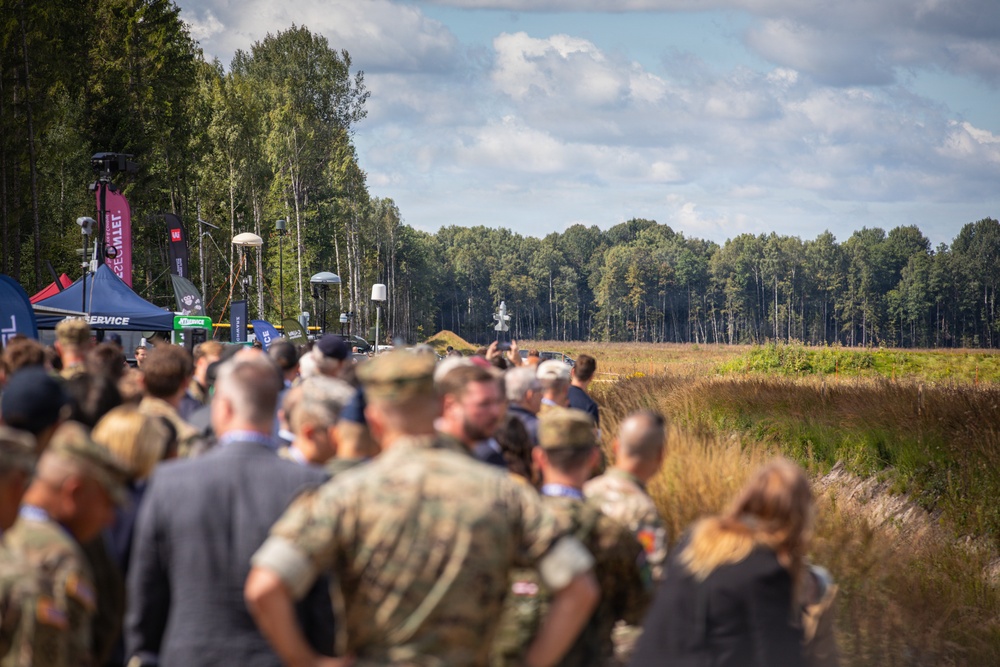
In a training area outside Jaunzemi, Latvia, a fixed-wing target drone built to look and fly like a Shahed-136 lifted off on Aug. 13, 2026, and was struck out of the sky by a counter-drone interceptor. The intercept was one data point in a much larger experiment: could a patchwork of NATO and Ukrainian counter-UAS units, most of which had never worked together before, fuse their sensors and command systems into a single functioning network in real time?
That question was the point of LCI-X Crucible 3-26, an experimentation event run inside the broader Exercise Baltic Trust 2026 (BATT26) by NATO Allied Command Transformation (ACT), the Latvian National Armed Forces, and the NATO Communications and Information Agency (NCIA). Ukraine's 93rd Mechanized Brigade, commanded by Maj. Gen. Vladyslav Klochkov, took part directly alongside NATO forces — notable both because Ukraine is not a NATO member and because the brigade brought battle-tested counter-drone experience directly into a formal Alliance experimentation structure. Roughly 650 personnel from 24 countries were involved, along with industry partners who brought detection, command-and-control and counter-drone hardware to be tested against a shared threat picture rather than in isolation.
What Crucible 3-26 Actually Tested
According to ACT's own account of the event, LCI-X Crucible 3-26 is the latest iteration of NATO's Layered Counter-UAS Initiative (LCI-X), which the alliance designates an ACT Beacon Project — shorthand within NATO for a priority modernization effort meant to move technology and concepts from experimentation toward fielded capability. Earlier Crucible events were held in Romania and Finland; Baltic Trust was the next stop in that rotating series, and NATO's own reporting on the exercise says future experimentation will extend connectivity across greater distances and more complex operational structures than this iteration attempted.
The core design question wasn't whether any single radar, jammer or interceptor could stop a drone — militaries have been proving that piecemeal for years, including against Shahed-type one-way attack drones over Ukraine itself. Instead, Crucible 3-26 examined whether multiple, physically separated counter-UAS cells could operate as a distributed structure sharing a common operational picture: one cell's radar detection, in principle, becoming another cell's cue to engage, without everyone sitting on the same physical position or using the same vendor's equipment.
Speaking about the exercise, Gen. Klochkov framed the test in similarly networked terms, describing participants working to determine how detection systems, command-and-control systems, and countermeasures against UAVs can exchange data, generate a shared operational picture, and ensure a coordinated response. Such exercises, he said, help evaluate technologies directly in the field, identify their limitations, and refine solutions in line with real operational needs — language that, paired with NATO's own framing of the Crucible series, positions Baltic Trust as one step in an iterative alliance-wide development cycle rather than a one-off demonstration.
Layered by Design
Coverage of the pre-exercise buildup filled in some of the specifics NATO worked through on the way to Baltic Trust. A NATO Technical Interoperability Exercise (TIE 26) held in the Netherlands from May 11–22, 2026, brought together roughly 300 participants from 40 companies across 11 Allied nations plus Ukraine and Australia, who put more than 60 commercial detection systems and 40 command-and-control software applications through their paces. That event's stated focus, per NATO's account, was testing the potential use of interceptor capabilities against simulated "enemy" drones — a line of testing explicitly informed by lessons from Ukraine's growing use of interceptor-based counter-UAS technology. The Aug. 13 shootdown of the Shahed-style target at Jaunzemi appears to have served as one live-fire validation point ahead of the fuller Crucible 3-26 experimentation window inside Baltic Trust.
None of the public reporting on this event specifies which vendors' sensors, C2 software or interceptors were networked together, what data formats or standards were used to pass tracks between cells, or what latency or hit rates the distributed setup achieved compared with stand-alone systems. DVIDS imagery documenting the exercise confirms industry participation alongside NATO and allied forces but does not itemize the systems involved. Those specifics — the parts that would let an outside observer judge whether the "distributed structure" actually outperformed isolated cells — were not disclosed in the sourced material.
Why the Ukrainian Presence Matters
The 93rd Mechanized Brigade's direct participation is arguably the most operationally significant detail here. Ukraine has spent more than four years absorbing the brunt of one-way attack drone and loitering munition strikes at a scale no NATO member has faced, and its forces have iterated counter-UAS tactics under live combat pressure that no peacetime exercise can replicate. Folding a brigade with that experience into a formal NATO experimentation event gives the alliance a direct channel for combat-tested counter-drone lessons to shape LCI-X's technical requirements, rather than relying solely on observation or after-action reporting from the war.
Why It Matters
Counter-UAS systems have proliferated fast across NATO militaries over the past several years, but proliferation has largely meant a scattering of point-defense solutions: a radar here, a jammer there, an interceptor battery somewhere else, often from different manufacturers with no shared data layer. That approach works against a single drone approaching a single position. It works far less well against the kind of massed, multi-axis drone raids — sometimes dozens of Shaheds or first-person-view drones launched in waves — that Ukraine has faced repeatedly and that NATO planners increasingly treat as the baseline threat rather than the worst case.
A networked counter-UAS architecture, where detection from one cell can cue engagement from another, addresses a structural gap rather than a hardware gap: it's the connective tissue, not another sensor or shooter, that determines whether a layered defense actually behaves as a layer instead of a set of disconnected outposts. That connective tissue is also the hardest part to build, because it requires interoperability across vendors and nations that don't normally share command-and-control infrastructure — precisely the friction LCI-X's Beacon Project status is meant to force through. Crucible 3-26's direct inclusion of a combat-experienced Ukrainian brigade signals that NATO is trying to validate this architecture against lessons drawn from an active drone war, not just synthetic training scenarios, ahead of the alliance's next round of counter-UAS experimentation.
Sources
- Military and Industry Unite to Advance NATO Counter Drone Capability through LCI-X 3-26 — NATO Allied Command Transformation
- Ukrainian, NATO troops collaborate on C-UAS battlefield tactics in Exercise Baltic Trust — Unmanned Airspace
- NATO tests C-UAS tech and concepts ahead of Baltic Trust exercise in August — Unmanned Airspace
- NATO, allies and industry test counter-drone systems at Exercise Baltic Trust 2026 — DVIDS