
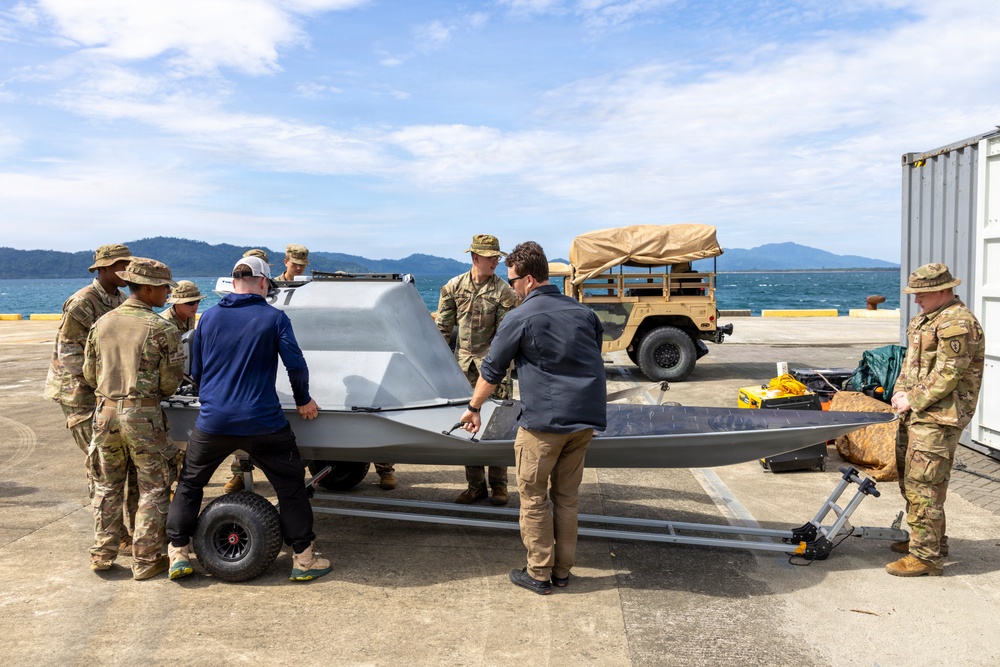
The U.S. Army used a swarm of autonomous unmanned surface vessels to escort a logistics ship through Philippine coastal waters during Exercise Salaknib 2026, the service confirmed in a June 17 release — a demonstration that positions the Army as an independent actor in unmanned maritime operations and underscores just how broadly the Indo-Pacific is reshaping which branches own which domains.
The exercise, a bilateral U.S.–Philippines event, staged the action in Casiguran Sound bay near Casiguran Port. The 125th Intelligence and Electronic Warfare Battalion, 25th Infantry Division Artillery, deployed the USVs ahead of a U.S. Army Logistics Support Vessel carrying Philippine Army personnel and armored personnel carriers that had completed a 260-plus-mile coastal transit to reach the sound. The unmanned boats established a security perimeter across the waterway, navigated autonomously using onboard sensors to identify potential threats, relayed real-time environmental and threat data to land-based operators, and then escorted the LSV approximately six miles to port.
"We deployed the autonomous intelligence, surveillance, reconnaissance boats to provide security for landing craft today," said Pvt. Caleb Hannah, 125th IEW Battalion.
The official army.mil release did not identify the USV manufacturer by name. Defense News, based on branding visible in imagery, identified the vessels as HAVOC USVs designed for maritime domain awareness. That attribution should be treated as probable rather than officially confirmed — the Army has not publicly acknowledged the manufacturer in its release, and contract or procurement details were not disclosed alongside the exercise report.
Compressing the Decision Cycle
The operational logic behind deploying autonomous surface vessels ahead of a manned logistics ship is straightforward: push the sensor layer forward without risking sailors. What the Salaknib demonstration attempted to show was whether that logic holds in a real coastal environment — variable currents, marine traffic, a congested electromagnetic spectrum — rather than a controlled test range with predictable conditions.
Ben Outlaw, identified in coverage as an industry partner representative, framed the system's value in terms of the kill chain rather than sensor coverage alone. "These boats provide situational awareness to commanders with their ability to find, fix, target, kill and confirm," he said, adding that "with the information the USV provides, the commander's decision-making process has been compressed from hours to seconds."
That compression claim is the central selling point for autonomous maritime ISR, and it carries real weight in a geography defined by constrained waterways and predictable transit corridors. A logistics vessel approaching port through a sound is exactly the kind of high-value, low-maneuverability movement that an adversary could exploit with relatively modest anti-ship capability. Pre-clearing the route with an expendable, sensor-equipped swarm — one that can detect, track, and relay without a human aboard — closes that vulnerability window without consuming the crewed assets needed later.
The 125th IEW Battalion's involvement is also worth parsing. Intelligence and electronic warfare units are not traditionally associated with maritime surface operations; their integration into a USV escort mission signals that the Army is treating autonomous surface vessels primarily as ISR assets — data collectors that happen to float — not simply as patrol boats with the crew removed. That framing has implications for how these systems will be funded, organized, and commanded within Army structure.
Army Enters Maritime Unmanned Without Waiting for the Navy
The Navy has been the public face of U.S. unmanned surface vessel development, operating a growing fleet of medium USVs and smaller autonomous craft. The Navy's medium USV inventory stood at roughly four vessels as of April 2026, with plans to expand to more than 30 by 2030. The Salaknib demonstration positions the Army as an independent actor rather than a consumer of Navy capability — developing and exercising its own organic maritime ISR without waiting for joint doctrine to catch up.
That matters because Army operations in the Pacific inherently involve water at every phase. Island-hopping logistics, littoral fire support, coastal force protection, port approach security — these missions require the Army to operate in the maritime environment regardless of whether Navy surface assets are available or tasked elsewhere. Building organic unmanned maritime ISR capacity gives Army commanders a tool they can direct without deconflicting with fleet priorities, which in a distributed maritime campaign could be decisive.
The Philippines is a particularly pointed venue for this kind of demonstration. The archipelago's geography means that nearly every Army movement of consequence crosses a waterway, and the South China Sea's increasingly contested surface makes maritime surveillance a live operational requirement rather than a training abstraction. Bilateral exercises like Salaknib serve a dual function: they build U.S. force capability through realistic conditions, and they signal to regional partners — and to potential adversaries — what the joint force can field on short notice at scale.
Why It Matters
The Salaknib USV mission is a data point in a deliberate shift: the Army is inserting itself into the maritime unmanned domain and doing so in the Indo-Pacific, in front of a treaty ally, under operational rather than range conditions. The 260-mile LSV transit that preceded the final escort leg was not a staged event — it was a realistic logistics scenario, and the USV swarm was integrated at the most tactically relevant moment: the constrained final approach, under observation, carrying armored personnel carriers.
No contract announcement accompanied the demonstration, so immediate acquisition timelines remain opaque. What is clear is that the Army views autonomous surface vessels as a legitimate capability layer for joint littoral operations, not a curiosity borrowed from the Navy's portfolio. If the HAVOC USV attribution holds and endurance proves durable under sustained operational tempos, these systems become candidates for persistent picket duty — weeks-long area denial or surveillance tasking — rather than one-off escort missions tied to a specific exercise.
The harder problem ahead is doctrinal: how the Army integrates organic USV capacity into joint planning without creating deconfliction friction with Navy surface operations in overlapping littoral zones. Salaknib 2026 did not answer that question. It did establish, unambiguously, that the Army intends to be in the conversation — and that it is doing the operational groundwork in the theater that matters most.
Sources
- Army.mil — Army demonstrates security capabilities with autonomous maritime systems at Salaknib 26 (June 17, 2026)
- Defense News — US Army tests autonomous boats during Philippine exercise (June 22, 2026)
- Army Recognition — U.S. Army tests Rampage USV in the Philippines to improve intelligence during coastal operations (June 2026)
- War.gov — USV Swarm Demonstrates Maritime Security Capabilities During Exercise Salaknib 26 (June 2026)
