
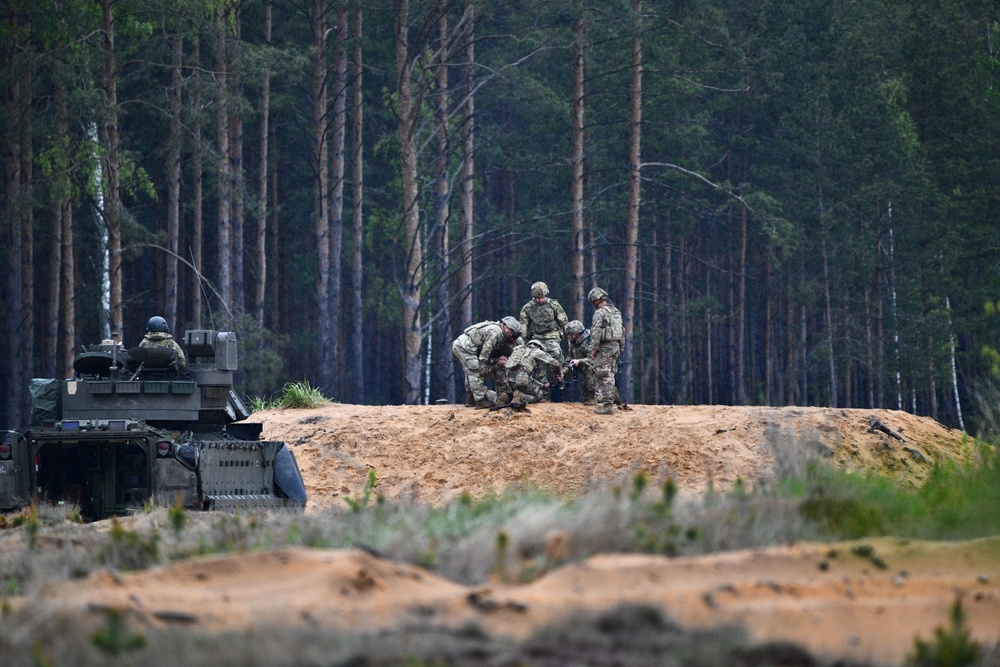
The U.S. Army is dissolving one of its most closely watched experiments in unmanned warfare: a roughly 600-soldier drone battalion built inside the 173rd Airborne Brigade to study dedicated drone-force concepts drawn directly from Ukraine's battlefield playbook against Russia. The unit will return to its core airborne-infantry mission once Exercise Saber Junction concludes this fall, less than a year after it was created.
The decision comes from Acting Chief of Staff Gen. Christopher LaNeve, who cited the need for soldiers to maintain "a strong grounding in warrior ethos, individual Soldier readiness, and small unit tactical skills" — language drawn from his "Army Azimuth" guidance document. The battalion's findings will not be discarded; instead, they are being folded into the Army's broader force-design work and the Pentagon's larger push toward drone dominance.
What the Battalion Was Built to Do
The unit was stood up in November 2025 by U.S. Army Europe and Africa, working with the Department of the Army and U.S. European Command, specifically to test what a dedicated drone force might look like inside a conventional airborne brigade. Soldiers assigned to the battalion spent nearly a year building their own drones and drilling on unmanned-systems tactics modeled directly on techniques Ukrainian forces have developed and refined in their war against Russia — a conflict that has become the world's most closely studied laboratory for small-unit drone warfare.
That approach put the 173rd's battalion in a different category from most Army unmanned-systems initiatives, which typically bolt drone capability onto existing formations or field small numbers of systems for evaluation. This unit was organized around drones as its primary function, an experiment in whether a standing, purpose-built drone battalion is the right organizational model for the U.S. Army going forward.
Why Now, and Why Saber Junction
The battalion's dissolution is timed to Exercise Saber Junction, the annual U.S. Army Europe and Africa exercise running from August into September 2026, which gives the unit one last large-scale training environment to generate data before stand-down. After the exercise wraps, the roughly 600 soldiers will shift back to conventional airborne-infantry duties, the core mission of the 173rd Airborne Brigade, which is based in Italy and Germany.
The move sits inside a much larger Army effort to expand drone capability across the force rather than concentrate it in a single specialized unit. That effort traces back to a June 2025 executive order and a July 2025 directive from Defense Secretary Pete Hegseth ordering the Army to expand unmanned-systems capability service-wide. Read against that backdrop, ending the 173rd's dedicated battalion looks less like a retreat from drone warfare and more like a bet that the Army's future lies in distributing drone proficiency across all its infantry formations rather than concentrating it in one standing unit.
What Happens to the Lessons Learned
Army officials say the battalion will hand off a lessons-learned package documenting what worked, what didn't, and how a drone-centric organizational model performed under operational conditions in Europe. That package is expected to inform the Army's ongoing force-design deliberations — the process by which the service decides how to structure its brigades, battalions, and specialties for the coming decade — as well as the Pentagon's wider drone-dominance push.
In practice, that means the operational and organizational data generated by nearly a year of building drones, running unmanned-systems drills, and integrating them into an airborne brigade's workflow won't simply disappear with the unit. It becomes an input into decisions the Army has yet to make publicly: whether future drone capability gets distributed as an organic capability inside every infantry battalion, concentrated in specialized units elsewhere in the force, or something in between.
Why It Matters
The episode is a useful data point in a debate the U.S. military has not settled: does drone warfare, as practiced by Ukraine, require dedicated, purpose-built units, or can it be layered onto existing infantry formations without diluting their core mission? The Army's decision to unwind its own version of that model after less than a year — while explicitly preserving the lessons it generated — suggests the service isn't rejecting the drone-centric concept so much as concluding that a standing airborne brigade wasn't the right home for it, at least not without eroding the "warrior ethos" and small-unit skills LaNeve's guidance emphasizes.
For an Army trying to modernize under real budget and readiness constraints, the case also illustrates a structural tension that will likely recur as more services experiment with unmanned systems: every soldier-hour spent building and flying drones is an hour not spent on the fundamentals a general-purpose infantry brigade still needs to fight and survive. How the Army resolves that tension — whether through dedicated drone MOSs, brigade-level unmanned-systems companies, or something else entirely — will shape how quickly, and in what form, Ukraine-style drone warfare actually gets absorbed into U.S. ground forces. The 173rd's experiment, even in its dissolution, gives planners a real-world case study to draw on rather than a theoretical one.
Sources
- US Army to end experimental drone battalion in Europe — C4ISRNET
- US Army to end experimental drone battalion in Europe — Military Times
- Army Will Shut Down a Unit in Europe Focused on Learning Drone Warfare — Military.com
- Army will shut down a unit in Europe focused on learning drone warfare — The Washington Post
