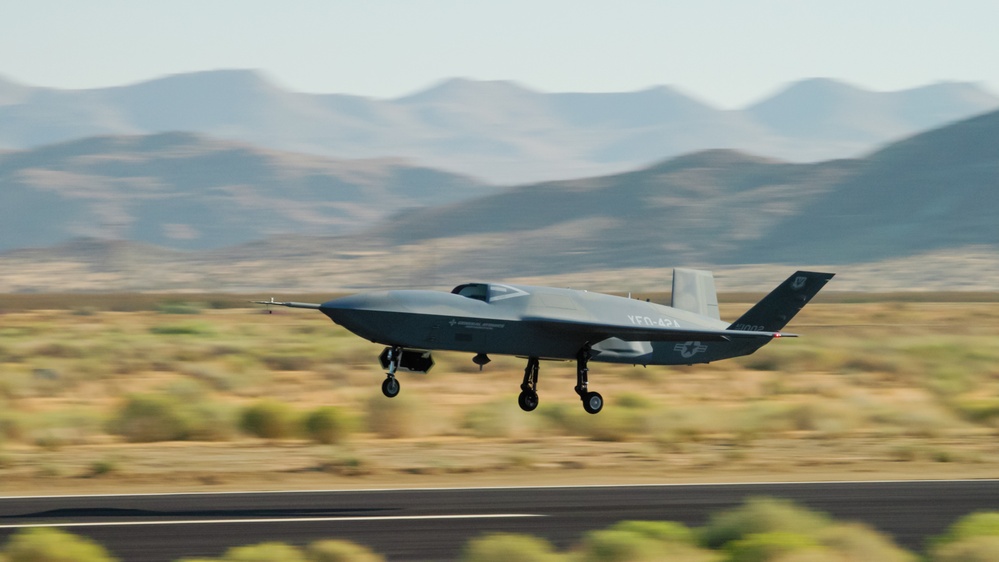
The U.S. Air Force awarded Engineering and Manufacturing Development and production contracts to General Atomics Aeronautical Systems Inc. and Anduril Industries on June 17, 2026, advancing both companies' Collaborative Combat Aircraft designs from prototype status into the first formal production increment — four months ahead of the program's original schedule. The announcement ends the competitive phase for CCA Increment 1 and formally drops the "Y" prototype prefix from both aircraft: General Atomics's YFQ-42A becomes the FQ-42A, and Anduril's YFQ-44A becomes the FQ-44A.
The accelerated timeline reflects what Air Force officials described as both platforms meeting rigorous mission requirements during testing. General Atomics's aircraft, known informally as the Dark Merlin, first flew in August 2025. Anduril's Fury followed in October 2025. The production award came roughly seven months after each vehicle's maiden flight — a pace unusual for a program at this scale.
"We see CCA as representing the next evolution of air power. It is our first instance of taking human-machine teaming into the aviation world to this extent, and being able to drive it operationally." — Col. Timothy Helfrich, CCA program
What the Contracts Actually Cover
The Air Force has not disclosed the production contract values. What the public record does show: the FY2027 budget request includes approximately $1.4 billion in CCA Increment 1 development funding and nearly $1 billion in procurement funding, according to Breaking Defense — figures that reflect the scale of the program without mapping directly to the June 17 award. The official program targets more than 150 combat-capable CCAs delivered across the first three production lots by the end of the decade, with a long-term aspiration of roughly 1,000 aircraft across the broader program.
The unit cost ceiling is a defining constraint: the Air Force has set a target of under $30 million per aircraft, approximately one-third the flyaway cost of an F-35A. That number drives both the platform design choices and the autonomy software competition running in parallel — because an autonomous or semi-autonomous aircraft that can absorb attrition is only viable if it's actually affordable to replace. Both aircraft are designed for an air superiority primary mission with a combat radius of 700 nautical miles.
Selection decisions, according to Col. Helfrich, were based on "ability to meet the Air Force's schedule, the demanding cost criteria and performance." Boeing, Lockheed Martin, and Northrop Grumman were among the broader field of competitors that did not advance to production contracts under Increment 1.
The Autonomy Software Race Is Still Open
Winning the airframe competition doesn't settle everything. Simultaneously with the production award, the Air Force selected three companies to compete for the mission autonomy software that will actually fly the CCAs in contested airspace: Anduril (which thus holds both an airframe and a software position), Shield AI with its Hivemind system, and Collins Aerospace, an RTX subsidiary. General Atomics, Lockheed Martin, and Northrop Grumman did not advance in the software competition.
The autonomy downselect process runs through two consecutive six-month competitive performance phases, with a single vendor selection planned for Summer 2027. That separation — airframe production proceeding while autonomy software remains contested — is deliberate. The Air Force is treating the mission autonomy layer as a separable, competitive capability rather than locking it to a particular airframe contractor. Anduril's dual position in both competitions is notable: the company has bet heavily on software-defined autonomy as its core differentiator, and its Lattice platform underpins both the Fury airframe's own systems and its software competition entry.
The FQ-44A's path hasn't been entirely clean. A General Atomics aircraft suffered a crash in April 2026 attributed to an autopilot error; the aircraft resumed flying approximately one month later, and the program's timeline held. The Air Force's decision to proceed on schedule despite that incident reflects confidence in the overall test data set.
CCA in the Broader Force Structure
CCA Increment 1 is specifically scoped to air superiority — operating in coordination with crewed fighters like the F-35 and F-22 to extend the reach, sensor coverage, and weapons capacity of a manned element without putting another pilot in a contested environment. The 700-nautical-mile combat radius means these aircraft can range well beyond what a carrier air wing or forward-deployed squadron could cover with crewed assets alone, and at a price point that changes the calculus on acceptable risk.
The program is also explicitly structured for competition beyond Increment 1. CCA Increment 2 — a separate development track with a different mission focus — already has nine vendors holding early development contracts, ensuring the industrial base stays engaged and that Increment 1's two-vendor duopoly doesn't harden into a permanent structure. The Air Force's stated intent is to maintain competitive pressure across increments rather than consolidate to a single prime.
The Secretary of the Air Force framed the June 17 award in direct programmatic terms: "These contracts reaffirm our confidence in the strategic path forward for the program to procure over 150 combat capable CCA by the end of the decade." — Secretary of the Air Force Troy Meink. The Chief of Staff emphasized the pace rationale: "Delivering this capability to our warfighters faster ensures our forces maintain the tactical edge required to deter and, if necessary, defeat any adversary." — Gen. Ken Wilsbach, Chief of Staff of the Air Force. Coming four months ahead of the original schedule, the award makes that language more than boilerplate — the program office actually moved faster than planned, in a procurement environment where schedule slips are the norm.
Why It Matters
The CCA program is the most significant structural shift in U.S. tactical aviation since the F-22 — not because of the platforms themselves, but because of what they represent operationally. Human-machine teaming at this scale, with uncrewed wingmen flying coordinated missions alongside crewed fighters, changes how an air superiority package is composed, how many targets it can engage simultaneously, and how much risk a commander can accept when a platform is expendable. At a sub-$30 million unit cost, the math on attrition becomes different than it is for a $100 million crewed aircraft.
The dual-track structure — two competing airframes, three competing autonomy software stacks — also signals a deliberate acquisition philosophy. The Air Force is trying to avoid the single-point-of-failure dynamics that have dogged large defense programs, keeping competitive tension at both the hardware and software layers. Whether that structure survives budget pressure and the autonomy downselect in 2027 will determine whether CCA delivers on its decade-end targets.
Sources
- af.mil — Air Force advances future of air superiority with CCA contracts
- GlobalSecurity.org — USAF CCA contracts announcement (af.mil mirror)
- DefenseScoop — Air Force picks Anduril, General Atomics to build first operational CCA drones
- Breaking Defense — Air Force CCA drone wingman: Anduril, General Atomics selection
- The War Zone — USAF Orders Both General Atomics FQ-42 And Anduril's FQ-44 Into Production
- Anduril Industries — Anduril Wins Production Contract for U.S. Air Force CCA Program