
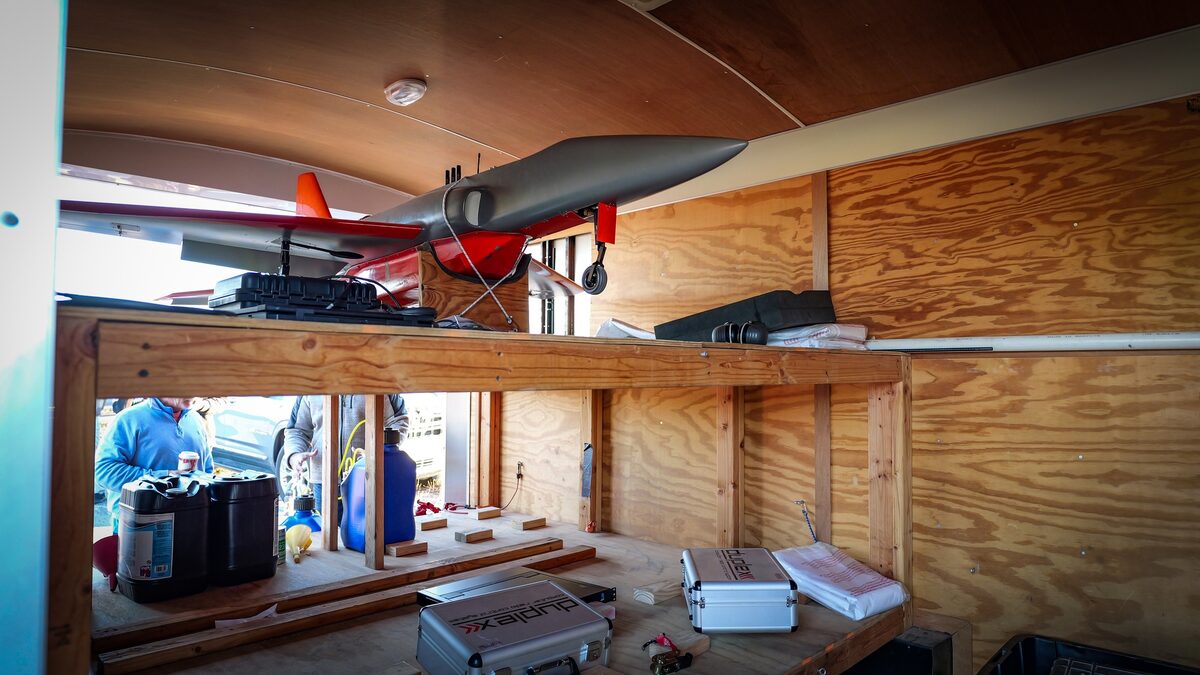
Every weapons maker now calls its product "open" and "modular." The Air Force Research Laboratory has started checking those claims itself, and Anduril's Barracuda-M is the first test case from a production line.
AFRL announced on 28 September 2026 that its Munition Open Architecture Test and Evaluation Laboratory (MOATEL) at Eglin Air Force Base, Florida, had independently verified the Barracuda-M family against the Air Force's Weapon Open Systems Architecture (WOSA) standard, according to The Aviationist and ExecutiveGov. Anduril says Barracuda is the "first weapon system in large-scale production to complete MOATEL's independent WOSA verification process."
The reports give different dates. Janes says the certification is dated 23 September 2026. The Aviationist reports that AFRL announced it on 28 September, and ExecutiveGov, in a story dated 29 September, attributes the announcement to AFRL "Monday." Air Force Materiel Command (AFMC) posted about it on X on 30 September, per The Aviationist. UASFeed could not reach AFRL's own announcement page to confirm which date applies to which step. One plausible reading is that the certification was signed first and announced later.
What MOATEL actually tested
AFMC described the review as a four-day assessment covering 14 domains. Together they span most of the functions that turn an airframe into a guided weapon:
- Mission autonomy
- Seeker
- Inertial measurement unit (IMU)
- GPS
- Air-data sensor
- Propulsion
- Airframe control
- Target state estimator
- Altimeter aiding navigation
- Clock
- Autopilot
- Guidance
- Navigation
- Munitions data bus
The list covers sensors, flight control, navigation, propulsion and the autonomy software that ties them together. According to ExecutiveGov and The Aviationist, AFRL said the evaluation verified that Anduril's software architecture met WOSA requirements for the domains under test. In practice, a subsystem or software module that follows the standard should be swappable without rebuilding the rest of the weapon.
The data bus is where that claim is tested hardest. According to The Aviationist and ExecutiveGov, the assessment "demonstrated modularity between Anduril's internal and external MDB implementations." The munitions data bus (MDB) carries information between the weapon's subsystems. Showing that both Anduril's own MDB implementation and an outside one work with the same Barracuda-M architecture is the evidence behind the main promise of open architecture: the government can bring in new technology without being tied to one supplier's internal plumbing. The Aviationist says this enables rapid technology refresh of WOSA-compliant software.
Who checks the checker
The most important part of the announcement is who did the checking. Open-architecture compliance can rest on a vendor's own documentation. Jonathan Shaver, the AFRL project manager The Aviationist credits with creating WOSA, said open architecture is only meaningful when it can be independently verified "instead of accepting vendor self-assessment."
That is a pointed statement in a market where "open" can become a marketing word. MOATEL's role is to turn the label into something a program office can rely on: a government lab at Eglin running the weapon through a defined set of domains and recording the result.
Janes carried comments from Brig. Gen. Douglas Wickert, who commands AFRL and serves as the Department of the Air Force's Technology Executive Officer, and from Anduril's Pat Morris.
The weapon in question
The Aviationist describes Barracuda-M as a family of autonomous, jet-powered cruise missiles, also called autonomous air vehicles (AAVs). Janes reports that the Barracuda-500 variant has a range greater than 500 nautical miles and that Barracuda is competing in the Enterprise Test Vehicle programme run by the US Air Force and the Defense Innovation Unit.
That context matters. Low-cost autonomous air vehicles are meant to be bought in numbers and upgraded often. A weapon that can take a new seeker or navigation module without a full redesign fits that model much better than one whose subsystems are tightly bound together. ExecutiveGov presented the verification as a production-scale demonstration, part of broader Department of War efforts on modular weapons and scalable missile production.
Why It Matters
Open architecture has been an acquisition goal for years. Its weak point is verification: if only the vendor can vouch for its own modularity, the government has little leverage when it later tries to add a third-party component. Independent testing at MOATEL addresses that. A compliance finding from a government lab is something program offices can cite, competitors can design against, and future upgrades can rely on.
Applying that process to a weapon already in large-scale production, not a prototype, makes it more significant. AFRL's Shaver said it shows open architecture can scale beyond prototypes, and AFRL said it will keep applying the process as additional weapons programs move through development and production. Anduril says Barracuda is the first production weapon to get through MOATEL's full process. If the approach holds, independent WOSA verification could become routine for low-cost autonomous munitions, and vendors would have to show their weapons are open, not just say so. The demonstration that internal and external data-bus implementations are interchangeable is the specific evidence to watch as other programs go through the same lab.
Some questions remain open, including the exact sequence of certification and announcement dates. The public reports also do not describe how MOATEL scores each domain or what a failing result would look like. More detail from AFRL would make the process easier to judge as it expands to other weapons.
