
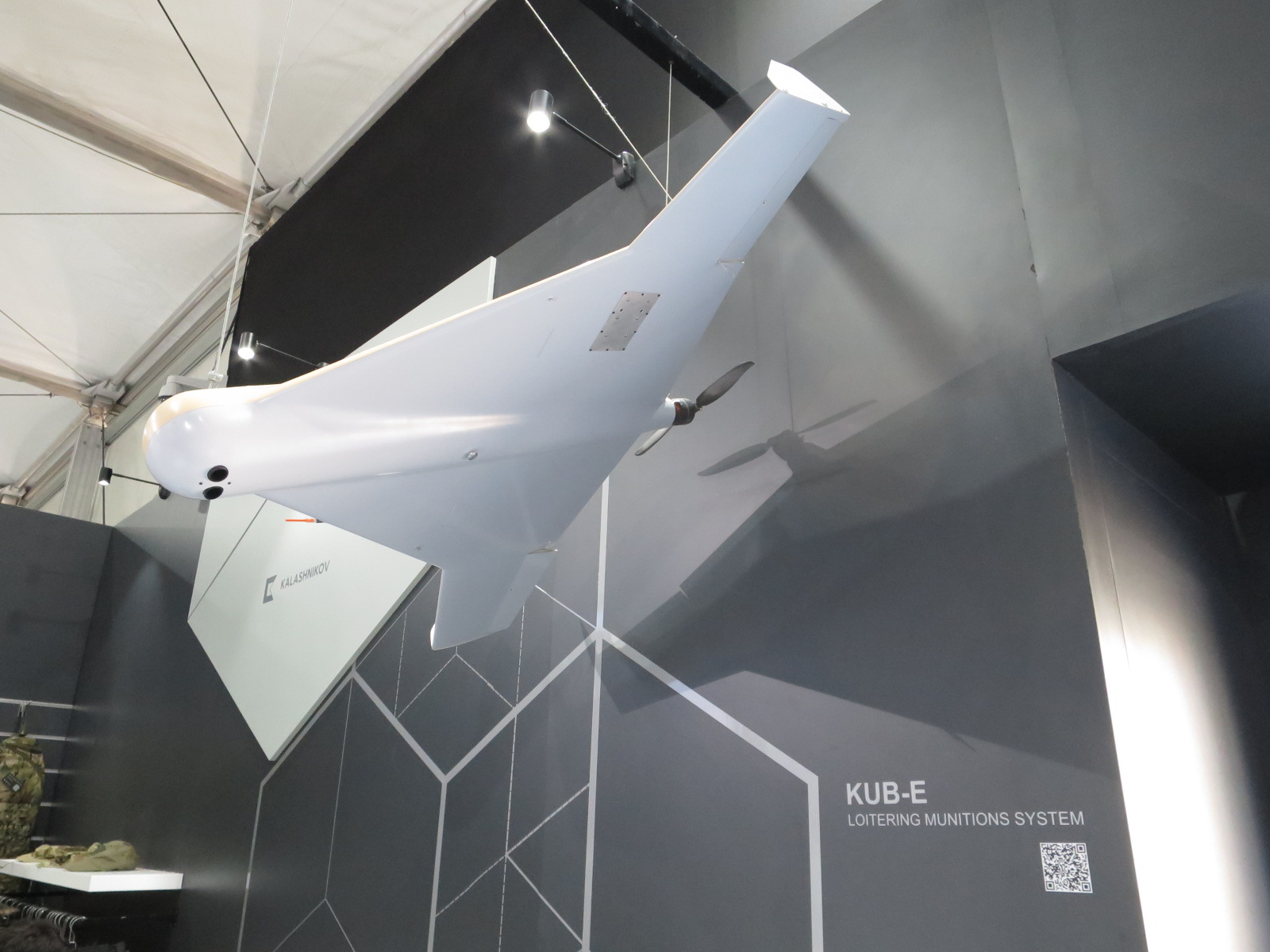
Russia's most recognizable loitering munition is the Lancet — fast, heavy, X-winged, and optimized to kill armor and ships in terminal dives approaching 300 km/h. The KUB-BLA is something quieter. A compact delta-wing vehicle powered by an electric motor, it loiters at 80–130 km/h for up to 30 minutes over a ~40 km operating radius. Its manufacturer-stated targets are "enemy manpower, UAV launch sites, logistics depots, airfield shelters, and unarmored and lightly armored combat equipment." Where the Lancet is a precision anti-armor weapon, the KUB-BLA is a hunter of soft infrastructure and personnel — the kind of target that does not require kinetic penetration so much as proximity, fragmentation, and stealth on approach.
Both systems come from the same organizational tree. The KUB-BLA is produced by ZALA Aero Group, a subsidiary of Kalashnikov Concern within Rostec, Russia's state defense conglomerate. ZALA first displayed the system publicly at IDEX-2019 in Abu Dhabi. Director General Alexander Zakharov confirmed completion of state testing in November 2021. Serial production followed in 2022. Since then the KUB-BLA has appeared on Ukrainian battlefields — comparatively rarely against the Lancet's prolific record — and its successive variants have progressively acquired heavier payloads, AI-augmented targeting, and export market credentials. Understanding what the system is, how it has evolved, and what its supply chain reveals is increasingly relevant to anyone tracking the next generation of low-cost precision strike.
A Silent Machine Built Around Delta Geometry
The airframe is fiberglass: a 950 mm body length, 1,210 mm wingspan, and 165 mm body diameter. The wide triangular wing layout is not incidental — it maximizes lift-to-drag at low speed, keeping the munition aloft through its full 30-minute endurance window without demanding the high-energy propulsion that would increase acoustic signature. The rear-mounted electric motor drives a pusher propeller that is, by the standards of tactical munitions, quiet. Catapult launch eliminates runway dependency; the entire system is operable by a three-person crew.
This is a doctrinal choice as much as an engineering one. Against the target set the KUB-BLA is assigned — logistics nodes, radar emplacements, exposed personnel, soft-skinned vehicles — approach noise is itself a countermeasure vulnerability. A combustion-powered vehicle announces itself well in advance at low altitude. The KUB-BLA is designed to deny that warning time.
The original warhead fit was 3 kg maximum payload — sensors and explosive combined — with metal ball bearings integrated around the charge for anti-personnel fragmentation effect. That baseline was replaced. By August 2023, field-recovered and analysed systems documented the OFBCh-2.5 warhead loaded with OKFOL explosive, an HMX-based compound rated at approximately 1.7 times the energy density of TNT. Estimated blast radius at that charge weight is around 3 meters. The Kalashnikov Concern president announced in December 2023: "Tests have been successfully completed, and the first batch is being shipped to the customer right now" — referring to the upgraded warhead production run.
The KUB-2E, the export variant exhibited at IDEX 2025, extends the envelope further: speed ceiling rises to 150 km/h, range exceeds 40 km, and the warhead bay accommodates up to 4.6 kg of thermobaric explosive — a fundamentally different kill mechanism suited to enclosed positions, vehicle interiors, and personnel in cover. Loaded system weight is 14.5 kg. That the export presentation at Abu Dhabi features thermobaric payload capacity signals who ZALA believes the international buyers are.
Combat Debut and the Unresolved Autonomy Question
The KUB-BLA's first confirmed combat appearance was in March 2022, when Ukrainian air defenses downed one in Kyiv's Podilskyi (Podil) district — geographically close to government buildings and several foreign embassies, a targeting signature consistent with the munition's anti-infrastructure role. Confirmed KUB engagements have since remained sparse relative to the Lancet's documented record.
Navigation in the base system is GPS-guided for routing, with infrared sensors handling terminal acquisition. There is no dynamic course correction once the terminal phase begins. ZALA has marketed an AI visual identification system (AIVI) for real-time target recognition and classification. The 2024 Kub-2 variant added optoelectronic AI targeting explicitly for moving targets — a direct acknowledgment that the base system's inability to engage non-static targets was a documented operational gap.
Available data "do not currently allow us to assess the potential threat level posed by this drone" — Defence Express Ukraine, on the Kub-2's AI targeting effectiveness.
That caveat matters. Whether the Kub-2's autonomous identification constitutes genuine scene understanding or a narrower template-matching approach has not been independently confirmed. The gap between claimed and verified capability in Russian drone procurement advertising is historically wide. What can be stated with confidence is that ZALA identified moving-target engagement as a weakness and iterated toward it.
The Western Microelectronics Embedded in the Airframe
On November 2, 2023, the U.S. Departments of State, Commerce, and Treasury jointly sanctioned ZALA Aero alongside dozens of companies identified as supplying components or materials to the firm. The supplier network includes PRC-based and Türkiye-based intermediaries used to route controlled exports around U.S. and allied licensing requirements.
The Lancet, from the same ZALA/Rostec stable, has been confirmed to incorporate an Nvidia Jetson TX2 AI processing module and Xilinx Zynq system-on-chip, both commercial off-the-shelf parts marketed, in the Jetson's case, specifically as edge-AI platforms for autonomous systems; recovered KUB-BLA units have similarly been reported to contain export-controlled components. That the same parent company — ZALA under Rostec — integrated commercial-grade Western electronics into both its primary loitering munitions is not a coincidence of procurement. It reflects a systematic preference for capable, mass-produced commercial silicon over bespoke military components, combined with an evasion network sophisticated enough to keep that pipeline operating well into a major sanctions regime.
The November 2023 package was partly designed to disrupt that network. Evasion through third-country intermediaries has proven durable. The supply chain question remains open.
Why It Matters
The KUB-BLA's operational significance runs across three dimensions. First, it demonstrated that Russia developed, tested, and fielded a functioning precision loitering munition using largely commercial technology before the full-scale invasion — arriving on Ukrainian battlefields in a form Western assessments had flagged as an emerging threat category but not expected to encounter in early 2022. The system validated the concept; later variants are iterating on it.
Second, the development cycle has not stopped. Upgraded warheads, HMX explosives, AI-targeted optoelectronic seekers for moving targets, thermobaric payloads — each represents an increment that changes the threat calculus for the next engagement. The KUB-BLA that appears in a future conflict will not perform like the one shot down over Podil in March 2022.
Third, the export trajectory is consequential. At IDEX 2025, the KUB-2E was displayed alongside its pairing with the SKAT-350M reconnaissance UAV, which "relays target coordinates and data to the KUB-2E for a strike" — enabling coordinated multi-platform attack sequences that approach swarm-level coordination without requiring onboard autonomy to execute. Separately, ZALA Director General Alexander Zakharov confirmed in August 2021: "We have begun developing a modification of the KUB-UAV for deployment on high-speed boats and special-purpose ships." A naval variant capable of launch from high-speed patrol craft extends the platform's reach well beyond land warfare.
None of this makes the KUB-BLA the most destructive weapon in Russia's drone inventory — that remains the Lancet by documented kill count. What it makes the KUB-BLA is the platform most actively being refined for export, most clearly designed around commercial-electronics integration as a feature rather than a workaround, and most indicative of where sub-$50,000 precision loitering munitions are heading across the defense market. Understanding it is understanding the baseline every serious buyer and every serious defender now has to plan against.
Sources
- Janes — IDEX 2025: Kalashnikov showcases KUB-2E loitering munition (Feb 2025)
- Janes — Army-2021: ZALA Aero develops naval version of KUB UAV (Aug 2021)
- CTC Sentinel / West Point — On the Horizon: The Ukraine War and the Evolving Threat of Drone Terrorism (Mar 2025)
- Army Technology — ZALA KYB Strike Drone (Russia)
- EDR Magazine — Russia receives improved KUB-BLA loitering munition (Dec 2023)
- Defence Express (Ukraine) — Russia's KUB-BLA drone received a modernized warhead (2023)
- Defence Express (Ukraine) — Russian KUB-BLA drone with 3 kg warhead allegedly received artificial intelligence (2024)
- GlobalSecurity.org — KUB UAV
- Army Recognition — Russia using Kalashnikov ZALA Aero KUB suicide drones in Ukraine (Mar 2022)
- Flying Magazine — U.S. Sanctions Take Aim at Russia's Lancet Kamikaze Drones for the First Time (Nov 2023)
