
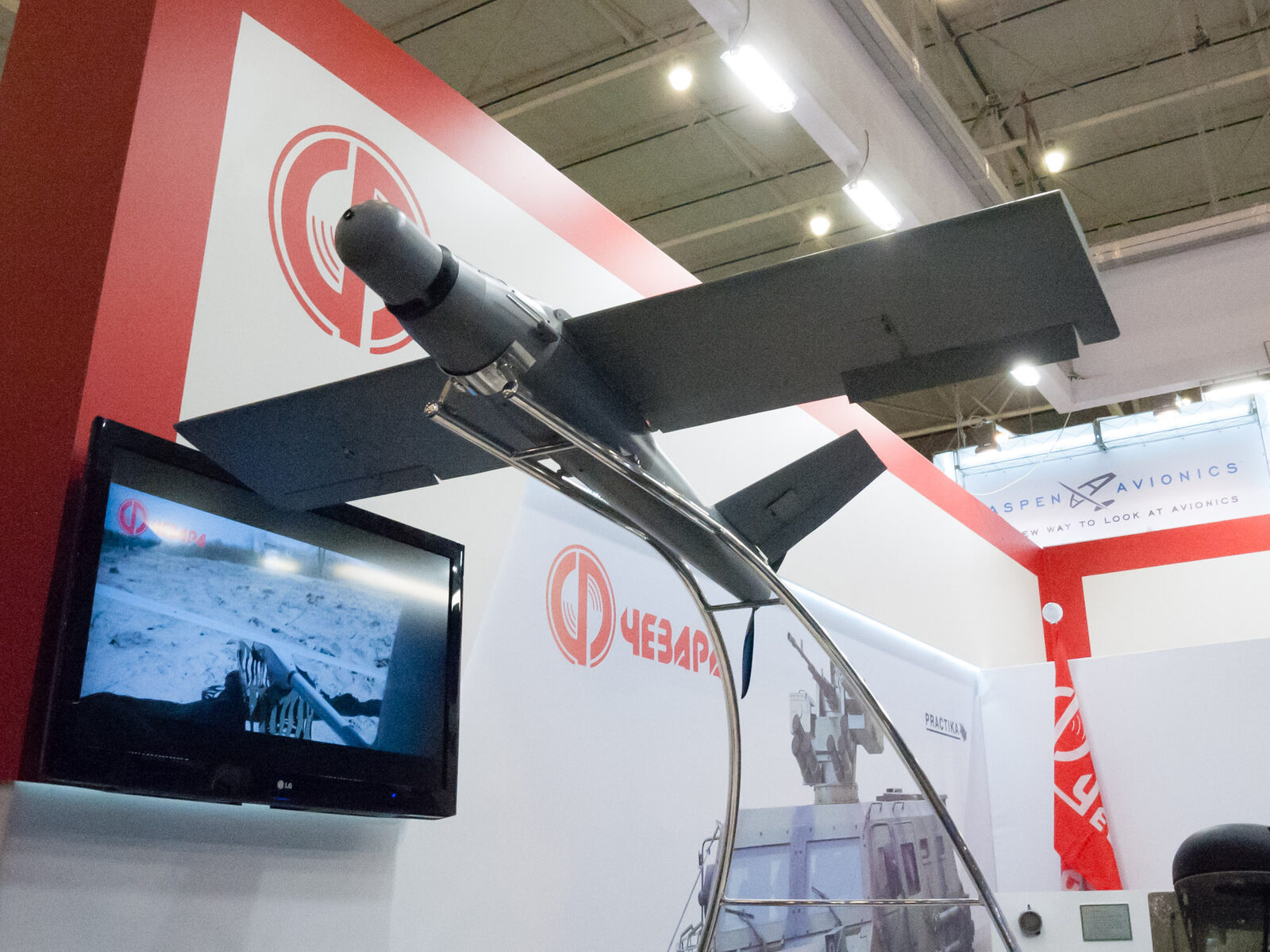
When WB Electronics unveiled the Warmate concept at the MSPO defense exhibition in Kielce in 2014, Poland was still a decade away from the drone-saturated battlefields that Russia's full-scale invasion of Ukraine would produce. The timing proved prescient. A modular 1.1-meter airframe that deploys in under five minutes from a two-person crew isn't a novelty — it's a system that collapses the distinction between a reconnaissance platoon and a fire-support element. The Warmate entered production in 2016; by 2018, it was already reaching Ukrainian hands before it formally commissioned with Polish forces in January 2021. Today it anchors one of Europe's most aggressive loitering munition procurement programs.
One Platform, Two Roles
The base Warmate is compact by design: 1.0–1.1 m body length, 1.4–1.6 m wingspan, approximately 5.3 kg at maximum takeoff weight. An electric motor drives a twin-bladed pusher propeller, keeping the acoustic signature minimal. Cruise speed runs 75–90 km/h; the maximum is 120–150 km/h. Endurance extends to 70 minutes at operational altitudes up to 500 m AGL for the base system (the Warmate 3 extends this to 1,000 m AGL), with daylight and thermal imaging sensors feeding a continuous real-time video stream. A pneumatic launcher puts it airborne; the ground control station is man-portable, or the system operates from an armored vehicle. Two operators can be ready and flying in under five minutes.
The defining architectural choice is optionality. In attack mode the Warmate is a one-way terminal effector that dives on a designated aim point. In observation mode it can be recalled and recovered intact for reuse as an ISR asset. That flexibility — a single airframe functioning as either a persistent surveillance node or a precision munition depending on what the operator sees in the feed — is precisely what distinguishes loitering munitions from conventional UAS and indirect fire. The crew can orbit, assess, and commit only when confident in target identification, or abort entirely if the picture changes.
A Modular Warhead Menu and an Expanding Variant Family
Maximum payload mass for the base system is 1.4 kg, filled by one of three warhead options:
- High-explosive fragmentation (HE-FRAG): Effective against personnel and light materiel.
- High-explosive anti-tank (HEAT): Designed to defeat armor on infantry fighting vehicles.
- Thermobaric: Optimized for entrenched personnel and bunkers where overpressure effects exceed fragmentation yield.
That warhead ceiling is a realistic constraint: the Warmate is not a bunker-buster. Against command posts, crew-served weapons, logistics nodes, and troop concentrations — the links that define the tactical kill chain in positional warfare — the modular selection gives a dismounted element meaningful target flexibility at minimal logistical cost.
WB Group has extended the family along a performance ladder that tracks the evolving threat environment. The Warmate TL (tube-launch) variant weighs 4.5 kg with a 1.7 m wingspan and 30-minute endurance, launching from a man-portable tube without any pneumatic cart. It carries the same 1.4 kg HEAT and thermobaric warheads and is described by WB Group as "a radio agnostic solution" controllable via any open-architecture communications network, enabling integration on tactical ground vehicles, aircraft, and surface vessels in addition to dismounted infantry.
The Warmate 3 steps up to a 3 kg warhead and range exceeding 80 km. Its defining addition is three independent navigation systems enabling operation in GNSS-denied environments — a capability derived directly from combat experience in Ukraine. A November 2025 contract for 1,000 Warmate 3 units for unnamed non-European armed forces confirms export demand for the enhanced variant. At the heavier end, the Warmate 5.0 carries approximately 5 kg and adds moving-target tracking, targeting radar systems, electronic warfare nodes, air defense platforms, and command posts — the same priority set Russia's Lancet pursues. WB Group positions it explicitly as a Lancet-class competitor. Above that sit the Warmate 20 and Warmate 50, the latter armed with a 50 kg warhead at ranges described as "several hundred kilometers," pushing the family from tactical effector to operational-depth strike platform.
Ukraine, Poland, and the Logic of Scale
The Warmate's combat record predates the 2022 full-scale invasion by years. WB Group began supplying Ukraine with Warmate units after the first batch was delivered in 2018, and the company has confirmed that thousands of munitions have been delivered, making the Warmate the most heavily transferred Western loitering munition in the conflict. That operational archive — accumulated across years of real targeting in GPS-degraded environments — separates it from competitors still building test datasets in controlled conditions.
"They are combat-proven and repeatedly operated in GNSS-denied environments" — WB Group statement on Ukraine operations
Domestic procurement tells a parallel story of accelerating scale. Poland's initial 2017 contract covered 1,000 units under a roughly $20 million agreement, with the first batch delivered in 2018 for testing. Formal commissioning came in January 2021, when Lt. Gen. Rajmund Andrzejczak authorized deployment by both regular forces and the Territorial Defence Forces (WOT). In 2025, a new framework agreement set a ceiling of approximately 10,000 Warmate units through 2035 — ten times the original order. The most recent tranche came on 28 May 2026, when Poland's Armaments Agency signed three contracts with WB Group for over 400 Warmate systems alongside Flyeye ISR UAVs and Gladius battery systems, partially funded through the EU's Security Action for Europe (SAFE) instrument and slated for integration with Poland's Topaz battle management system.
Geography underpins the urgency. Warsaw sits approximately 1,151 km from Moscow. Poland is not hedging against a theoretical contingency; it is building a deep magazine for a threat its planners treat as a near-term scenario. The 10,000-unit framework through 2035 reflects a procurement posture that most NATO allies have not matched.
Export demand reinforces the industrial logic. The November 2025 non-European contract adds to a growing export customer base. WB Group, a privately held company, now supplies loitering munitions to customers across multiple continents while simultaneously ramping domestic production to five-figure quantities.
Why It Matters
What the Warmate demonstrates concretely is that the revolution doesn't require exotic fabrication or classified propulsion — it requires disciplined systems engineering, a modular warhead architecture, and the willingness to iterate against live combat feedback rather than controlled test conditions. WB Group has done all three, producing a system that is simultaneously man-portable for dismounted infantry, integrable on naval and air platforms via the TL variant, and scalable toward operational-depth strike via the 5.0 and 50 kg variants.
For NATO partners still relying on U.S. Switchblades or Israeli Hero-series systems to fill loitering munition gaps, the Warmate's emergence as a high-volume, combat-validated, European-origin alternative matters both strategically and industrially. The 10,000-unit domestic framework signals that Poland is building not just a stockpile but a sustained production base. Whether allied procurement systems can accelerate to match that posture — and whether WB Group can sustain output at that scale — are the questions that will define the Warmate's strategic legacy.
Sources
- Janes — Poland confirms thousands of Warmate loitering munitions delivered to Ukraine
- Janes — WB Group signs deal with Poland for delivery of Warmate, Flyeye and Gladius UAVs (28 May 2026)
- Janes — WB Group unveils Warmate TL variant
- C4ISRNET — Polish arms maker pitches new strike drones amid long-range trend (4 Sep 2024)
- Army Technology — WB Group and Polish Army: Warmate loitering munition
- Army Recognition — Poland launches cutting-edge Warmate loitering munition to rival Russia's Lancet (2024)
- Military Factory — WB Electronics Warmate specifications
- The Defense Post — Poland's Warmate kamikaze drones commissioned (22 Feb 2021)
