
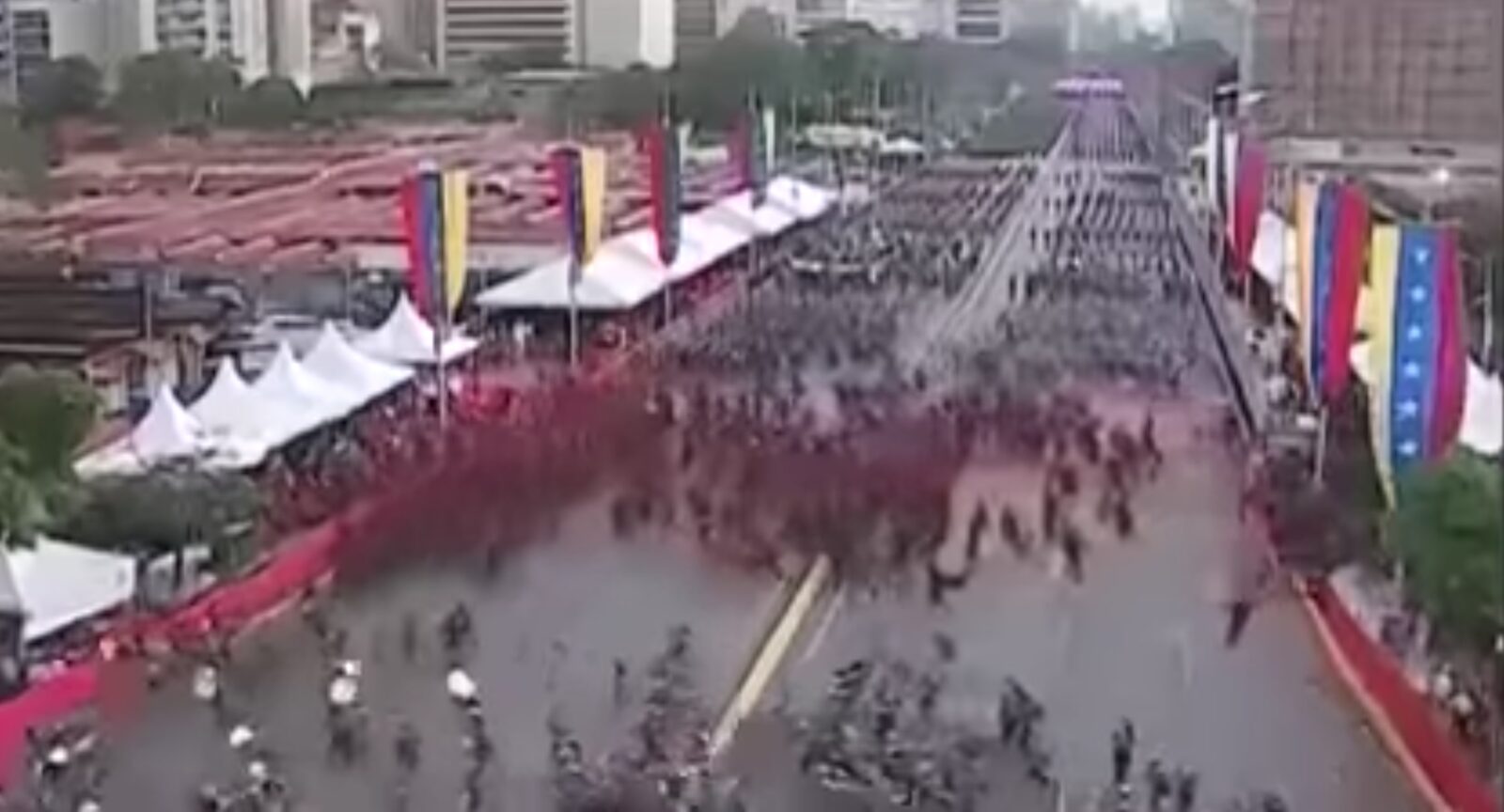
At 5:41 PM on August 4, 2018, Venezuelan President Nicolás Maduro stood at the podium on Avenida Bolívar in central Caracas, addressing a crowd assembled near the Centro Simón Bolívar Towers for the 81st anniversary celebration of the Bolivarian National Guard. The ceremony was broadcasting live on Venezuelan state television. Then explosions interrupted the broadcast.
Cameras caught what followed: uniformed soldiers breaking ranks, scattering in visible panic across what had been an orderly military parade ground. Maduro, his wife, and Defense Minister Vladimir Padrino López were unharmed. Several National Guard soldiers sustained injuries. No deaths were reported.
What state television had inadvertently documented — live, in front of a national audience — was the first confirmed drone assassination attempt against a sitting head of state.
A $10,000 Strike Package
The platforms were two DJI Matrice 600 hexacopters — a prosumer-grade industrial drone commercially available at approximately $5,000 each. The standard legs had been removed from both aircraft. Each carried approximately one kilogram of C-4 plastic explosive, giving each drone a roughly two-pound high-explosive payload delivered on a platform anyone with a business account could order. Bellingcat's open-source analysts confirmed the model through imagery review, matching the airframes to the M600's distinctive hexacopter configuration and component layout.
The operators were reportedly stationed on streets adjacent to the parade venue, working from positions with sightlines to the stage. The total hardware investment: roughly $10,000 in commercially available drones. Whatever the C-4 cost to acquire on Venezuela's black market represented the attack's only non-civilian procurement challenge.
Venezuelan security forces deployed signal inhibitors that they claim "disoriented" the closer of the two aircraft. The second drone reportedly lost control and crashed into a residential apartment building approximately two blocks from the stage. That drone detonated inside the building, punching a hole in a wall and starting a fire. The attack failed to reach Maduro or the stage.
A Claim That Contradicted the Government's Own Account
Responsibility arrived on Twitter within hours. A group calling itself Soldados de Franelas — rendered variously in English as Soldiers in T-shirts, Flannel Soldiers, or Soldiers in Flannel — posted from the account @SoldadoDFranela claiming ownership of the operation. Their statement was specific:
"The operation consisted of the flight of two drones loaded with C-4 explosive to the presidential tribune. Snipers of the Guard of Honor shot down the drones before they arrived at the target." — Soldados de Franelas, Twitter, August 4, 2018
That account diverged immediately from the Venezuelan government's version, which credited electronic signal inhibitors rather than rifle fire from Honor Guard snipers. Both explanations for how the drones were stopped cannot simultaneously be true. No independent verification of either version was possible, and the authenticity of the Soldados de Franelas claim was never conclusively established by a third party.
Arrests, Accusations, and the Opposition in the Crosshairs
The Venezuelan government moved quickly to make arrests in the immediate aftermath. Interior Minister Nestor Luis Reverol announced publicly: "We have six terrorists and assassins detained. In the next hours there could be more arrests." More than a dozen people were ultimately arrested in the days that followed.
Maduro moved quickly to assign responsibility across multiple fronts simultaneously. He publicly accused Colombian President Juan Manuel Santos of coordinating the attack. He pointed at Miami-based exile communities. He implicated the Venezuelan political opposition. Colombia's government issued a flat denial of any involvement.
Days after the attack, National Assembly member Juan Requesens, an opposition lawmaker, was arrested. Exile opposition leader Julio Borges was accused by Maduro of financing the operation. Borges, whom Venezuela alleged had fled to Colombia, rejected the accusation on Twitter: "Neither the country nor the world believe you when it comes to this farce of an attack."
Several analysts noted a structural problem with the government's narrative: the attack conveniently provided legal pretext to arrest opposition legislators and move against exile figures who had been vocal critics of the Maduro government. Some researchers raised the possibility explicitly — that the incident was a false-flag operation designed to manufacture justification for a political crackdown. Footage of soldiers visibly fleeing the scene in panic, broadcast live on state television, directly contradicted Maduro's broader narrative of monolithic military loyalty and control. A government confidently claiming its armed forces had intercepted the attack had inadvertently aired those same forces in undisguised disarray.
Colombia's flat denial held, and international skepticism about the official Venezuelan account was widespread, though no external investigation corroborated or disproved the government's version.
The Trial: Four Years, Ninety-One Hearings
Formal proceedings began December 2, 2019, and concluded on August 4, 2022 — precisely four years to the day after the attack. The trial involved 91 hearings, 60 expert witnesses, 193 official witnesses, and 36 civilian witnesses. Seventeen defendants were ultimately sentenced.
Drone pilots Bryan de Jesús Oropeza Ruiz and Argenis Gabriel Valera Ruiz received maximum 30-year sentences. Operation leader Henrybert Enmanuel Rivas Rivas received 30 years, as did military officers General Alejandro Pérez Gámez and Colonel Pedro Javier Zambrano Hernández, and explosives expert Yolmer José Escalona Torrealba. Juan Requesens received an 8-year sentence for conspiracy. Julio Borges remained at large under an outstanding arrest warrant.
The convictions were issued by a Venezuelan court in a jurisdiction where judicial independence has been extensively documented as structurally compromised. The trial produced sentences; it did not resolve the underlying factual dispute over what occurred on Avenida Bolívar, who ordered it, or whether the attack was what the government said it was.
Why It Matters
The Caracas attack established the commercial drone as a confirmed instrument of political assassination — attempted, documented, and broadcast live. The DJI Matrice 600 was not a military or even a modified-for-military platform; it was an off-the-shelf commercial hexacopter available to any buyer. The entire platform cost roughly $10,000. The only element not available from a consumer catalog was the explosive. That price point is what made the incident so significant to the counter-UAS community: it demonstrated that a state-level threat — an assassination attempt against a head of state — could be resourced and executed at a cost within reach of a well-funded criminal organization, a domestic opposition faction, or even a well-capitalized individual.
Julia Macdonald, Assistant Professor of International Relations at the University of Denver's Korbel School of International Studies, argued that the attack was less a conceptual surprise than a confirmation — analysts had long anticipated that increasingly accessible drone technology and prior weaponization by non-state actors in Iraq, Syria, Ukraine, and Yemen would eventually produce an attempt of this kind. What the Caracas incident provided was a documented case study where the scenario had actually played out.
The C4ISRNET reporting from 2019 framed the attack as a benchmark case driving counter-UAS policy discussions across militaries. The operational challenge it exposed was structural: systems designed around conventional air defense have no obvious answer to a commercially sourced hexacopter flown at low altitude into a crowd. The signal inhibitor approach Venezuelan forces claimed to use can disrupt commercial drone control links — but the attack also illustrated the ceiling of that countermeasure. One drone still reached a residential building and detonated. Electronic defeat of a drone does not reliably translate to safe termination.
The unresolved false-flag question added a distinct analytical layer. Even if the Venezuelan government staged the incident, the fabrication had to be technically and operationally plausible. The specific choices — M600 hexacopters, C-4 payloads, adjacent-street launch positions — were consistent with what a real drone assassination attempt would require. For security planners, the operational template was now public regardless of who actually flew the drones. Six years on, the Caracas attack remains the canonical reference incident in policy and technical discussions of weaponized commercial UAS. The platforms have gotten cheaper and more capable; the concept has not changed.
Sources
- Bellingcat — Drones Attack Maduro in Caracas (2018-08-07)
- C4ISRNET — It's a Cat-and-Mouse Game as Militaries Fight the Big Threat of Small Drones (2019-02-15)
- CBS News — Nicolas Maduro: Venezuela failed assassination plot, arrests (2018-08-05)
- CBS News — Maduro links opposition lawmakers to drone attack (2018-08-05)
- Political Violence at a Glance (UC Institute on Global Conflict and Cooperation) — The Most Surprising Thing About the Venezuela Drone Attack Is That It Hasn't Happened Sooner (2018-09-04)
- Orinoco Tribune — Juan Requesens Sentenced for 2018 Drone Attack Against President Maduro (2022-08)