
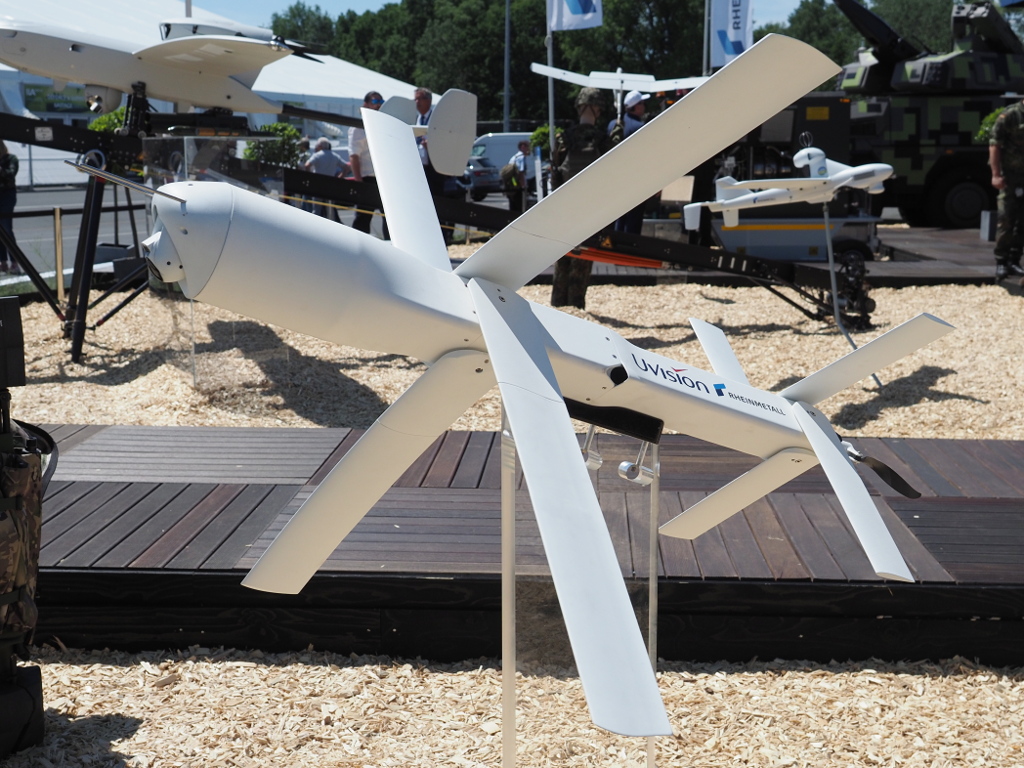
On June 21, 2021, the U.S. Marine Corps announced it had selected UVision's Hero-120 for its Organic Precision Fires-Mounted (OPF-M) program — a contract that would put loitering munitions on Marine Corps light armored vehicles, tactical trucks, and experimental drone boats. The choice elevated an Israeli munition into one of the most consequential mounted strike programs in the post-Afghanistan reorientation of the Corps.
The term "loitering munition" — sometimes called a "kamikaze drone" in the popular press — describes a weapon that combines the sensor persistence of an unmanned aircraft with the terminal lethality of a precision-guided munition. Unlike a conventional missile, a loitering munition can circle overhead for minutes to hours, stream sensor data back to an operator, and then dive on a selected target. Unlike a traditional UAS, it doesn't come home. The HERO family, built by Israeli company UVision Air Ltd., is among the most range-diverse systems in this category, spanning a product line from squad-portable rounds to strategic-strike weapons.
Five Models, One Operator Interface
The HERO line covers five production variants, from a 3-kilogram backpack munition to a 125-kilogram strategic platform. Despite the scale, all variants share a common ground control unit (GCU) — one trained crew can operate any model in the family without hardware-specific retraining on a new system.
The smallest, the Hero-30, weighs 3 kg total, carries a 0.5 kg warhead, reaches 10 km, and stays airborne for 30 minutes on an electric motor. It is canister-launched and man-portable by a single soldier. Deployment from canister to airborne runs under two minutes. At the other extreme, the Hero-1250 weighs 125 kg, carries a 50 kg warhead to 200 km range, and can loiter for six hours on a gasoline engine — strategic-strike endurance and payload from a platform that can still be vehicle-launched.
Between those endpoints:
- Hero-120: 12 kg munition weight (~25 kg with canister), 4.5 kg High Explosive Dual-Purpose (HEDP) warhead by Rheinmetall, 40–60+ km range, 60 minutes endurance, electric motor. The HEDP design combines a shaped charge for armor penetration with fragmentation for anti-personnel effect. This is the program workhorse.
- Hero-400: 40 kg, 10 kg warhead, 60 km range, 2 hours endurance, electric motor, supports rail or canister launch.
- Hero-900: 90 kg, 25 kg warhead, 150 km range, 2 hours endurance, gasoline engine.
The design architecture is consistent across all variants. Every HERO model uses a cruciform (cross-shaped) wing configuration credited with high maneuverability in constricted battle environments. All carry a 3-axis stabilized electro-optical/infrared (EO/IR) gimbaled camera. The operator's task is target identification and engagement authorization, not aircraft control; the munition manages its own flight path. As one technical description frames it, the operator locates and tracks targets “using a gimbaled Electro-Optic & Infrared Camera,” freeing crew attention for what matters in the field of view.
Critically, the system maintains man-in-the-loop control throughout the mission. If no target is engaged, the operator can abort and recover the munition via parachute — a constraint on both collateral damage and unit cost that shapes how commanders can employ the system. HERO variants are also engineered for GPS-denied environments with resistance to communications interference, a specification that reflects the contested electromagnetic reality of near-peer conflict rather than counterinsurgency assumptions.
The USMC OPF-M Selection
The OPF-M program traces to the Corps' post-2019 restructuring of its combined arms concept for distributed maritime operations. The January 2019 Request for Information specified precision strike capability at ranges “exceeding 7 km and up to 100 km” — not a lightweight anti-personnel tool but a vehicle-mounted system capable of engaging armored targets at standoff ranges that would otherwise require artillery or close air support. UVision won the competitive selection contracted through its U.S. partner Mistral Inc. of Maryland, following a series of demonstrations and field user evaluations proving effectiveness against anti-personnel, light, and heavy armored vehicle targets.
“We are proud to be selected by the Marines to provide advanced solutions for the US frontline forces.” — Major General (Ret.) Avi Mizrachi, CEO of UVision
The OPF-M integration covers three distinct platforms: the 8×8 Light Armored Vehicle-Mortar (LAV-M), the 4×4 Joint Light Tactical Vehicle (JLTV), and the Long-Range Unmanned Surface Vessel (LRUSV) — the Corps' experimental armed drone boat. Standard configuration is an 8-cell multi-canister launcher, with 4-cell and 6-cell modular variants available to suit different platform constraints. To support the contract and meet domestic sourcing requirements, UVision established a U.S.-based production facility.
Why It Matters
The broader adoption curve of the Hero family is inseparable from the operational lessons flowing out of Ukraine and the Middle East. Both theaters have reinforced the concept of tiered loitering munition architectures — not a single platform for all engagements, but a calibrated toolkit where warhead weight, range, and endurance are matched to target type and tactical context. An unnamed European defense customer completed an extended UVision training program building exactly this layered architecture using Hero-30, Hero-120, and Hero-400 in combination, explicitly driven by battlefield lessons from both ongoing conflicts. During live-fire exercises, UVision reported that “a substantial number of HERO loitering munitions were launched with a very high success rate.”
The international procurement record reflects that demand. Hungary signed a contract with Rheinmetall/UVision for HERO systems valued in the “three-digit million-euro range.” UVision and Rheinmetall also conducted Arctic live-fire and environmental testing of the Hero-120 that year, extending operational qualification into cold-weather conditions that matter directly to NATO's northern flank posture.
The comparison with AeroVironment's Switchblade family is instructive for understanding where HERO sits in the loitering munition hierarchy. The Switchblade 300 — the man-portable system that became the visual shorthand for kamikaze drones in Ukraine coverage — carries a warhead roughly equivalent to a 40 mm grenade with 10 km range and 15 minutes endurance. Against that baseline, the Hero-120 offers substantially greater range (40–60+ km), longer endurance (60 versus 15 minutes), and a larger purpose-designed HEDP warhead. The more fundamental distinction, though, is employment concept: the Switchblade 300 is backpack man-portable, a soldier-scale asset. The HERO family from Hero-120 upward is engineered for vehicle, vessel, or aircraft integration. They are not competing for the same tactical slot; they represent different tiers in a layered organic fires concept.
That tiering logic is precisely why the Marines structured OPF-M around the Hero-120 rather than a lighter system, and why the unnamed European customer trained simultaneously on three HERO variants. The weapon that makes sense depends on target type, required standoff, and available platform. UVision's answer is a common operator interface across a 3-to-125 kg strike range — a depth of product line that few competitors can match. Whether that architecture holds up in contested airspace, where GPS jamming and kinetic counter-UAS systems are operational realities rather than hypotheticals, is a question the live-fire record will answer more honestly than any specification sheet.
Sources
- Janes — Hero-120 loitering munition selected for USMC OPF-M system requirement
- Rheinmetall — HERO Loitering Munitions (manufacturer product page)
- The War Zone — Marines Pick Loitering Munition To Arm Light Vehicles And Drone Boats
- EDR Magazine — UVision to provide Hero-120 OPF-M systems to the US Marine Corps
- Army Recognition — UVision to provide Hero-120 OPF-M systems to US Marine Corps
- Autonomy Global — UVision's HERO Loitering Munitions Training in Europe Underscores Global Demand
- Automated Decision Research — Rheinmetall/UVision HERO Loitering Munitions
- Think Defence — UAS and Loitering Munitions for Light Role Infantry