
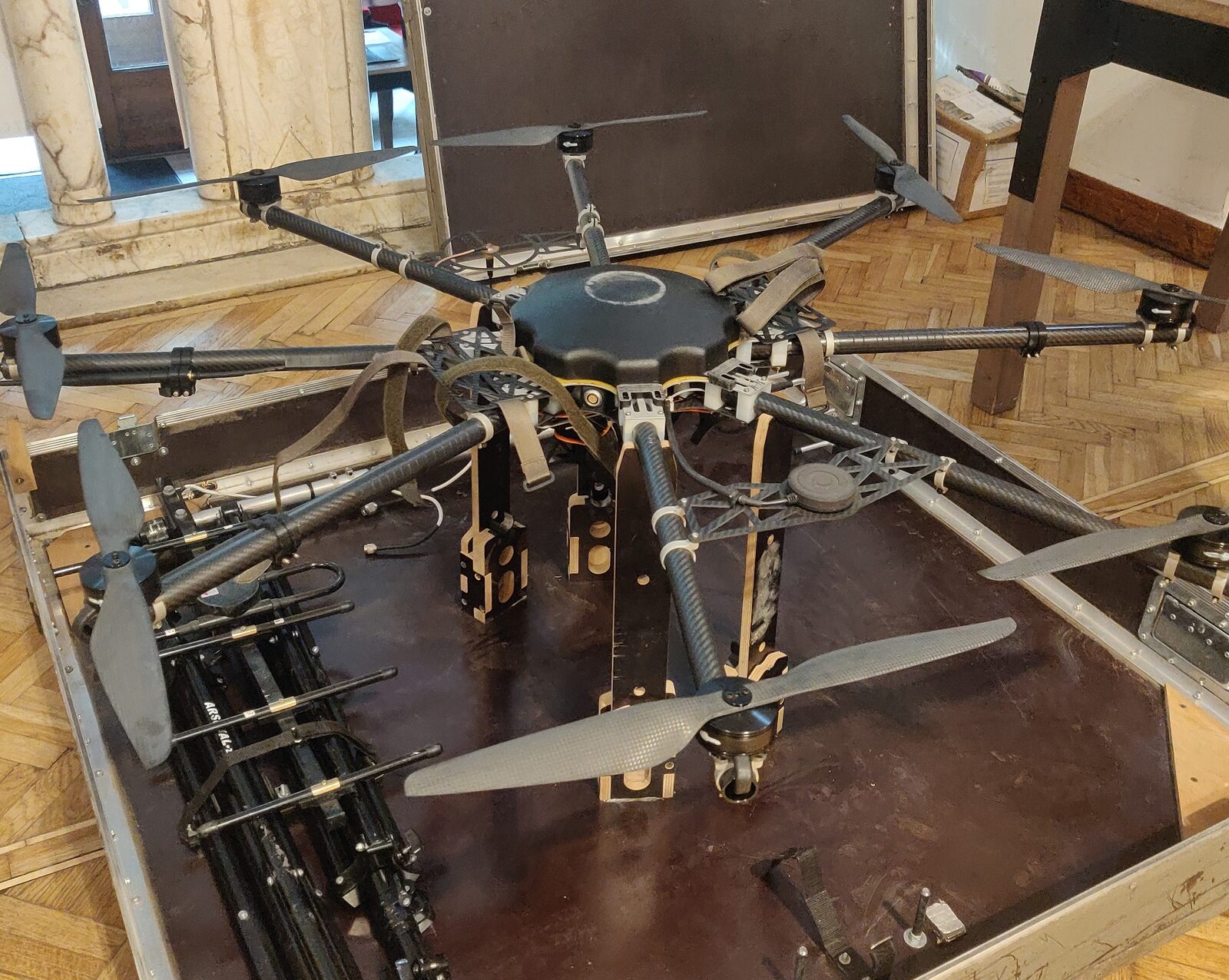
The name came from Russian troops, not Ukrainian ones — and that detail matters. “Baba Yaga” in Slavic folklore is a child-eating witch, a creature of the dark forest, deeply embedded in the collective nightmare of post-Soviet childhood. When Russian soldiers began using the term for the large, slow-moving hexacopters hunting them at night, they were naming something that had crossed from technology into superstition. According to Ukrainian drone operators in the Hart Offensive Guard Brigade, enemy forces “spread the word through all their channels to take cover because ‘Baba Yaga’ is coming.”
That fear was earned. But the origin story of these platforms is stranger than the mythology: the machines now dropping anti-tank mines and shaped charges onto Russian positions were, not long ago, spreading fertilizer on Ukrainian farmland.
Agricultural Hardware, Weaponized
The Baba Yaga class is not a single drone but a family of heavy multirotor platforms sharing a common lineage in agricultural octocopter design. These are not improvised quadcopters welded together in a basement — they are large, professionally engineered platforms originally built for crop-dusting and precision agriculture, stripped of their spray booms and loaded with ordnance.
The R18, developed by Aerorozvidka and fielded in 2022, is the archetypal example: an octocopter (eight rotors) capable of carrying approximately 5 kg of payload over a 5 km range, typically loaded with modified RPG-7 warheads. The hexacopter configuration common across the broader family is not incidental — it provides critical fault tolerance. Documented combat cases show platforms returning to base after losing one or two motors. That robustness in a contested electronic environment is a design feature as much as an engineering convenience.
The Vampire, fielded by developer SkyFall beginning July 6, 2022 — initially described as “prototypes built in a garage” — represents the next performance tier: payload capacity up to 15 kg, communications range up to 45 km, top speed up to 80 km/h, operating altitude up to 400 m, combat radius roughly 10–20 km, and approximately 23 minutes of endurance. Higher still is the Kazhan (“Bat”), produced by Reactive Drone. The Kazhan reaches payload capacities up to 30 kg — sufficient to carry an 82 mm mortar shell with room to spare.
What They Carry, and What They Do
The munitions menu for Baba Yaga platforms is wide. Documented loads include fragmentation shells, shaped charges, anti-tank TM-62 mines, 82 mm mortar rounds, and RPG warheads. A thermal imaging suite capable of detecting targets at 120 m makes nighttime operations particularly lethal; operators can prosecute targets in total darkness, which is when these platforms do most of their work.
Mission profiles extend well beyond direct strikes. The Vampire performs remote mine-laying, logistics resupply, and communications relay. One Ukrainian brigade transported four tons of cargo in a single month using Vampires alone. Grab-claw operations have retrieved enemy equipment in the field — the claw systems evolved from triple-hook designs made from grenade rings to 3D-printed precision grippers.
At 260 feet altitude, gravity-dropped payloads achieve approximately 60% hit accuracy — a figure that seems modest until weighed against the alternative of risking a human operator in the same position. AI-assisted targeting on advanced variants automatically calculates wind, altitude, and airspeed for strikes on moving targets. Internals recovered from captured platforms reveal the approach: a Starlink satellite uplink, a Raspberry Pi single-board computer, and Ukrainian-made two-way radios and video transmitters. Batteries and sensors can be swapped rapidly between sorties, enabling multiple missions per night from a single airframe.
Communications architecture on advanced variants runs triple-redundant: encrypted digital radio, Starlink satellite uplink, and LTE cellular. This layering is a direct response to Russian electronic warfare pressure. As one Hart Offensive Guard Brigade operator noted about the Vampire under jamming in Vovchansk: “Electronic warfare tools hardly affect it.” When the video feed degrades first and the control signal drops second, the platform activates automatic return-to-base rather than falling into enemy hands. The same resilience appeared in a documented incident where a round passed completely through a Vampire’s battery pack — the battery held charge and the drone returned.
“A bullet hit it, passed through the entire battery, and got stuck. Despite the hit, the battery held up, and the drone managed to return to the takeoff point.” — Ukrainian drone operator, Hart Offensive Guard Brigade
The Cottage Industry Behind the Numbers
Production is deliberately decentralized, assembled by defense workshops and volunteer tech groups dispersed across Ukraine. This is not accidental; it is a strategic hedge against targeted destruction of any single manufacturing node. By 2025, SkyFall alone had scaled Vampire production to thousands of units per month, with annual capacity of 100,000 units. Unit cost tracked that volume: from approximately $20,000 pre-war to $8,500 per unit as production matured. Ukraine remains the only confirmed combat operator of the Vampire, though Denmark has explored licensed local production and the Netherlands has financed Ukrainian unit contracts. Heavy bombers in this class routinely fly 25–35 miles carrying 5–10 kg of ammunition — a performance benchmark that reframes what small, affordable multirotors can achieve in sustained offensive operations.
The Russian countermeasures tell the other half of the story. FPV drone interceptors — small quadcopters that ram or destroy Baba Yagas mid-flight — have become a standard response, prompting Ukraine to deploy smaller quadcopter FPVs as armed escorts in a miniaturized air-superiority mission. This counter-counter dynamic — heavy bomber escorted by FPV wingmen — mirrors tactical logic from manned aviation compressed into platforms costing a few thousand dollars each. Mobile anti-drone teams, broadband electronic jamming, and the Yolka shoulder-launched interceptor system represent the organized layer of Russian defense. Infrared-goggle-equipped snipers using aimed single shots have also proven effective against the large, slow platforms. The captured black-market value of a Baba Yaga in occupied Donetsk — approximately 600,000 rubles ($7,860) — reflects their scarcity and intelligence value on the Russian side.
Why It Matters
Russia, after absorbing these strikes for two-plus years, has now fielded its own heavy multirotor analog. The Nemesis (412th Separate Unmanned Systems Brigade) carries Starlink terminals for uninterrupted communications and has a stated flight range exceeding 20 km. The technology has also begun diffusing beyond the immediate conflict: Denmark has explored licensed Vampire production; the Netherlands has financed Ukrainian unit contracts; and Armadrone’s REX — a fixed-wing hybrid unveiled in 2024, carrying 10 kg over 45 km with 1.5-hour endurance operated by a two-person crew — signals an evolutionary push toward longer-range, harder-to-intercept designs.
What began as a volunteer hack on agricultural hardware has produced a weapon category that major militaries are now racing to replicate. The Baba Yaga’s most significant feature may not be its payload capacity or its triple-redundant comms — it may be the production model it demonstrated: that a decentralized, rapid-iteration, small-team industrial base can outpace a state procurement system in fielding effective, mass-produced weapons. That lesson is being studied in Kyiv, Moscow, and every other capital currently revising its drone doctrine.
Sources
- Caliber.Az — A closer look at Ukraine’s feared Baba Yaga drones
- Army Recognition — Ukrainian Baba Yaga UAV: a nightmare for Russian forces
- Army Recognition — Ukraine to export Vampire heavy drone (BEDEX 2026)
- United24 Media — How Vampire drones withstand fire and jammers in Vovchansk
- Ukraine’s Arms Monitor — Drone warfare in Ukraine: Baba Yaga
- Inside Unmanned Systems — Ukraine and Russia’s national UAS programs
- Army Recognition — After the Baba Yaga, Ukraine created the REX drone (2024)
- GlobalSecurity.org — Ukraine drone news (Aug. 2024)
- U.S. Army TRADOC ODIN — Worldwide Equipment Guide: "Baba Yagas" (Ukrainian heavy multirotor bomber drones)
