
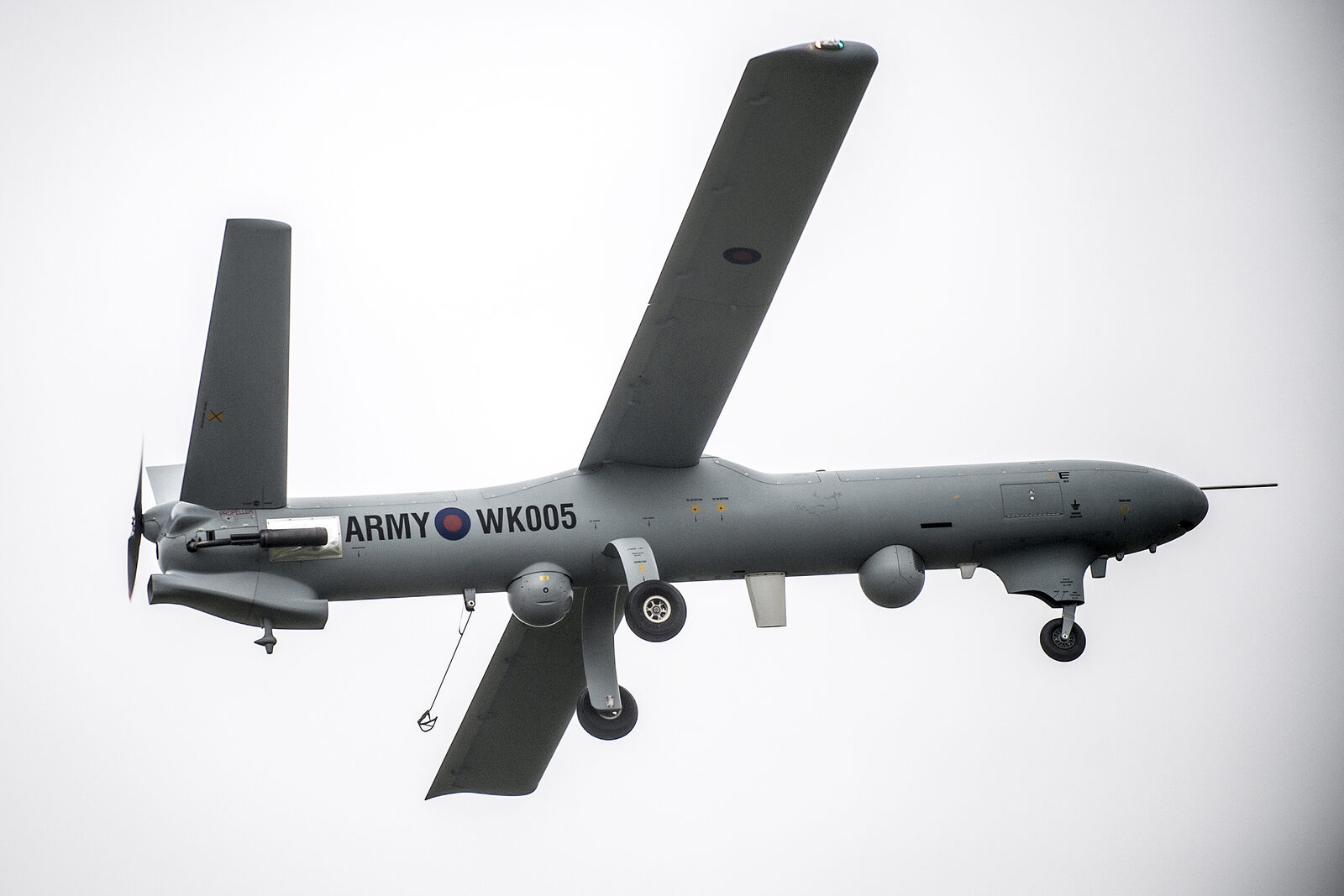
Twenty years after the British Army identified its need for a persistent tactical surveillance drone, the Watchkeeper WK450 is being quietly retired — not in combat, not after decades of hard use, but as a platform that technology overtook before it ever hit its stride. The programme's arc from a £775 million contract to a £1.35 billion write-down, punctuated by crashes, fleet groundings, and a utilisation rate that hovered at roughly 5 percent of the four-year target, stands as one of Western procurement's most instructive failures. Understanding what went wrong matters now because Europe is spending heavily on tactical UAS again, and often making the same structural mistakes.
The Procurement That Got Away
In July 2004, Thales UK was named preferred bidder for the British Army's Tactical Unmanned Air Vehicle (TUAV) requirement — a capability the Army urgently wanted after watching persistent ISR reshape operations in Iraq and Afghanistan. Fourteen months later, in August 2005, the Ministry of Defence awarded an initial contract valued at £775 million for 54 aircraft. The platform was the Watchkeeper WK450, built by UAV Tactical Systems (U-TacS), a joint venture between Thales UK and Elbit Systems, and derived from Elbit's Hermes 450 airframe. On paper, a modest adaptation of proven hardware. In practice, anything but.
The programme was designed around 1,910 individual specifications — a figure that became emblematic of an acquisition culture that prioritised covering every edge case over delivering anything on time. Mark Francois MP, then chair of the Parliamentary Defence Procurement Sub-Committee, later called it "an example of over-specification and mismanagement." The first prototype flew in Israel in April 2008, at which point the programme was already four years behind its intended service entry date. First UK flights did not begin until 2010. By 2012, spending had exceeded £847 million against the original £800 million ceiling, and the aircraft still lacked operational capability.
Initial operational capability was declared in 2014, when a single battery of four aircraft deployed to Helmand Province, Afghanistan, and flew more than 140 hours. The Watchkeeper — a fixed-wing platform spanning 10.5 metres, capable of more than 16 hours endurance, with a 150 kg payload and a 4,900–5,480 metre service ceiling — was built for exactly this kind of persistent, medium-altitude ISR. That deployment was the programme's most coherent operational moment, and it coincided with the conflict winding down. The platform Britain had spent nine years and nearly a billion pounds procuring arrived just as the mission that justified it was ending.
Three Crashes and a Grounded Fleet
The Watchkeeper's safety record compounded its schedule and cost problems. Watchkeeper WK031 was lost in an accident at West Wales Airport on October 16, 2014. In February 2017, WK042 went down over Cardigan Bay during an icing detection trial. The subsequent Defence Safety Authority (DSA) inquiry found that moisture accumulation in the pitot probes triggered a flight control algorithm malfunction, causing the aircraft to pitch repeatedly between 3,200 and 3,500 feet before descending into the sea. Most of the wreckage was never recovered.
"The software algorithms used to identify and disqualify single sensor failure were not always well understood by [Thales] within the UK." — DSA investigators
A month later, on March 24, 2017, WK043 was also lost over Cardigan Bay. Two consecutive losses grounded the entire fleet. Air Marshal Susan Gray, Director-General of the DSA, found that Watchkeeper's air data system design "limited its ability to fly safely in cloud and precipitation" — a critical structural flaw for a platform marketed as all-weather capable. By the time the programme concluded, 8 of the 54 airframes ordered had been lost — roughly one in seven. The crashes exposed a design inheritance problem: the Watchkeeper was a bureaucratically modified Hermes 450 in which the modifications had undermined what made the original platform work.
Capability Achieved, Barely Exercised
Full operational capability was declared in 2019 — fourteen years after the contract was awarded. The fleet was operated exclusively by 47 Regiment Royal Artillery (Unmanned Aerial Systems), but it never generated the utilisation numbers that would justify its cost. Between 2018 and 2022, the fleet accumulated only 1,191 flying hours against a desired annual rate of 6,000 — roughly 5 percent of the four-year target.
The reasons were structural. The UK's notoriously poor flying weather meant the platform's meteorological limits were frequently hit. Pilot shortages at 47 Regiment were chronic, with the Army at one point proposing a £30,000 retention bonus to stem attrition. When Watchkeeper did fly operationally, the missions were modest: UK Border Force conducted Channel migrant-monitoring patrols in 2020 and 2021, logging 15 sorties and 44 hours in September 2020, and 6 sorties and 24 hours in October. For a £1.35 billion programme, Channel surveillance was a thin return.
Romania signed a framework agreement for up to seven Watchkeeper systems in December 2022 — the only export sale the programme ever generated — for approximately $409–410 million. In October 2024, a Watchkeeper participated in NATO Exercise Athena Shield in Estonia with upgraded sensor payloads, marking one of the platform's few appearances in a contested-environment scenario before its retirement was announced the following month.
Why It Matters
On November 20, 2024, Defence Secretary John Healey announced to the House of Commons that the Watchkeeper fleet would be retired, describing it as "a 14-year-old army drone which technology has overtaken." The original out-of-service date was 2042; the announcement accelerated retirement by nearly 18 years. Ukraine was explicit context. Lord Coaker, Minister of State at the MoD, stated that "lessons from Ukraine showed that MALE UAVs were not survivable" in contested airspace. Hamish de Bretton-Gordon, a former British Army officer, put it plainly: "One has to question whether these big drones have had their day...too easy to interdict and take down."
The initial withdrawal target of March 2025 slipped almost immediately to March 2027, confirmed by Minister for Defence Readiness Luke Pollard in a written parliamentary response. The two-year extension carries a cost of £95,659,000 — approximately 73 percent of the entire budget for the replacement programme. As Pollard stated: "The cost of keeping the Watchkeeper programme in service for the additional two-year period is currently anticipated to be £95,659,000." The extension exists not because the platform is operationally essential but because capability gaps in LTDF (Land Tactical Deep Find) missions cannot yet be filled by anything else.
Project Corvus, the successor programme, seeks a NATO Class 3 MALE drone with 24-hour endurance. The £130 million contract tender was released July 31, 2025, with a decision expected March 31, 2026. Candidate platforms include Elbit's 650 Spark and DZYNE Technologies' ULTRA, with a contract period running from May 2026 to April 2031, extendable to 2036. The Royal United Services Institute has cautioned that "the British Army cannot simply replace Watchkeeper on what is close to a like-for-like basis" — the threat environment has shifted too fundamentally for a direct substitution to make strategic sense.
What Watchkeeper actually teaches is more uncomfortable than any single procurement lesson. The 1,910-specification requirement produced a platform optimised for a regulatory and environmental context — UK skies, peacetime training, wide-area ISR — that turned out to be the least relevant context it would face. Weather incompatibility was baked into the design from the start but treated as an operational inconvenience rather than a structural flaw. Contested-airspace survivability was never a baseline assumption. The gap between declared capability and actual utilisation — 1,191 hours against a four-year target of 24,000 — went largely unremarked until retirement forced the accounting. Europe's next generation of tactical UAS procurement is now underway. The Watchkeeper dossier is compulsory reading.
Sources
- The Defense Post — Watchkeeper WK450: A Complete Guide
- Royal United Services Institute (RUSI) — Replacing Watchkeeper: Staying Behind the Curve
- Army Technology — UK Throwing Good Money After Bad in Watchkeeper Drone Retention
- UK Defence Journal — Army's Ageing Watchkeeper Drone to Stay in Service to 2027
- LBC — British Army's Watchkeeper Drone Programme Scrapped
- The Register — Watchkeeper Drone Crash: Moisture Blocked Pitot Probe
- UK Ministry of Defence / Defence Safety Authority — Service Inquiry Report: Loss of Watchkeeper WK043 over Cardigan Bay, 24 March 2017
- The Aviationist — Watchkeeper Withdrawal Revised to March 2027
