
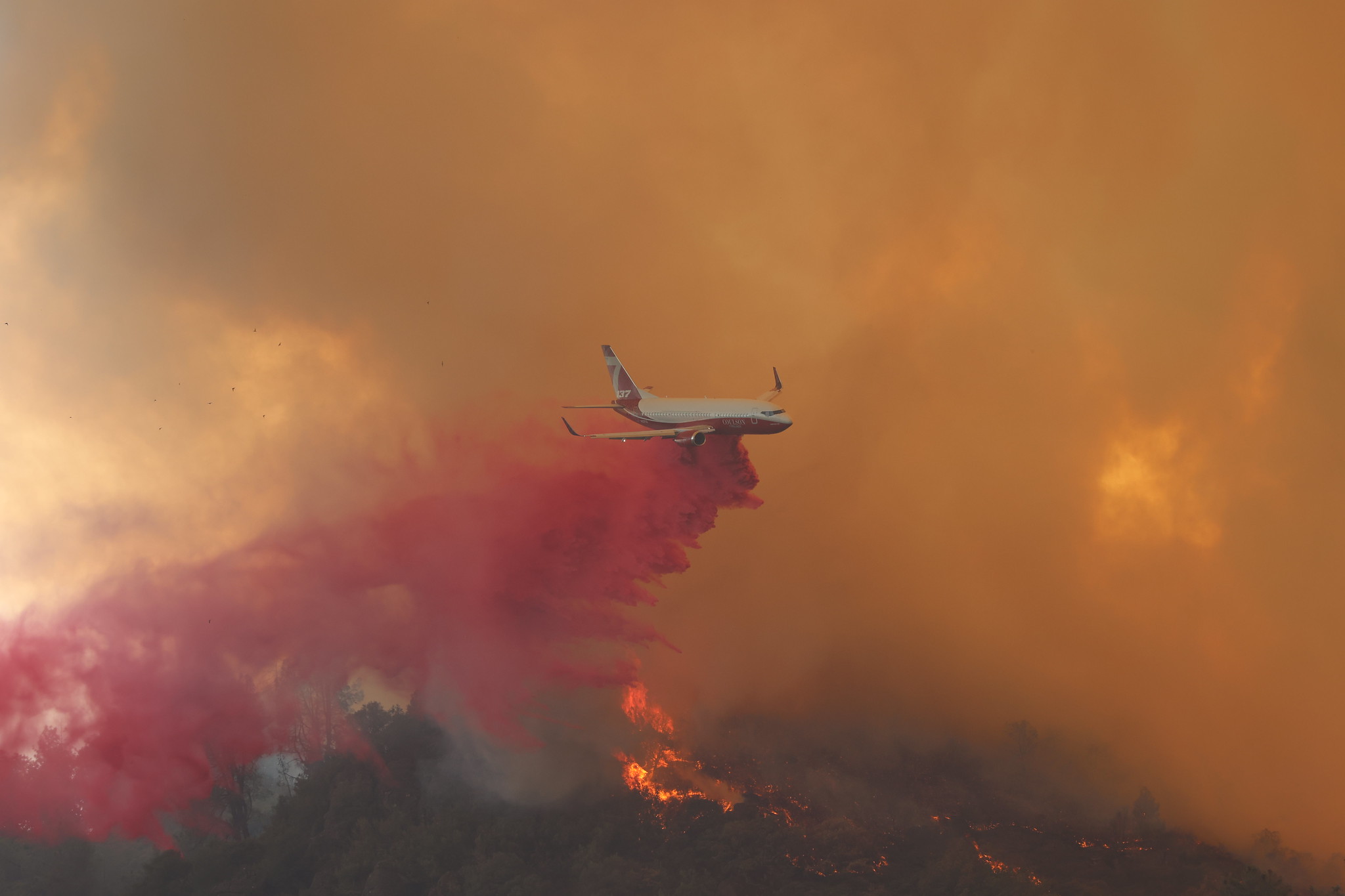
On June 24, 2015, a hobby drone appeared over the Lake Fire burning roughly 90 miles east of Los Angeles. Cal Fire’s Public Information Officer Daniel Berlant posted a warning that became the defining phrase of wildfire drone enforcement: “Tonight a hobby drone grounded firefighting aircraft by flying over the #LakeFire. When you fly…we CAN’T! Puts our pilots lives at risk.” That phrase captured something precise about the physics of wildfire airspace that no regulatory language had managed to convey.
The problem isn’t airspace bureaucracy. It’s geometry: firefighting aircraft operate at altitudes of a few hundred feet—exactly where recreational drones fly. When an unannounced aircraft enters that corridor, the aerial operation must halt. There is no safe way to route a loaded air tanker around an unknown contact at low altitude over burning terrain while managing lead planes, helicopters, and an air attack supervisor working the same airspace.
How Wildfire Airspace Is Structured
When the FAA issues a Temporary Flight Restriction over an active wildfire, it acts under 14 CFR §91.137(a)(2)—one of three sub-provisions of the disaster-area TFR regulation. The (a)(2) provision exists specifically to provide a safe environment for disaster relief aircraft, the sub-category covering aerial firefighting. The restriction is published as an FDC NOTAM (Flight Data Center Notice to Air Missions, prefixed “!FDC”) specifying a cylindrical volume whose radius and ceiling vary by incident.
Inside that cylinder, a wildfire aerial operation is a carefully deconflicted choreography: lead planes scouting drop zones, single-engine and heavy air tankers running retardant, helicopters working bucket drops at lower altitudes, and an air attack supervisor overhead coordinating everything. The FAA doesn’t manage this with radar vectors—it manages it by keeping the airspace sterile. Any unauthorized aircraft breaks that sterility and forces an immediate stand-down.
Drone operators who believe their LAANC authorization covers them are mistaken. LAANC does not override an active TFR; Part 107 certification doesn’t either. Operators must check independently via tfr.faa.gov, 1-800-WX-BRIEF, or the B4UFLY mobile app before every flight. Under 14 CFR §91.103, each pilot in command bears a pre-flight duty to become familiar with all available information concerning that flight—including active restrictions. That duty creates dual liability for operators who skip the check.
The Scale of the Problem
The U.S. Forest Service has documented unauthorized drone intrusions into wildfire TFRs since 2018—with the caveat that no centralized national reporting mechanism exists, so documented totals represent only confirmed cases. In 2018, more than 17 unauthorized drone flights occurred near wildfires in five western states, resulting in aerial firefighting operations being suspended more than 20 times. The following year, at least 20 unauthorized flights across seven states grounded or rerouted aircraft nine times.
The Buckley Draw Fire in Utah in August 2025 set what incident managers called a record: 22 drone intrusions in under one week, 12 of which were reportable incidents; the 22 drone intrusions cumulatively grounded or rerouted aircraft for a total of between 6.5 and 11 hours. Sierra Hellstrom, of the Northern Utah Type 3 Incident Management Team, was direct: “To have 22 in less than a week is really unheard of in wildland fire.” The cost arithmetic compounds fast. A single-engine air tanker runs more than $2,000 per operating hour; a heavy tanker can reach $20,000. Multiply those rates across twelve groundings in a single week and the dollar figure runs well into six figures—before counting acreage that burned while aircraft sat.
Two incidents mark the outer edges of the damage spectrum. At the Trailhead Fire in El Dorado Hills, California, in June 2016, eight air tankers were grounded across two days of drone interference; Cal Fire spokesperson Brice Bennett offered no ambiguity: “Hobby drones in the area mean we cannot fly.”
Penalties, Enforcement, and the Broader TFR System
The current FAA civil penalty ceiling is $75,000 per violation—applied per violation, not per flight. A single reckless sortie generating multiple infractions carries separate exposure for each. Separately, 49 U.S.C. §46320 makes knowingly and recklessly interfering with a wildfire response a standalone federal offense carrying up to $20,000 in addition to FAA civil penalties. Interfering with firefighting operations on public lands is also a federal crime punishable by up to two years in jail.
The FAA’s 2025 enforcement report shows how cases resolve. The largest single drone fine—$36,770—came from a wildfire-adjacent incident: a drone came within approximately 140 feet of a police helicopter during active emergency response in Baltimore County, halting those operations for 30–40 minutes. The pilot lacked both a Part 107 certificate and drone registration. Other 2025 highlights include a $14,790 fine for a Super Bowl LVII TFR violation and a $20,371 penalty for a VIP airspace incursion.
Wildfire TFRs are one piece of a larger system. Presidential and VIP movement TFRs under 14 CFR §91.141 establish a 10-nautical-mile inner ring closed to all civil aviation except scheduled commercial carriers and a 30-mile outer ring requiring IFR clearance. Stadium TFRs under 14 CFR §91.145 cover NFL, MLB, NCAA Division I football, and major NASCAR venues— 3 nautical miles, surface to 3,000 feet AGL, bracketing each event by one hour. Disney theme parks have operated under a continuously active TFR for more than 20 years. Space launch TFRs grew from 12 events in 2014 to 157 in 2024. All are published as FDC NOTAMs; all require a pre-flight check that LAANC does not substitute for.
“Even a two-foot wingspan foam remote control airplane, if it flies into an engine of a single-engine helicopter and causes the engine to quit…it’d have to make either an emergency landing or, worst case scenario, crashes, and there’s fatalities.” — Eric Panebaker, forest aviation officer
The FAA will not ask air tanker and helicopter crews to absorb that probability. Wildfire aerial operations cannot tolerate even one unknown aircraft in the corridor. A drone operator who decides the footage is worth it isn’t just making a legal miscalculation—they may be making the fire larger.
Sources
- US Forest Service — If You Fly, We Can’t (UAS and Wildfire Aviation)
- KUER — Illegal drones near a Utah wildfire mean lost time and money and put firefighters at risk (2025)
- DroneXL — FAA Drone Enforcement 2025: Fines and Suspensions
- CBS Sacramento — Eight air tankers grounded at Trailhead Fire (2016)
- FAA Safety Briefing Magazine — Avoiding TFR Tangles
- Pilot Institute — TFR Explained
- Know Before You Fly — Avoid Wildfires
- CBS San Francisco — Hobby drone prevents firefighting aircraft from flying over California wildfire (2015)
- PracticeTestGeeks — FAA TFR Guide
