
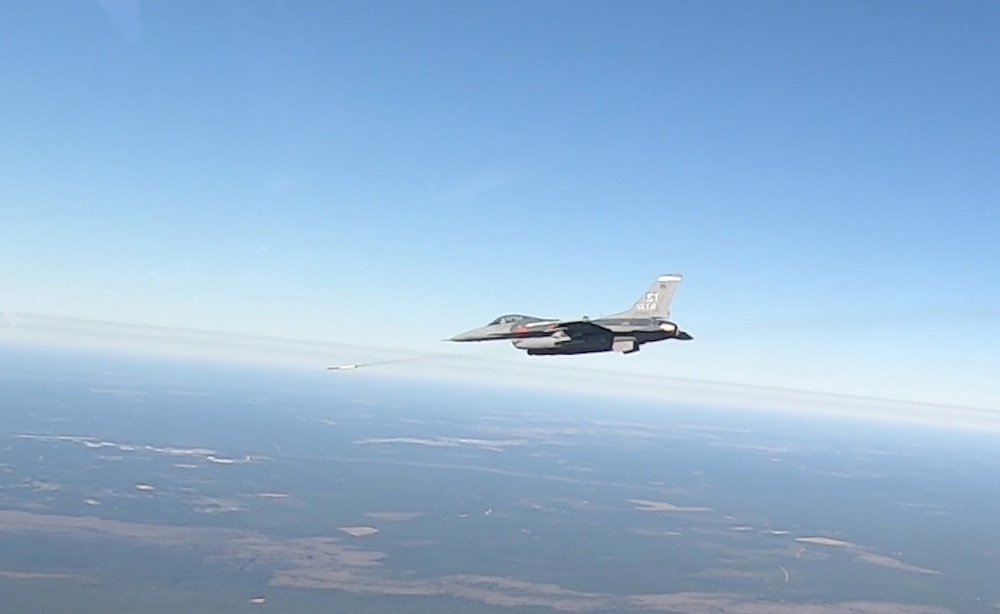
The US State Department has approved a Foreign Military Sale that would put a cut-price counter-drone weapon into the hands of the Italian Air Force's Eurofighter Typhoon fleet. The package, announced August 21 and first reported by Janes on August 24, covers 5,031 APKWS II WGU-59B/B laser-guidance sections at an estimated value of roughly $364 million — a purchase that says as much about the economics of shooting down drones as it does about Italy's air defenses.
The buy would arm Italy's F-2000 Typhoons — the Italian designation for the Eurofighter — with BAE Systems Inc.'s Advanced Precision Kill Weapon System II, a guidance kit that turns an unguided 2.75-inch Hydra rocket into a laser-guided precision munition. No contract has been signed yet; sources in Italy told Defense News the technology is still being evaluated, and the State Department's approval simply clears the way for Italy and BAE Systems to begin further negotiations toward integration onto the Italian jet.
What Italy Is Actually Buying
An FMS approval isn't a delivery order. It's the US government clearing the sale in principle, which lets Italy and BAE Systems begin the contracting and integration work that would put the rockets on Italian aircraft. The State Department framed the deal in alliance terms, saying it would "strengthen Italy's homeland defence" and enhance the country's "contribution to NATO integrated air missile defence" — language that positions the purchase less as a one-off procurement and more as a NATO-wide capability play.
The headline number that makes APKWS attractive isn't the $364 million topline — it's the unit economics buried underneath it. Defense News reports a per-round cost under €100,000, roughly $117,000, against a price roughly ten times higher for an AMRAAM air-to-air missile. For an air force that might need to fire at a cheap quadcopter or a low-cost one-way attack drone, that gap is the entire point.
Q&A: Why a Rocket Kit and Not a Missile
Isn't a Typhoon already armed with missiles that can kill a drone?
Yes, but that's the problem the sale is meant to solve. Firing a radar-guided AMRAAM or an infrared-homing Sidewinder at a small drone works, but it burns a weapon designed and priced for shooting down fighters and cruise missiles. Air forces that have watched adversaries mass-produce cheap drones — and watched defenders burn through expensive interceptor stocks doing it — have been hunting for something in between a gun and a $1 million missile.
What is APKWS II, mechanically?
It's a laser-guidance section — seeker, control fins, guidance electronics — that slots into an existing unguided 70mm Hydra rocket, converting it into a precision-guided munition. The underlying rocket motor and warhead are decades-old, low-cost hardware; APKWS simply gives it the accuracy to hit a small, maneuvering target instead of just a fixed one.
Has this actually been proven on a Eurofighter, or is this still theoretical?
It's proven, and recently. The UK's Royal Air Force pushed APKWS onto its own Typhoons earlier in 2026 through what Defense News describes as a rapid two-month testing and integration cycle, and has already deployed the capability operationally. Italy's sale follows directly on the heels of that British precedent — the RAF effectively did the pathfinding work that makes a fast Italian integration plausible.
A Pattern Across the Eurofighter Fleet
Italy is not moving in isolation. Per Janes, BAE Systems managing director Richard Hamilton has said the other nine customers of the Eurofighter — out of ten operator nations total — have indicated their intent to pursue the same counter-drone integration following the RAF's rapid adoption. A common low-cost interceptor that any Eurofighter user could integrate would let operators share testing data, tactics, and potentially even production capacity, rather than each air force solving the counter-drone problem separately and expensively.
That dynamic matters because Eurofighter nations sit on NATO's eastern and southern flanks — geography where small drones, whether reconnaissance quadcopters probing air defenses or longer-range one-way attack systems, have become a recurring nuisance and, at times, a real threat. A weapon that costs a tenth of a beyond-visual-range missile changes the calculus of whether to engage at all, rather than letting a drone loiter because expending a seven-figure missile on it feels disproportionate.
Why It Matters
The APKWS-on-Eurofighter push is a case study in a broader shift reshaping Western air forces: the recognition that the drone threat is a volume problem, not a precision problem, and that air-to-air missiles built for the Cold War's high-end fight are the wrong tool for it — expensive, magazine-limited, and increasingly reserved for threats that actually require them. A sub-$120,000 laser-guided rocket lets a fighter pilot engage a small drone without triggering a cost-benefit crisis every time the trigger is pulled, and without depleting stocks of missiles that would be needed in a peer conflict.
For Italy specifically, the sale reinforces the Eurofighter's relevance as a multirole platform in an era when air forces are being asked to defend against threats that didn't exist when the jet was designed in the 1980s and 1990s. For NATO as a whole, a common low-cost interceptor adopted across multiple Eurofighter operators — following the RAF's fast-tracked example — points toward the kind of shared capability that alliance planners have been pushing for as drone incursions along NATO's frontiers have grown more frequent. The fact that Washington is willing to approve rapid FMS sales of a proven, relatively low-cost system suggests the US sees allied counter-drone readiness as an urgent gap worth closing quickly, not a program to be worked through the normal multi-year acquisition timeline.
What happens next is the harder test: whether Italy can replicate the RAF's two-month integration timeline, whether a formal contract follows the FMS approval on a similarly fast schedule, and whether other Eurofighter operators convert reported interest into their own sales. If they do, APKWS II could become the alliance's default answer to the small-drone problem — not because it's the most capable interceptor available, but because it's the one every Typhoon-flying air force can actually afford to use.
