
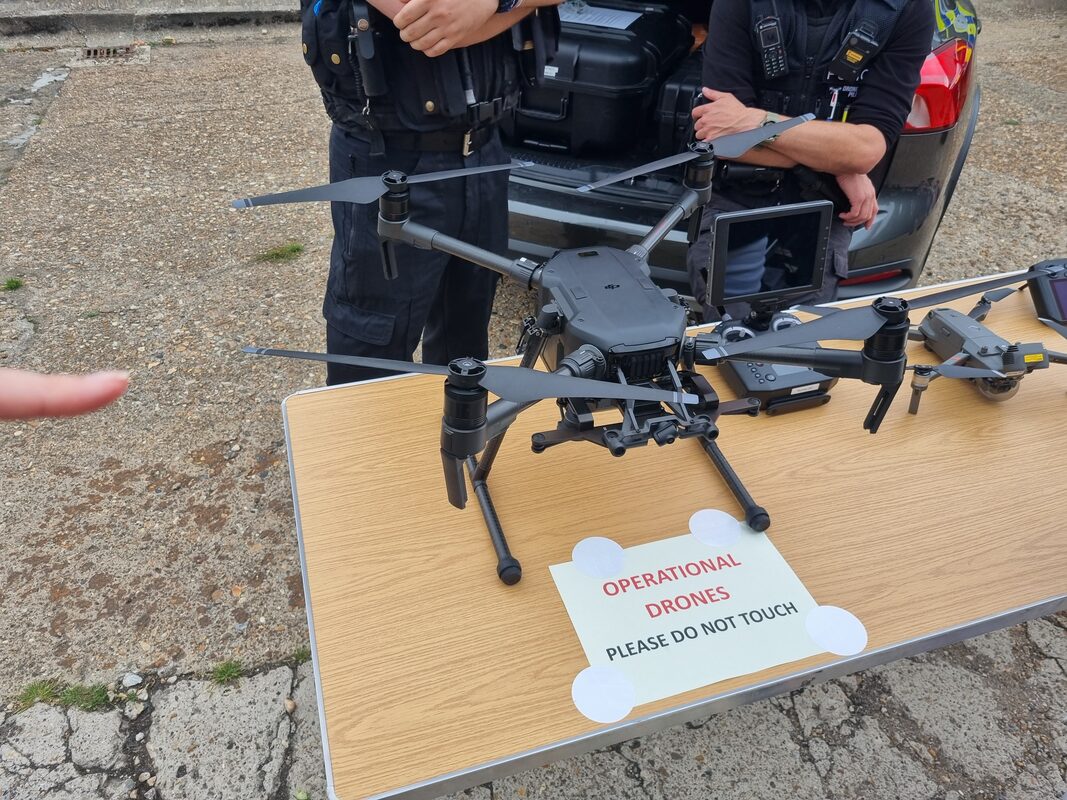
The UK government wants police to be able to read a drone's identity from farther away. On Nov. 24 the Department for Transport (DfT) announced a London trial worth nearly £2 million that will give officers equipment able to detect drones' digital "number plates" at greater range and with more accuracy than the current setup allows.
The problem it targets is simple. According to the DfT, today's digital number plates identify a drone and its location, but they can generally be picked up only within a confined vicinity of the aircraft. An officer has to be fairly close to a drone to learn whose it is. The new equipment is meant to stretch that distance.
What the money buys
The DfT is putting in £1.2 million. The Regulatory Innovation Office is adding another £500,000. Those two contributions come to £1.7 million of the "nearly £2 million" headline figure. The department did not say where the equipment will be used. That decision belongs to the National Police Chiefs' Council (NPCC), which will decide deployment, so policing priorities rather than the department will set where the kit ends up in the capital.
The announcement quotes Transport Secretary Heidi Alexander and Louisa Smith, chief operating officer of Apian. It also mentions sensor work on the railway in Birmingham with Network Rail, which suggests the government sees detection as a network of sensors serving different kinds of infrastructure, not one London tool.
Unmanned Airspace, reporting the same announcement, said the trial is also framed as helping drones share airspace safely, with the aim of growing medical deliveries and shopping services such as Amazon's. It added that no further details on the Regulatory Innovation Office's wider aims were immediately available.
The incidents behind it
The government gave three recent cases to justify the spending:
- Football: disruption at an Arsenal fixture last month.
- Concerts: more than 10 drones seized around Oasis concerts last year.
- Aviation: an aircraft encountering an illegal drone near Heathrow in October.
The three cases cover three different settings: a packed stadium, a crowded outdoor music venue, and the approach to a major airport. In each one, police would want to identify a drone quickly and find its operator before the incident escalates or the pilot packs up and leaves. Close-range detection is a poor fit for a stadium perimeter or the area around an airport, where the drone may be well inside a sensitive zone before anyone nearby can read its broadcast.
How it fits with May's spending
The London trial is not a standalone project. The DfT says it builds on nearly £50 million of government investment announced in May to boost drone and flying taxi technology. Unmanned Airspace describes that May package as UK Civil Aviation Authority (CAA) funding for drone integration and airspace modernisation.
A related May announcement, reported by The Register, was a £20.5 million central system that records the identity and location of drones in flight using what the government calls Hybrid Remote ID. This adds internet-based reporting on top of the radio broadcast the drone already sends out. Security minister Dan Jarvis described it then as "a numberplate system for the skies," and the comparison drawn at the time was to automatic number plate recognition (ANPR) on the roads.
The legal basis is already partly there. According to The Register, the CAA has required some drones to fly with Direct Remote ID since the start of 2026, and more categories will be covered from the start of 2028. The broadcasts exist now. What police lack is the ability to receive them from far enough away to be useful.
The pieces fit together like this. Direct Remote ID is the broadcast from the aircraft. Hybrid Remote ID is the central record that adds network reporting. The London trial is the receiving side on the ground, an attempt to give officers longer ears.
Why It Matters
The number plate comparison is useful, and it has a built-in limit. ANPR works because almost every car carries a plate, and removing or faking one is itself an offence that tends to get noticed. Remote ID works only when the drone is actually broadcasting. A detection system built on Remote ID will find drones that comply with the rules, along with drones flown by people who are careless or don't know the rules: a hobbyist who strays over a stadium, or a fan filming a concert from a no-fly area. That covers a real share of nuisance incidents, and catching more of them at longer range matters.
It does far less against a deliberate bad actor who builds or modifies an aircraft that doesn't broadcast. Nothing in the announcement says this trial is meant to detect drones that aren't emitting a Remote ID signal. As described, its aim is to read the existing digital plate farther away and more accurately. It extends reach. It does not counter rogue drones, and it should be judged that way. The Heathrow case shows the gap. A Remote ID receiver helps only if the illegal drone near the airport was broadcasting in the first place.
That doesn't make the trial a waste of money. Longer-range detection of compliant drones lets police sort the crowd quickly. If most drones over a sensitive site can be identified and tied to an operator within seconds, the aircraft that can't be identified stand out. Separating the many from the few is probably where Remote ID is most valuable for security, and better range makes that sorting faster.
The economic case is part of the pitch too. The DfT says the UK drone sector could add up to £103 billion over 25 years, and the Unmanned Airspace account links the trial to safely integrating delivery drones. A credible identification layer is likely to matter to regulators weighing routine commercial drone traffic over cities. The same infrastructure that helps police at a football ground is meant to reassure the public that the skies over London aren't anonymous.
Open questions remain: how much range the new equipment actually adds, how the NPCC prioritises sites, how trial results will be measured, and whether the system will be built out after London. The announcement gives no figures on any of these. The overall direction, though, is consistent: mandate the broadcast, record it centrally, and now extend the distance at which police can receive it.