
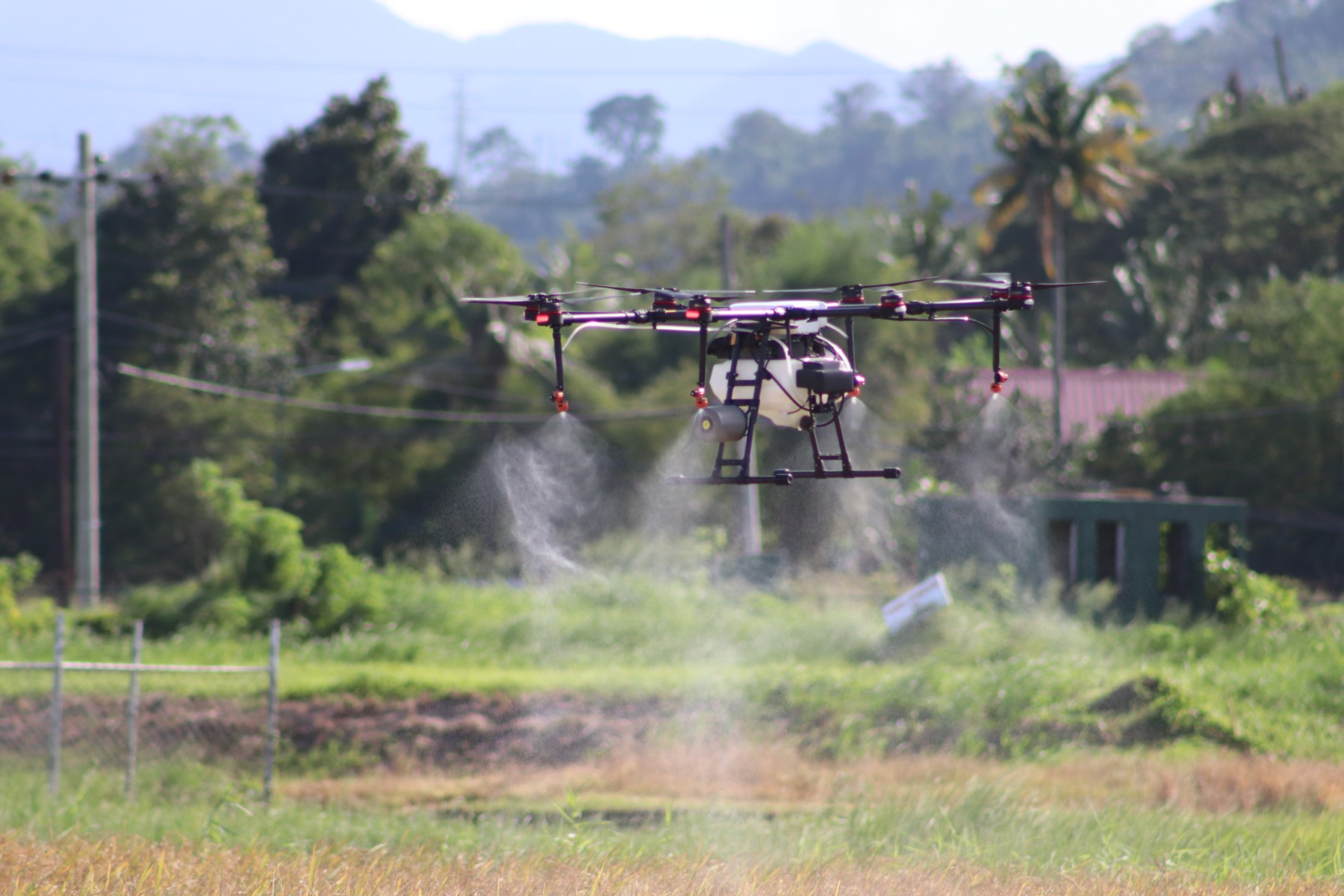
America's agricultural spray-drone sector treated far more acreage in 2025 than in 2024. The industry also sold far fewer new aircraft. Those two facts are now part of a Federal Communications Commission docket, where the trade group for spray-drone dealers is asking regulators not to treat crop sprayers as weapons.
The American Spray Drone Coalition (ASDC), whose members it says handle nearly 80% of US spray-drone sales, estimates that units sold fell from about 8,950 in 2024 to about 3,711 in 2025, a drop of roughly 59%. Over the same period, according to the group's annual impact survey, acreage treated by drones rose 58.7% to more than 16.4 million acres. The number of FAA-approved Part 137 drone operators rose to 1,710.
ASDC says demand did not cause the slump. "We went from 8,950 spray drones sold in 2024 to 3,711 in 2025. That was not because of a lack of demand. That was because of a lack of supply," ASDC president Eric Ringer told AgFunderNews. He pointed to US Customs and Border Protection holds on DJI shipments, which he said have come "in fits and starts."
The group's comments in FCC PS Docket 26-189 argue that a pending proposal would make that supply problem worse for the largest category of agricultural drones.
What the FCC Has Proposed
On July 21, 2026, the FCC's Public Safety and Homeland Security Bureau and Office of Engineering and Technology released Public Notice DA 26-758. It seeks comment on barring the importation and marketing of previously authorized foreign-produced "military-grade" uncrewed aircraft systems and critical components that are on the Commission's Covered List.
The definition of "military-grade" is where agriculture comes in. The notice's list covers:
- UAS weighing 55 pounds or more at takeoff;
- UAS capable of dispensing "economic poison" as defined in 14 CFR 137.3, the FAA rule governing agricultural aircraft operations;
- UAS with thermal-imaging sensors or LiDAR sensors;
- swarming UAS and docking stations.
The bureaus explain the dispensing category in security terms. The notice says aerosol dispensing platforms "operating independently or in a swarm can carry out mass chemical or biological attacks against U.S. persons and our food supply."
The bureaus propose that importing and marketing stop 180 days after publication in the Federal Register. The prohibition would not apply to domestic production, to importation or marketing for federal government use, or to commercial testing and product development, and it would not affect continued use of drones that have already been purchased. Comments are due 30 days after Federal Register publication. As DroneXL reported on Oct. 21, the bureaus had not adopted the proposal as of that date.
DJI has told the FCC that the "economic poison" category is "a roundabout way of describing every agricultural drone that can spray pesticides or spread seeds," as AgFunderNews quoted it. DroneXL reads the definition the same way, calling it "the definition of a crop sprayer." On that reading, nearly the whole foreign-made commercial spray-drone fleet could fall under the rule, not just a narrow class of hardware.
What the Dealers Are Asking For
ASDC's filing, as summarized by DroneXL and AgFunderNews, makes several requests:
- A Part 137 carve-out. Exclude FAA Part 137 agricultural spray drones from the "military-grade" prohibitions and provide a structured, multi-year off-ramp.
- A two-year parts window. Guarantee two years after any ban takes effect to keep importing flight controllers, motors, batteries and repair modules for drones bought legally before it.
- Anti-circumvention audits. Pair the parts window with audits meant to stop manufacturers and distributors from assembling new aircraft under the guise of spare parts.
- A tariff-funded rebate. Direct tariff revenue from foreign drone imports into a direct-buyer rebate for American drones, open to makers holding an FCC Conditional Approval or an equivalent clearance, to bridge the cost gap.
The parts request matters because of how the installed base is spread. ASDC counts more than 15,000 spray drones in US service, and DroneXL reports the filing says a typical spray drone package costs more than $40,000. The FCC proposal leaves existing drones in use. DroneXL argues, though, that a sprayer keeps flying only as long as someone can replace its motors, batteries and flight controller.
Reading the Numbers
The survey describes a market moving in two directions at once. Acreage rose 58.7%, but ASDC says that growth came almost entirely from a 58.3% increase in approved Part 137 operators, not from better productivity: average acres treated per operator stayed statistically flat at 9,584. At the same time, new-unit sales collapsed. ASDC attributes the sales drop to the CBP import restrictions on DJI that followed enforcement of the Uyghur Forced Labor Prevention Act, which makes the slump a supply story in ASDC's telling, not a loss of interest.
Prices to growers moved in the other direction. ASDC's survey found that the average price per sprayed acre fell 38%, from $21 to $13. The survey attributes the drop to heightened competition, citing members' reports of undercutting by operators without a Part 137 certificate, particularly in the corn belt.
The origin mix shifted, too. Chinese-made aircraft fell from 93.52% of the surveyed market to 75.75%, while US-made aircraft rose from 6.48% to 24.25%. ASDC says the American gain mostly reflects the vacuum left by the drop in DJI imports rather than a sustained competitive shift, and that XAG and EAVision, both Chinese manufacturers, benefited most from the DJI restrictions.
The survey also suggests that preference for American hardware is weak. Forty-nine percent of surveyed operators said they would pay no premium for an American-made drone, and 41% said they would pay a premium of up to 25%. Operators ranked productivity first and said country of origin had little influence on what they buy. Ringer, who also cofounded American Autonomy Inc., told AgFunderNews that US-sourced batteries and motors are "orders of magnitude more expensive" than Chinese equivalents.
A caveat applies to all of these figures. The survey polled Part 137 certificate holders, and its sales numbers come from interviews with manufacturers and distributors plus public statements, so, as DroneXL notes, they are industry estimates rather than customs records. They come from an advocacy group with a direct stake in the outcome of the docket. The 1,710 operator count is the one figure the survey takes from an FAA-reported total.
Why It Matters
The FCC's approach to "military-grade" UAS defines threat by capability, not by intended use. Under that logic, an aircraft able to dispense a pesticide counts as a possible chemical delivery platform whether it flies over a soybean field or anywhere else. The security concern stated in the notice is specific: aerosol dispersal at scale, possibly by swarms, aimed at people or the food supply. Because the definition is written around capability, it also reaches the equipment behind the 16.4 million acres the survey says drones treated in 2025.
That leaves the Commission with a familiar dual-use problem in an unusually concrete form. The features that make a spray drone useful, including payload capacity, precise dispensing and autonomous flight, overlap with the ones the notice flags. ASDC's proposed carve-out depends on whether the FAA's Part 137 certification, which applies to agricultural aircraft operations, is enough of a control to separate legitimate operators from the threat the bureaus describe.
Timing is the other issue. The 180-day clock would run from Federal Register publication, and domestic suppliers still hold only about a quarter of the market by ASDC's count. The coalition's 2025 data show what a supply shock has already done: sales fell by more than half even as treated acreage grew by more than half. ASDC's argument is that a bar on imports without a parts window would extend that pressure across the more than 15,000 aircraft that farmers and applicators already own.
The bureaus have not acted. The record in PS Docket 26-189 now includes an industry argument that Part 137 sprayers deserve a carve-out and an off-ramp, and DJI's objection that the definition is a broad ban described in narrow terms.
Sources
- FCC Public Notice DA 26-758: FCC Seeks Comment on Prohibiting the Importation and Marketing of Certain Foreign-Produced Military-Grade UAS (PS Docket 26-189, July 21, 2026)
- DroneXL: Spray Drone Sales Fell 59%, and Dealers Want an FCC Carve-Out (Oct. 21, 2026)
- AgFunderNews: US spray drone market 'very much in flux' as firms attempt to navigate evolving landscape, says ASDC
- American Spray Drone Coalition: 2025 ASDC Impact Survey Results
