
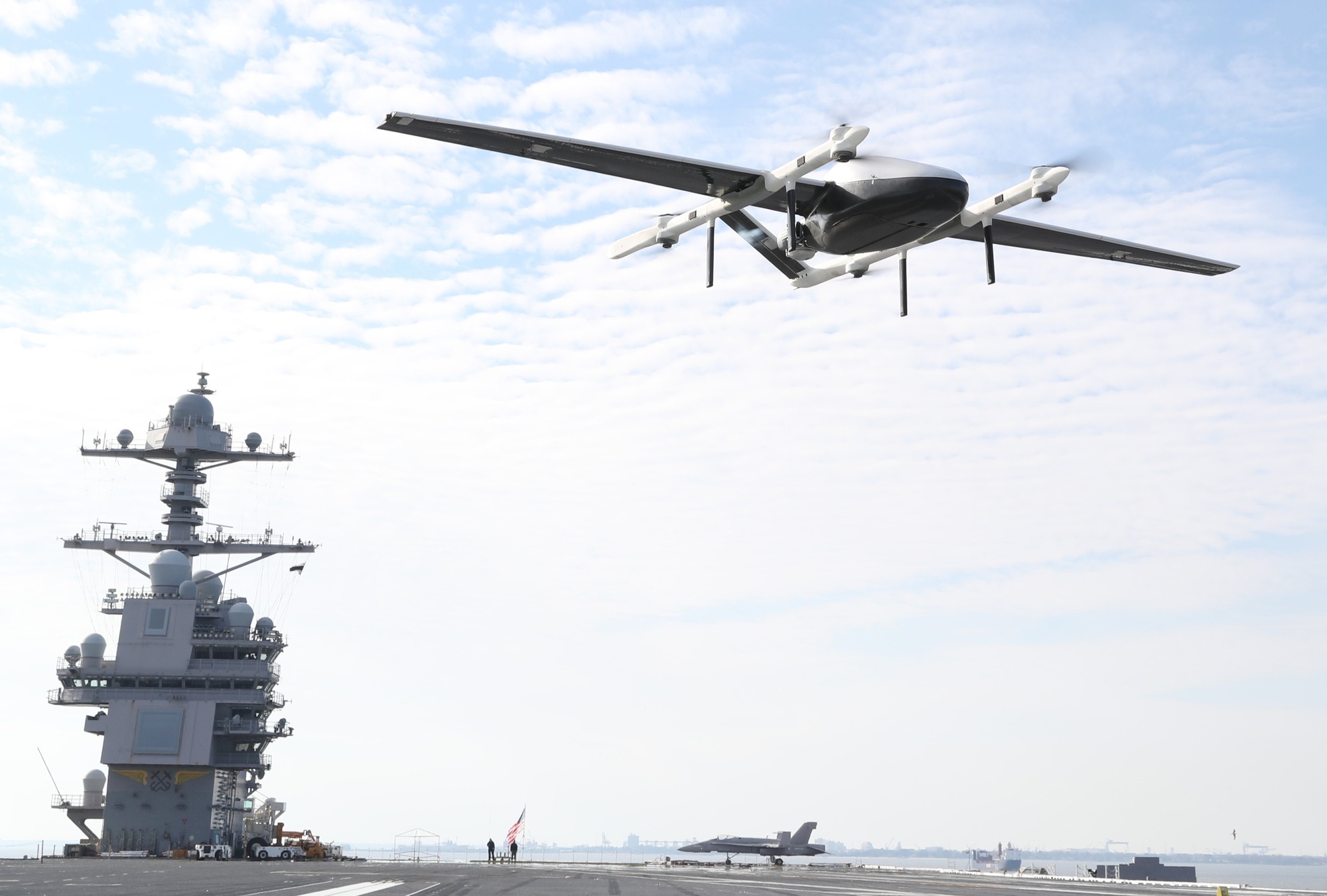
While much of the drone-delivery industry has spent the better part of a decade chasing the suburban front porch, a comparatively quiet operator out of Austin, Texas has been flying in the opposite direction — out over open water, hundreds of miles from the nearest neighbor or doorstep. According to a June 26, 2026 report from DroneLife, Skyways Aviation is expanding its offshore and maritime cargo operations and positioning itself for the FAA's forthcoming Part 108 rule that would normalize beyond-visual-line-of-sight (BVLOS) flight.
The pitch is straightforward once you stop thinking about pizza and start thinking about supply boats. Offshore oil platforms, naval vessels and remote maritime sites all need small, time-critical deliveries — parts, samples, documents — and the incumbent options are crewed helicopters and surface vessels, both expensive and both carrying real human risk. A long-range cargo drone changes the math.
The aircraft: a dual-fuel long-hauler
Skyways' workhorse is the V3, a vertical-takeoff-and-landing (VTOL) aircraft built around a dual-fuel architecture. It uses electric power for the lift phase — the hover and vertical climb that let it operate from a deck or pad without a runway — and switches to jet fuel for cruise. That hybrid approach is what gives the platform its headline figure: a stated range of more than 1,000 miles.
On payload, the V3 carries up to 100 pounds across roughly 7 cubic feet of cargo volume. That is well short of a helicopter sling load, but it is squarely in the range of the high-value, low-mass items that drive offshore logistics costs: a failed sensor, a replacement valve, a biological sample that needs to reach a lab onshore before it degrades. The combination of long legs and a useful-but-modest payload is a deliberate fit for the maritime niche, where the distances are punishing and the cargo is often small.
Who's already flying with them
Skyways is not a pre-revenue concept company. CEO Charles Atkin founded the firm roughly nine years ago, and alongside CCO Bill Wimberley the company has assembled a customer and partner list that reads more like a maritime-logistics roster than a typical drone-startup deck.
The named relationships include All Nippon Airways, which anchors a hub in Okinawa, and DSV A/S, the Danish transport and logistics giant. Skyways also counts multiple unnamed oil majors among its customers — the platform operators who feel offshore logistics costs most acutely. Perhaps the most striking entry is a Japanese Navy project slated to launch this summer, a signal that the maritime case for long-range cargo drones extends from commercial platforms to defense vessels.
Geographically, the company says it already operates across three continents. The next phase of expansion targets the Gulf of Mexico — the dense cluster of offshore energy infrastructure that is an obvious proving ground for platform-to-shore delivery — along with three or four additional countries.
Why offshore, and why now?
The "why offshore" answer is partly about economics and partly about airspace. Open water is, for a BVLOS operator, some of the most forgiving airspace available: sparse traffic, few people on the ground beneath the flight path, and a clear operational need. That makes maritime corridors a natural place to build out long-range autonomous cargo flight while the regulatory framework for more crowded environments catches up.
The "why now" answer is regulatory. Skyways is explicitly preparing for the FAA's Part 108, the rule that would govern routine BVLOS operations — and a key part of that preparation is detect-and-avoid compliance, the onboard capability to sense other aircraft and stay clear of them without a human watching from the ground.
The regulatory backdrop: from waivers to a rule
To understand why Part 108 matters so much to a company like Skyways, it helps to look at the framework it would replace. Under the FAA's current approach, package delivery by drone runs largely through the Part 135 air-carrier path, supplemented by individual BVLOS waivers and authorizations. That system works — companies fly under it today — but it scales poorly. Each waiver is its own negotiation, and an operation built on a stack of case-by-case approvals is hard to grow into a global fleet.
Part 108 is the FAA's attempt to turn that bespoke waiver process into a standing rule. Legal analysis of the Part 108 notice of proposed rulemaking describes two authorization pathways — lower-risk Operating Permits and higher-risk Operating Certificates — layered over five population-density categories, running from the sparsest (Category 1) to the most densely populated (Category 5). Detect-and-avoid runs through the framework: drones would have to yield to crewed aircraft broadcasting their position over ADS-B. Those structures determine whether an operator can move beyond one-off waivers and into normalized, repeatable BVLOS service.
The structure itself is an argument for the offshore strategy. Under the proposal, an Operating Permit would let a company fly only in areas up to Category 3, while operations over the denser Category 4 and 5 areas would require the more demanding Operating Certificate. The analysis suggests a final BVLOS rule could arrive as early as the first quarter of 2026. An operator that wants to scale BVLOS flight is therefore better off over water — about as sparse as airspace gets — where the operational and regulatory hurdles are lowest, rather than waiting to clear the bar for the most crowded environments.
Why It Matters
Skyways' offshore bet is a useful corrective to the dominant narrative about drone delivery. The headline-grabbing version of this industry is consumer-facing — small packages dropped in backyards — but the version quietly booking revenue today is industrial and maritime, moving high-value cargo across distances no rotorcraft would economically cover for a 100-pound load.
It also illustrates how the path to BVLOS scale is gated as much by regulation and detect-and-avoid capability as by aircraft engineering. The V3's 1,000-mile range is impressive, but range alone does not create a business; the ability to fly those miles legally and repeatably does. By aligning its expansion with Part 108 and investing in detect-and-avoid now, Skyways is betting that the operators who do the unglamorous compliance work over open water will be the ones positioned to scale when the rule lands — and when the denser categories of operation eventually open up. For the broader UAS sector, the lesson is that the first durable, profitable long-range drone-logistics businesses may well be built offshore, out of sight, before they ever come ashore.
