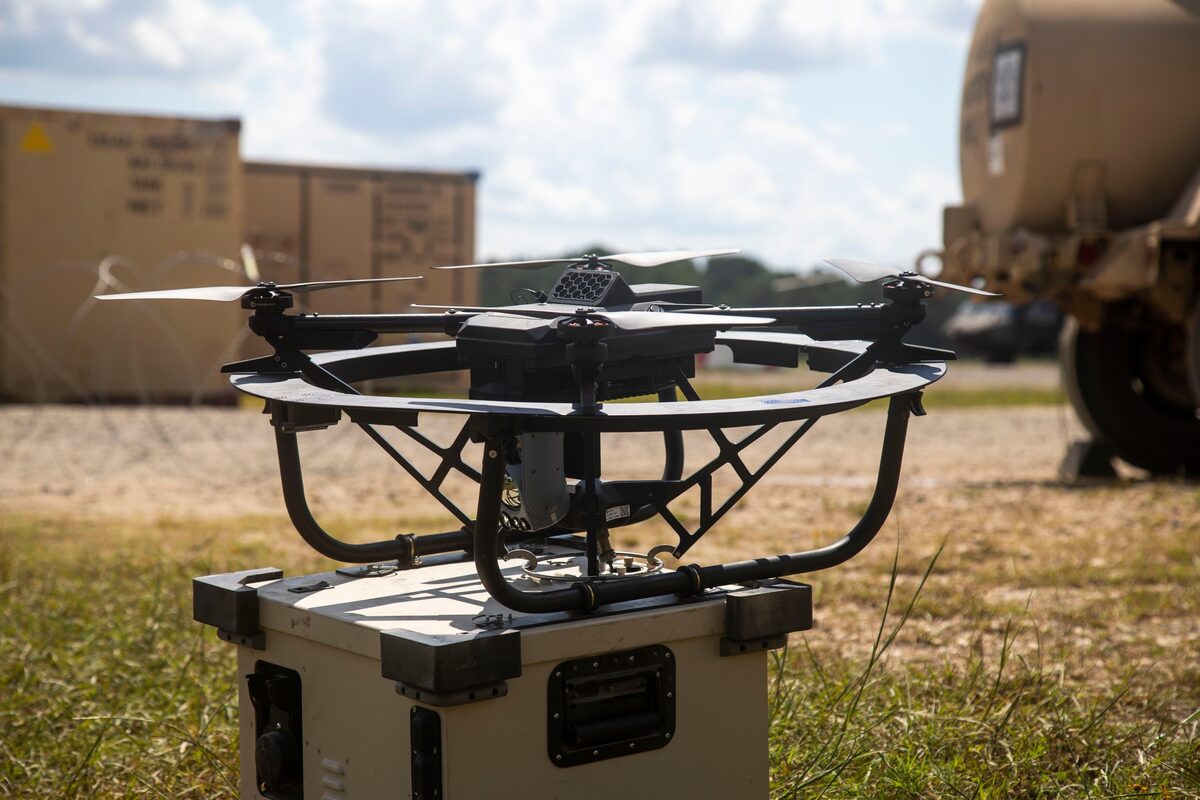
Skydio has spent nearly a decade building quadcopters that fly themselves around obstacles. At its Ascend 2026 user conference in Summerlin, Nevada, the company showed what it wants to be known for next: aircraft that fly far, and the robotic infrastructure that launches, recovers and recharges them without a human anywhere nearby.
CEO Adam Bry introduced the F10 Lightrunner on stage on Sept. 23 — Skydio's first fixed-wing drone — alongside MegaDock, an automated launch-and-recovery station built to house and service up to five of the aircraft at once. Together they represent a bet that the next phase of public-safety and utility drone work isn't about a better quadcopter, but about coverage: a box on a roof or a pole that can put an aircraft over a 30-mile radius, unattended, indefinitely.
A Fixed-Wing First for a Quadcopter Company
Skydio built its reputation on quadcopters — the X10 and its predecessors, prized by police departments and utilities for obstacle-avoidance autonomy in tight, cluttered environments. The F10 Lightrunner breaks that pattern entirely. It's a fixed-wing aircraft designed for range and speed rather than hover precision: a 100 mph top speed and a 30-mile operating radius, which DroneDJ notes translates to roughly 2,800 square miles of coverage from a single launch site. Skydio says a mission, including the aircraft's charging cycle, can run up to two hours.
The airframe is small for what it's being asked to do — about 15.43 lbs including batteries, according to DroneXL's reporting from the Ascend show floor. Onboard compute pairs an NVIDIA Jetson Orin with a Qualcomm Snapdragon 865, the kind of processing headroom Skydio's quadcopters have used for real-time obstacle avoidance, now applied to a much longer-range mission profile. Sensing comes from SideEye, a wingtip camera gimbal combining a 48-megapixel telephoto lens, a 64-megapixel narrow lens and a FLIR Boson+ thermal camera — enough to identify a person or vehicle from altitudes and standoff distances a quadcopter orbiting a scene could never reach.
Safety certification is where the F10's design choices matter most for how it will actually be allowed to fly. The aircraft has an integrated parachute that deploys from as low as 150 feet, which DroneXL reports makes it eligible for FAA Part 107 Category 3 flight over people while in forward flight — the regulatory category that permits flight over non-participants under defined conditions. That eligibility claim doesn't rest on an established Skydio track record, though. A Federal Register notice published in September 2025 shows the FAA had accepted a Declaration of Compliance in August 2024 for a Skydio X10 fitted with a third-party parachute recovery system from AVSS — but AVSS voluntarily asked the FAA to rescind that approval in April 2025, telling the agency it was no longer supporting that aircraft configuration and that no production units had ever been sold. The FAA rescinded the declaration effective Sept. 18, 2025. The notice doesn't specify which over-people category that abandoned declaration covered, so the F10's Category 3 claim, per DroneXL, stands as a claim about the new aircraft rather than a continuation of a path Skydio has already proven out. The company also says the F10 is NDAA compliant, a threshold that keeps it eligible for U.S. federal, state and local government purchases barred from buying certain foreign-made drone components.
MegaDock: The Infrastructure Play
If the F10 is the headline aircraft, MegaDock is the more consequential announcement for how Skydio expects agencies to actually deploy it. The dock is not a small pad — DroneXL puts its footprint at 14.5 by 20.75 feet and 9.5 feet tall, weighing roughly 6,900 lbs and requiring a hardwired 200-240V, 100-amp power supply. It's built to withstand 80 mph winds unanchored and 110 mph anchored, and it uses a suction-based robotic gripper to handle takeoff and landing without a runway, a net, or a technician standing by. Skydio says it can charge an F10 from 10 to 90 percent in 45 minutes and get an aircraft airborne 20 seconds after a launch command — numbers aimed squarely at the Drone-as-First-Responder use case, where the gap between a 911 call and an aircraft overhead is the entire value proposition.
Each MegaDock holds up to five F10s, meaning a single installation functions less like a launch pad and more like a small, automated air wing: a cluster of long-range aircraft that can be dispatched individually or in sequence, recovered automatically, and put back into a ready state within the hour — all without a pilot or a maintenance crew on site.
Software to Match: Asset Command and Security Command
Skydio paired the hardware announcements with two new software platforms, Asset Command and Security Command, and confirmed fleet-wide upgrades across its existing product lines. Neither the company's own announcement nor DroneDJ's reporting detailed the full feature sets, but the naming signals where Skydio is pointing the software: Asset Command toward infrastructure and facility monitoring, Security Command toward the kind of perimeter and incident-response work that has become Skydio's core public-safety business. In Skydio's own Sept. 24 blog post announcing the launch, the company frames the F10, MegaDock and the two software platforms as an extension of what it calls its "Family of Flying Robots" platform — language that positions this less as a product drop and more as a system upgrade across everything Skydio already sells.
Q&A: What Does This Actually Change?
Why does a fixed-wing aircraft matter for a company known for hovering quadcopters?
Range. A quadcopter is built to loiter and inspect at close range; a fixed-wing aircraft trades that hovering precision for speed and endurance. A 30-mile radius means one F10 can cover ground that would require multiple quadcopter launch sites, which is the entire argument for pairing it with a dock that can turn it around and relaunch it repeatedly through a shift.
Why does the dock matter as much as the aircraft?
Because unattended operation is the actual product. A fixed-wing drone with 30-mile range is only as useful as an agency's ability to launch, recover, recharge and relaunch it without dispatching a person to the field every time. MegaDock's suction-gripper recovery and 45-minute recharge cycle are what turn a single aircraft into standing, always-on coverage rather than a one-off flight requiring a pilot in a truck.
Who is this for?
Skydio's own positioning and DroneDJ's reporting point to police departments running Drone-as-First-Responder programs, plus utilities and other operators needing to cover long linear or wide-area assets — transmission lines, pipelines, large facility perimeters — where a short-range quadcopter program would require dozens of launch points to match one F10-and-MegaDock installation.
Is this legal to fly over people today?
DroneXL reports the F10 qualifies for Part 107 Category 3 flight over people, while in forward flight, based on a parachute that deploys from 150 feet. That claim doesn't carry the regulatory track record it might appear to: the only Federal Register documentation of a parachute-based over-people approval tied to a Skydio airframe is a September 2025 notice rescinding — not confirming — a third-party AVSS declaration of compliance for the X10, which AVSS abandoned after selling zero production units under it. The F10's Category 3 eligibility, as reported by DroneXL, is a claim about a new aircraft rather than a continuation of an established Skydio regulatory relationship.
Why It Matters
The F10 and MegaDock launch is less about a single new aircraft than about where Skydio wants to sit in the public-safety and infrastructure-monitoring market. Selling a drone is a one-time transaction; selling an automated dock that requires hardwired 200-240V power, a fixed installation footprint, and a recurring software subscription is a long-term infrastructure commitment — the kind that locks an agency into a platform for years rather than a budget cycle. It also raises the stakes on autonomy and safety certification: a fixed-wing aircraft flying 30-mile radii over populated areas, launched and recovered without a human present, puts real weight on the FAA's Category 3 over-people framework and on whether Skydio's parachute-based safety case for the F10 fares better than the third-party AVSS parachute program for the X10, which was abandoned in 2025 after no production units sold. If it works as described, it's a meaningful step toward drones functioning as standing infrastructure rather than equipment someone has to deploy — the difference between a department owning a drone and a department having persistent air coverage.
Sources
- Skydio unveils F10, MegaDock and software for autonomous drone fleets — DroneDJ
- Skydio Extends Its Family of Flying Robots Platform With F10 Lightrunner and MegaDock, Two New Commands, and Fleet-Wide Upgrades — Skydio
- Skydio's 100 mph F10 Debuts at Ascend, Where 'Lobbying' Is Profanity — DroneXL
- Notice of Rescission of Unmanned Aircraft Systems Operations Over People Declaration of Compliance for Skydio X10 With AVSS Parachute Recovery System — Federal Register