DJI controls more than 70 percent of the global commercial drone market. For years, the U.S. military flew its hardware. Then Congress drew a line. Section 848 of the FY2020 National Defense Authorization Act barred procurement of drones manufactured in China, grounding significant government fleets overnight and creating a structural vacuum that American manufacturers were only beginning to fill. Skydio, a San Mateo, California company that had spent six years obsessing over autonomous obstacle avoidance, stepped into that gap—and has not stepped out. Today it is the largest domestic small-UAS manufacturer in the United States.
That position was not handed to it. It was built, over a decade, from a specific technical conviction: that mass-market chips could make self-flying drones cheap enough to actually deploy at scale across the industries civilization depends on.
Adam Bry and Abe Bachrach met at MIT in 2009 as graduate researchers working on autonomous drone technology. Their lab focused on self-flying fixed-wing aircraft capable of navigating without GPS, using laser range finders to build environmental maps—hardware that cost thousands of dollars per unit. Bry and Bachrach believed that smartphone-grade sensors and chips could dramatically collapse those costs. Both joined Google X's Project Wing in 2012, working on autonomous delivery drones tested in Australia. They departed after approximately eighteen months to co-found Skydio with Matt Donahoe in February 2014. Bry holds an MIT SM degree and earned a spot on MIT Technology Review's TR35 list of young innovators; he was later appointed to the FAA's Drone Advisory Committee in 2021.
The founding thesis has remained consistent across product generations: drones should navigate themselves, avoid obstacles without pilot intervention, and do useful work across the sectors—public safety, infrastructure inspection, military reconnaissance—where autonomous aerial capability has genuine operational value.
From Consumer Breakthrough to the Army's RQ-28-A
Skydio's first product, the R1, launched in 2018 and immediately established the company's technical credibility. The system ran on NVIDIA Jetson hardware and built a continuous 360-degree environmental model—enabling obstacle avoidance that pilots with years of DJI experience found startling. The consumer market responded. More importantly, serious operators signaled they would pay a premium for autonomy that actually worked.
The Skydio 2 and 2+ followed, running six 4K, 200-degree navigation cameras to map a continuous 360-degree environmental model around the aircraft, but the company was already pivoting. Enterprise and defense customers—government agencies, utilities, public safety departments—needed data security, supply-chain transparency, and operational repeatability that a consumer-oriented product could not credibly claim. Skydio restructured around that demand. The X2 emerged as its first explicitly enterprise platform, and the U.S. Army began fielding the X2D variant as the RQ-28-A in 2022 under the Short Range Reconnaissance (SRR) Tranche 1 contract—the first Skydio platform to carry a military designation.
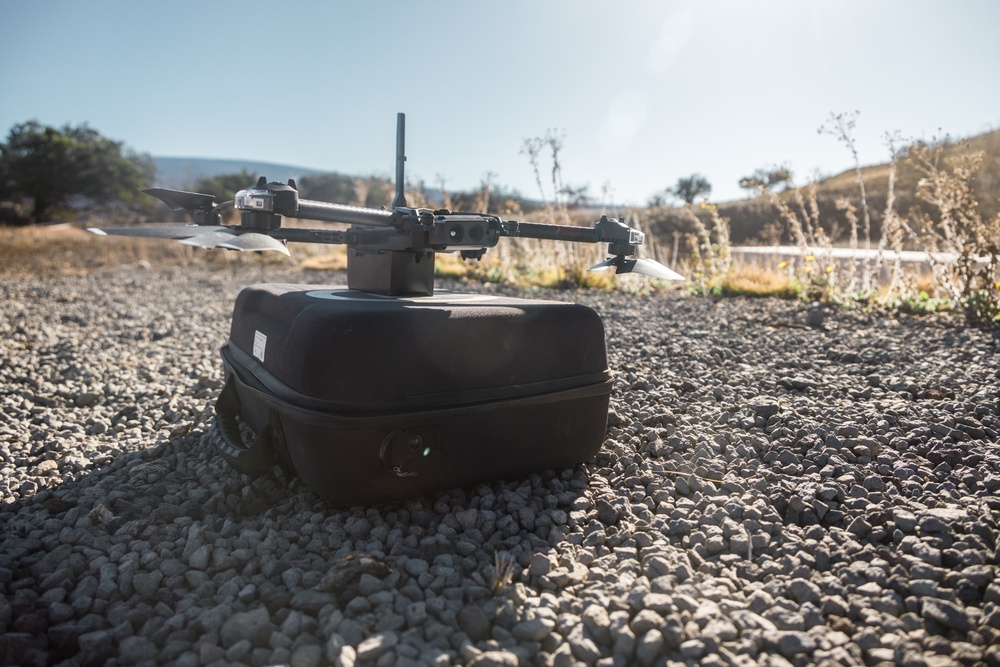
The current flagship, the X10 and X10D, packs a 48-megapixel telephoto lens, thermal imaging, NightSense autonomous night-flight capability, and a Blackout Mode engineered for denied or degraded RF environments. Skydio describes the X10D's design as having been "sharpened by hard lessons in Ukraine and close iterative feedback with soldiers." Following Russia's 2022 invasion, the company donated more than $300,000 in drones and training services to Ukrainian forces—field feedback from one of the most drone-saturated combat environments ever recorded fed directly back into the platform's development cycle.
Blue UAS: The Certification Architecture That Defined the Market
When Congress prohibited Chinese-manufactured drone procurement in 2020, the Pentagon needed a mechanism to certify that domestic alternatives actually met cybersecurity and supply-chain standards. The Blue sUAS program, launched in September 2020, became that mechanism—a months-long verification process before any platform earns clearance for military purchase. The program emerged from Section 848 and a vetting process that began as early as November 2018, evaluating thirty-four industry responses before clearing five companies: Skydio, Altavian, Parrot, Teal, and Vantage Robotics.
Skydio's X2D was its first cleared platform. On May 30, 2024, the X10D was added to the Blue UAS list, carrying with it Authority to Operate (ATO) status that streamlines procurement across defense agencies without requiring each customer to run an independent cybersecurity review. In February 2025, the Defense Innovation Unit announced thirty-seven additional systems pending final cybersecurity approval—including the Skydio X10D alongside the AeroVironment Dragon, Teledyne FLIR Black Hornet, Shield AI V-BAT, and Anduril Ghost—a snapshot of the competitive landscape as domestic sUAS production has matured.
"This represents an important step forward in providing secure, autonomous uncrewed aerial systems to more U.S. defense operations." — Mark Valentine, President of Global Government, Skydio
Blue UAS certification translates directly to contract flow. Beyond defense, the company serves 200-plus public safety agencies and sixty-plus energy utilities.
The financial trajectory reflects that demand. The company has raised approximately $562 million in total capital through its Series E, anchored by a $230 million round that closed in February 2023 at a $2.2 billion valuation. Linse Capital led the round; Andreessen Horowitz, NVIDIA, Next47, IVP, DoCoMo, UP.Partners, Hercules Capital, and Axon participated. Skydio assembles hardware in a 36,000-square-foot Hayward, California facility.
The China Sanctions Crisis
On October 10–11, 2024, China sanctioned Skydio in retaliation for drone sales to Taiwan's National Fire Agency—sales Beijing framed as part of U.S. military support for Taiwan. The sanctions hit a specific vulnerability: batteries, one of the few remaining components Skydio had not yet sourced outside China. Its primary Chinese battery supplier, which Skydio has not publicly named, ceased shipments. Ten Skydio executives were personally sanctioned, including CEO Adam Bry and Asia-Pacific General Manager Tom Moss.
Skydio rationed batteries to one per drone, extended software licenses and warranty terms for affected customers, and worked to qualify alternative suppliers it expected online by spring 2025. Bry was direct about what the episode exposed:
"This is a clarifying moment for the drone industry...the Chinese government will use supply chains as a weapon to advance their interests over ours."
He characterized the sanctions as an "attempt to eliminate the leading American drone company and deepen the world's dependence on Chinese drone suppliers." The episode compressed years of theoretical supply-chain risk into a single operational crisis—and made the argument for domestic sourcing in terms that procurement officials and congressional staff could not easily dismiss.
Why It Matters
Skydio's position in the U.S. defense and public-safety market is as much a product of congressional policy architecture as of engineering. Section 848 of the 2020 NDAA and the American Security Drone Act—embedded in the FY2024 NDAA—extended Chinese-drone procurement prohibitions not just to direct government buyers but to DoD contractors as well, significantly widening the addressable market for cleared domestic alternatives. DJI's 70-plus percent global market share means that any U.S. operator with data-security requirements effectively has a single credible domestic alternative at scale. That is currently Skydio.
The October 2024 sanctions episode sharpened the industrial argument. If a single Chinese government decision can sever a critical subsystem overnight, the supply-chain independence Skydio has spent years building—domestic assembly, U.S.-sourced components, American software stacks—becomes less a marketing claim and more a hard operational requirement that defense customers must factor into procurement decisions.
Whether Skydio sustains that position depends on execution: completing supply-chain hardening before battery rationing becomes a retention problem, maintaining its autonomy lead as competitors develop their own certified platforms, and converting its growing order book into delivered hardware at a tempo the Army and other defense customers will accept. The company's ten-year arc—from a lab conviction about cheap chips to a billion-dollar defense franchise—suggests it understands what compound technical advantage actually requires. The China sanctions demonstrated, with unusual clarity, what the cost of losing that advantage might look like for the broader U.S. defense industrial base.
Sources
- Skydio — About (company overview, mission, scale)
- Skydio Blog — China's Sanctions on Skydio (Oct 30, 2024)
- Skydio Blog — DoD Adds Skydio X10D to Blue UAS Cleared List (May 30, 2024)
- Skydio Blog — Skydio Raises $230 Million Series E (Feb 27, 2023)
- C4ISRNET — DoD Can Now Buy US-Manufactured Small Drones From These Five Companies (Aug 20, 2020)
- C4ISRNET — Pentagon Expands List of Commercial Drones Certified for Military Use (Feb 14, 2025)
- Contrary Research — Skydio Company Profile (May 2023)
- TechCrunch — US Drone Maker Skydio Faces Battery Squeeze After Chinese Sanctions (Oct 31, 2024)