
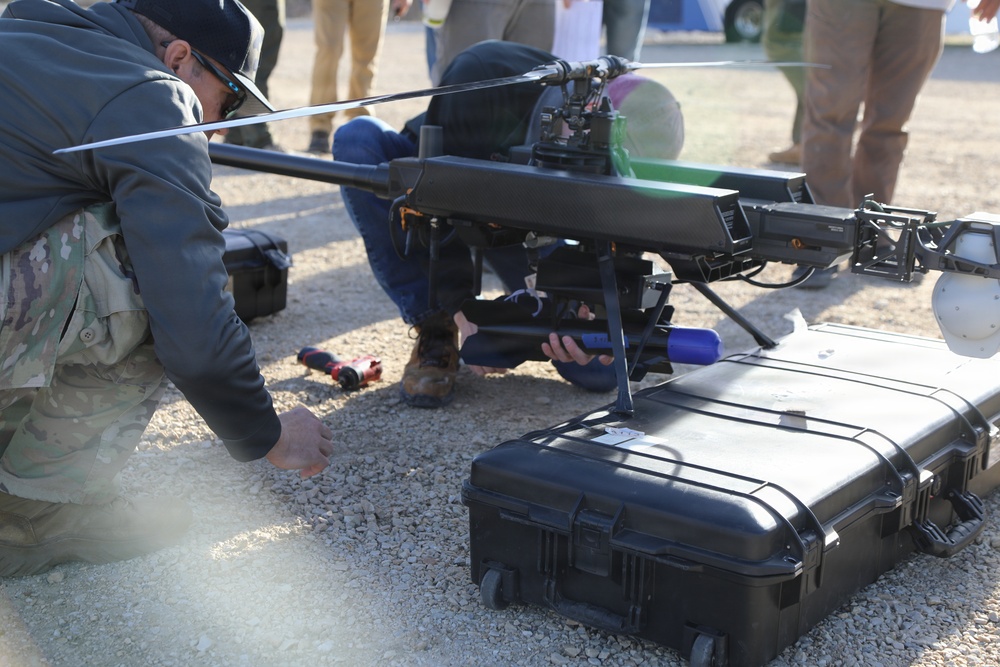
The Netherlands Ministry of Defence announced July 8 that it has selected the RQ-35 Heidrun, a hand-launched fixed-wing mini-UAS built by Danish manufacturer Sky-Watch A/S, to serve as its new company-level intelligence, surveillance, and reconnaissance platform. The award follows an open competition in which Sky-Watch beat out what Nordic Defence Sector described as "leading American and European suppliers" — a notable result for a relatively small Danish drone maker going up against the deeper-pocketed defense primes that typically dominate NATO procurement.
The contract was run through the Dutch Materiel and IT Command, known by its Dutch acronym COMMIT, which issued the original tender. Deliveries of the RQ-35 Heidrun systems are scheduled to take place throughout 2026, and the deal includes a seven-year technical support agreement covering system integration, operator and maintainer training, fielding support, and long-term sustainment.
What the Heidrun Brings to a Dutch Rifle Company
The RQ-35 Heidrun is a small, hand-launched fixed-wing UAS designed to give infantry units organic eyes over the next ridge or tree line without waiting on a battalion-level asset. According to specifications reported by Aeromorning, the aircraft has a takeoff weight of about 3 kg, a fuselage length on the order of 1.1 meters, and a wingspan of roughly 2.8 meters — dimensions that keep it man-portable and quick to deploy by a small ground team. Its sensor payload is an electro-optical/infrared (EO/IR) camera with what Aeromorning describes as "advanced zoom" capability, allowing operators to identify and track targets at range.
The system is built around an encrypted data link and an autonomous, mission-planning-based navigation suite, letting operators program routes and loiter patterns rather than fly the aircraft manually throughout a mission. That combination — small footprint, encrypted comms, and autonomous flight planning — is aimed squarely at the company-level ISR mission: giving a ground commander a persistent, organic reconnaissance capability that doesn't have to be requisitioned from higher up the chain.
Perhaps the most significant detail in the announcement is that the Heidrun is combat-proven in Ukraine, per Nordic Defence Sector. For a procurement office weighing bids from suppliers with polished specification sheets but no frontline record, a platform that has already logged operational hours in one of the most electronically contested battlefields in recent history carries obvious weight. Nordic Defence Sector also notes that the system is upgradeable via software rather than hardware replacement — a feature increasingly prized by militaries watching Ukraine's rapid, iterative drone-versus-counter-drone arms race, where capability gains often need to be pushed out in weeks, not procurement cycles.
An Open Competition, Not a Sole-Source Deal
What distinguishes this award from a routine allied arms sale is the competitive process behind it. COMMIT ran an open tender, and Sky-Watch's Heidrun won out over bids from established American and European suppliers — companies with far larger defense-industrial footprints than Sky-Watch's. Neither The Defense Post nor Nordic Defence Sector name the losing bidders, but the framing in both reports emphasizes that this was a genuine head-to-head contest decided on merit rather than a pre-arranged government-to-government sale.
The Defense Post's reporting frames the scope of the deal broadly: system integration, training, fielding support, and sustainment, layered on top of the 2026 delivery schedule and the seven-year technical support agreement. That length of commitment suggests the Dutch military is not treating this as a one-off equipment buy but as the start of a longer-term relationship with Sky-Watch as a sustainment partner — the kind of arrangement that typically only follows genuine confidence in both the platform and the vendor's ability to support it at scale.
Aeromorning also notes the deal is being framed within the context of NATO mission interoperability — a signal that the Netherlands expects the Heidrun to plug into alliance-wide ISR and command structures rather than operate as a standalone national system.
That interoperability requirement is not just marketing language. NATO members standardize how UAV control systems, data links, and ground stations exchange data across national platforms under STANAG 4586, the alliance's Standardization Agreement covering unmanned aircraft control-system interfaces, according to a NATO Science and Technology Organization technical paper on the standard. A mini-UAS built to plug into that architecture out of the box is easier for a member state to integrate into coalition ISR taskings than one that requires custom interface work down the line.
Why It Matters
This contract is a useful data point in a broader shift reshaping European mini-UAS procurement: battlefield performance in Ukraine is increasingly outweighing traditional vendor pedigree. Sky-Watch is not a legacy defense prime, and the Heidrun is not competing on the scale or price tag of a MQ-9 Reaper-class system — it's a small, cheap, hand-launched platform built for the company level, the tier of military organization that has arguably been transformed the most by the drone war in Ukraine. That a Danish manufacturer's combat-tested design beat out American and European competitors in an open Dutch tender suggests that buyers are now weighting real-world combat data and rapid software-upgrade paths more heavily than brand recognition or incumbency.
It also matters for NATO's broader interoperability push. As member states increasingly look to standardize or at least cross-certify ISR platforms for coalition operations, a win like this gives Sky-Watch a stronger case to pitch the Heidrun to other alliance members facing similar company-level ISR gaps — potentially accelerating a wider shift toward battle-tested, software-upgradeable mini-UAS across European militaries, rather than one-off national programs built around domestic industrial preferences.
Sources
- Netherlands Adopts Danish Drone for Tactical ISR Missions — The Defense Post
- Netherlands selects Danish ISR drone — Nordic Defence Sector
- Sky-Watch RQ-35 Heidrun wins Dutch Ministry of Defence bid — Aeromorning
- STANAG 4586 – Standard Interfaces of UAV Control System (UCS) for NATO UAV Interoperability — NATO Science and Technology Organization