
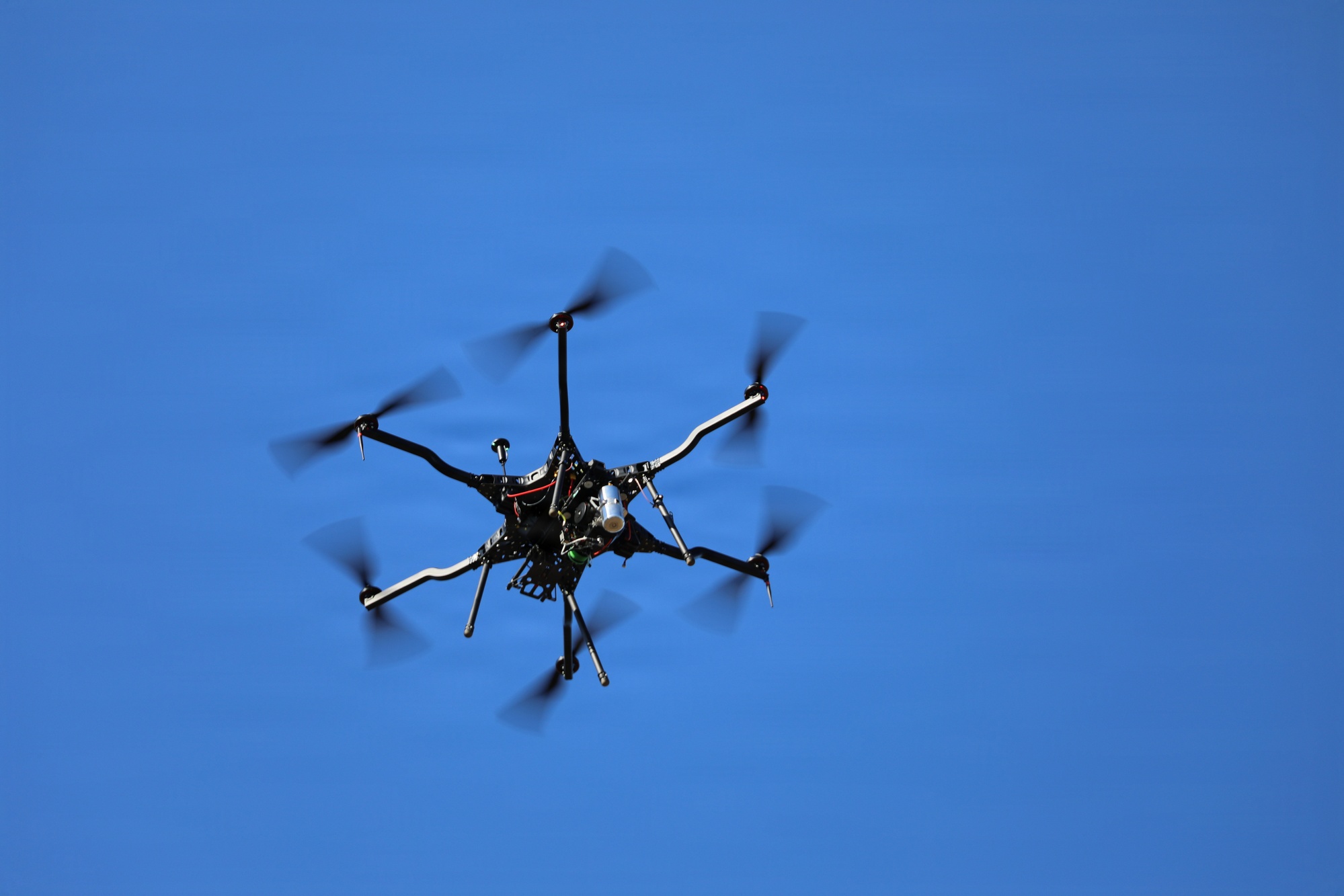
The U.S. Sentencing Commission has formally adopted a new federal sentencing guideline that will add years to prison terms for defendants who use unmanned aircraft while committing crimes. The amendment, published in the Federal Register on Sept. 18, creates a new guideline section, Sec. 3B1.6 ("Use of Unmanned Aircraft"), and directs judges to increase offense levels by either 4 or 6 points depending on how the drone was used in the underlying offense.
The change is not the Commission acting on its own initiative. It is the direct result of a congressional directive written into the SAFER SKIES Act, enacted as Section 8605 of the fiscal year 2026 National Defense Authorization Act (Pub. L. 119-60). Congress told the Commission to write a guideline implementing the drone-specific penalty scheme it had already created in the U.S. Code, and to do so on an accelerated timeline: a separate provision, Section 5017(a) of Pub. L. 119-75, set a Dec. 31, 2026 deadline for an emergency amendment. The guideline adopted this month satisfies that mandate, with a formal effective date of March 15, 2027.
What the Guideline Actually Does
Sec. 3B1.6 is an enhancement, not a standalone crime — it modifies the sentencing calculation for an existing federal offense once a court determines a drone was involved. The Federal Register notice (document 2026-19192, 91 FR 59298) lays out a two-tier structure:
- 6-level increase when the offense triggers the enhancement already written into 6 U.S.C. 124n-1(c) — that is, when the defendant knowingly operated an unmanned aircraft during, in relation to, or in furtherance of, a felony offense (other than an offense based solely on operating the aircraft itself).
- 4-level increase for other offenses in which a drone was used but the statutory Section 124n-1(c) trigger does not apply.
The guideline borrows its definition of "unmanned aircraft" directly from existing aviation law, 49 U.S.C. 44801, rather than writing a new one. It also draws a specific line on what counts as "use": mere possession of a drone during a crime does not trigger the enhancement. A court has to find that the aircraft was actually operated in connection with the offense.
In practice, that distinction matters. A defendant who happens to have a drone in a vehicle during a drug bust is in a different legal position than one who flew the aircraft to conduct surveillance on a target, scout a border crossing point, or ferry contraband. The guideline is built to capture the latter category of conduct, not the former.
The Statute Behind the Guideline
The sentencing guideline sits on top of a statute, 6 U.S.C. 124n-1, that took effect just eight months earlier. According to Cornell Law School's Legal Information Institute, the statute's provisions became operative 30 days after Dec. 18, 2025, and cover several distinct drone-related penalties:
- Section (c) — the felony-enhancement provision that the new guideline is built around — doubles the statutory maximum sentence for a felony (other than one based solely on operating the aircraft itself) committed while knowingly operating a drone during, in relation to, or in furtherance of the offense, or adds five years to the maximum, whichever produces the smaller increase.
- Section (d) targets a narrower and specific abuse: using a drone to deliver contraband to a federal inmate, an offense already criminalized under 18 U.S.C. 1791. Where a drone is the delivery method, the statute adds a five-year maximum on top of the underlying contraband charge.
- Section (f) addresses the other side of the drone-crime equation — improper counter-drone activity. An entity or individual already authorized to mitigate a drone threat under 6 U.S.C. 124n who acts without the federal coordination the statute requires faces a civil fine of up to $100,000 per violation, or suspension of its counter-UAS authority pending review by the Attorney General or the Secretary of Homeland Security.
The sentencing guideline formally adopted this month operationalizes only the Section (c) felony enhancement and the broader concept of drone "use" in an offense — it is the sentencing-guideline mechanism for translating that statutory doubling provision, and the catch-all 4-level increase for other drone-involved crimes, into the offense-level math that federal judges actually apply at sentencing.
How This Fits Together Procedurally
For readers unfamiliar with how federal sentencing works: Congress sets statutory maximum and minimum sentences by law, but within that range, federal judges calculate an actual sentence using the U.S. Sentencing Guidelines, a point-based system maintained by the Sentencing Commission. Each offense starts at a base offense level, and various "enhancements" and "reductions" adjust that level up or down before it is converted into a sentencing range via a guidelines table. Sec. 3B1.6 is one of those enhancements — a specific-offense characteristic that applies on top of whatever base offense level a crime already carries.
The Commission's own amendments page confirms the guideline's adoption and effective date, and provides the underlying proposed-amendment documents and a reader-friendly summary of the change for practitioners. The guideline goes into effect March 15, 2027, giving courts, prosecutors, and defense counsel roughly six months from adoption to prepare for its application in active cases.
Why It Matters
The rapid pairing of a new criminal statute (effective January 2026) with a Sentencing Commission guideline implementing it within the same calendar year reflects how quickly drones have moved from a niche enforcement concern to a defined category in federal criminal law. Drones have increasingly shown up as tools in specific criminal conduct — smuggling contraband over prison walls and international borders, conducting unauthorized surveillance, and supporting other felony activity — and Congress responded by writing drone use into the penalty structure itself rather than leaving it to prosecutorial discretion or ad hoc sentencing arguments.
For the UAS industry, the guideline is a reminder that regulatory attention to drones isn't confined to airspace rules and FAA registration — it now extends into the federal criminal code and the sentencing math that follows a conviction. For defense attorneys and prosecutors, Sec. 3B1.6 adds a concrete, quantified stake to any case where a drone shows up in the fact pattern, and the "use versus possession" distinction the guideline draws will likely become a central point of dispute in early cases once the enhancement takes effect in March 2027. The compressed timeline — statute effective in January 2026, guideline adopted in September 2026, application beginning March 2027 — also signals that Congress intends drone-related sentencing enhancements to be treated as a priority, not an afterthought, within federal criminal law.
