
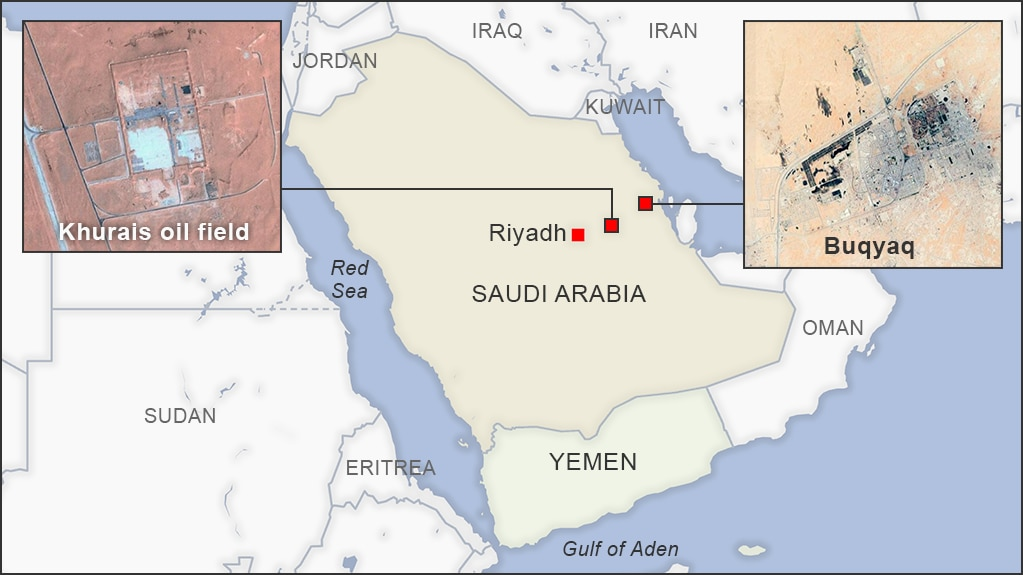
At approximately 4:00 a.m. on Saturday, September 14, 2019, a coordinated salvo of 18 one-way attack UAVs and 7 land-attack cruise missiles converged on two oil processing complexes in eastern Saudi Arabia. The strike lasted minutes. The consequences lasted months in financial markets and years in strategic doctrine.
When the smoke cleared over Abqaiq, 5.7 million barrels per day of Saudi crude output had vanished — more than half the kingdom's total production, and approximately 5 percent of all global crude supply, gone simultaneously. CSIS would later characterize it as "the single largest daily oil supply disruption in history." No interceptors fired. No F-15 sorties scrambled in time. Nothing made it to the weapons.
The World's Most Critical Chokepoint
Saudi Aramco's Abqaiq complex in the Eastern Province is not merely a large oil installation. It is arguably the single most consequential piece of energy infrastructure on Earth. Rated at 7 million barrels per day of stabilization and processing capacity, Abqaiq handles crude from Ghawar and other major Saudi fields before it moves to export terminals. That 7 million b/d throughput represents approximately 7 percent of total global crude production capacity — concentrated in one facility, sitting in open desert. Saudi Arabia's August 2019 production had been approximately 9.9 million b/d, with exports of 6.7–6.9 million b/d; Abqaiq was the artery through which nearly all of it flowed.
The secondary target that morning was the Khurais oil field processing complex, roughly 200 kilometers to the southwest. Khurais normally operated at 1.2 million barrels per day; it was shuttered entirely for approximately 24 hours. Fire damaged at least two stabilization towers at the site.
At Abqaiq, the strike pattern showed deliberate targeting of the facility's functional core. Eighteen individual impact sites were recorded: at least 5 on crude-stabilization towers, and 11 on the infrastructure responsible for separating gaseous hydrocarbons from the crude stream — the upstream bottleneck that the entire throughput chain depends on. By September 17, Abqaiq's processing capacity had fallen from its rated 7.0 million b/d to just 2.0 million b/d, a collapse of more than 70 percent.
Eighteen Weapons, Zero Intercepts
The weapon package was notable for its composition and, critically, its approach vector. The 18 attack UAVs were a delta-wing design not previously documented in any Houthi inventory. The 7 land-attack cruise missiles were likewise a type new to the conflict's known arsenal. Both weapon categories flew inbound from the north or northwest — not from the south, which is the direction of Houthi-controlled Yemen. That directional fact would dominate the attribution dispute that followed.
Saudi Arabia had made substantial investments in US-supplied air defenses, including Patriot PAC-2 surface-to-air missile batteries and F-15 fighter aircraft. Not one of the attacking weapons was intercepted. The failure here was not a system malfunction — it was an architectural mismatch. Patriot is optimized for high-altitude ballistic missile threats, designed around steep inbound descent trajectories. Low-flying cruise missiles and terrain-following UAVs operate well below that engagement envelope, exploiting a coverage gap baked into the system's original design priorities. The attacks came in under the radar, literally.
Cost asymmetry made the failure more acute. Attack drones in the strike package cost a fraction of a single interceptor missile, yet were deployed against a facility complex worth many billions of dollars. Eighteen of them, combined with seven cruise missiles, had just triggered the largest single-day supply disruption in the history of the oil market. The arithmetic of cheap offensive UAS employment against premium integrated air defense is not favorable to the defender at scale, and Abqaiq made that arithmetic undeniable.
Who Did It — Three Accounts, One Unresolved Record
The Houthis claimed the operation immediately. Military spokesman Yahya Saree announced on September 14 that the group had executed the strikes, threatening: "We promise the Saudi regime that our upcoming operations will expand and will be more painful, as long as the Saudi regime continues its aggression and blockade against Yemen." The Houthis had conducted sustained drone and missile attacks on Saudi territory throughout the Yemen conflict. Taking credit publicly was consistent with their operational pattern and strategic communication goals.
US and Saudi officials rejected that framing from the outset, pointing to the northern approach vectors as inconsistent with a Yemeni launch. Secretary of State Mike Pompeo wrote on Twitter the same day:
"Tehran is behind nearly 100 attacks on Saudi Arabia while Rouhani and Zarif pretend to engage in diplomacy. Amid all the calls for de-escalation, Iran has now launched an unprecedented attack on the world's energy supply. There is no evidence the attacks came from Yemen." — Mike Pompeo, US Secretary of State, September 14, 2019
A senior unnamed US official was more direct: "It was Iran. Houthis are claiming credit for something they did not do." Iran denied any involvement.
The most analytically detailed assessment came from the UN Panel of Experts on Yemen, in its April 2020 report (S/2020/326) submitted to the Security Council. The Panel concluded that Houthi forces were unlikely to have been responsible on two grounds: the weapons used did not have sufficient range to have been launched from Houthi-controlled territory, and the approach angles at both sites — from the north or northwest at Abqaiq, from the north or northeast at Khurais — were geometrically incompatible with a southerly origin in Yemen. The Panel noted the delta-design UAVs and the specific cruise missile variant were types not previously documented in Houthi inventory, bearing technical characteristics similar to Iranian-manufactured arms. Critically, the Panel stated it could not independently corroborate that the weapons were of Iranian origin.
Multiple news organizations reported in late 2019 that Iranian officials had allegedly planned the Abqaiq strike months in advance as a calculated response to US withdrawal from the JCPOA and reimposed sanctions — designed to maximize economic damage while avoiding mass casualties. Iran denied those reports. Senator Chris Murphy (D-CT) criticized what he called "irresponsible simplification" in blanket attribution to Iran, arguing the framing ignored the complex dynamics of the Saudi-Houthi conflict. The formal evidentiary record, as of the UN Panel's 2020 report, remains unresolved on the question of who gave the operational order and from where the weapons were actually launched.
The Market Shock
Oil markets don't take weekends. Brent crude futures opened at $71.57 per barrel on the evening of Sunday, September 15 — the first trading session after the Saturday attack — an intraday surge of approximately 19 percent from Friday's close of $60.22, before settling at $69.02 (a roughly 14.6 percent settlement gain). WTI crude moved from $54.80 to $62.67 per barrel (approximately 14 percent) when US markets opened September 16. Intraday price volatility reached 10.4 percent of closing prices — roughly triple the typical range — within hours of opening.
The Congressional Research Service characterized the September 16 move as "the largest single-day price increase for both price benchmarks over the last decade." EIA analysis of intraday data placed it as the largest daily percentage change in 29 years of historical records. For a brief window, a single coordinated drone strike had moved global energy markets more dramatically than any event in nearly three decades.
Saudi Aramco's recovery was faster than early damage assessments suggested. Approximately 50 percent of production — around 2.8 million b/d — was restored by Tuesday, September 17. Saudi officials projected full restoration to 11 million b/d by end of September and 12 million b/d by November — targets the company subsequently said it had met. The speed of recovery limited sustained disruption to global supply chains. It did not limit the strategic implications of what had just been demonstrated.
Why It Matters
The Abqaiq-Khurais strike is the most empirically documented case study available on asymmetric UAS employment against critical energy infrastructure. What it demonstrated was not speculative: cheap, commercially-derived attack drone technology combined with cruise missiles can achieve strategic effects — market disruption, supply shocks, precision infrastructure damage — that previously required state air forces, ballistic missile programs, or nuclear deterrence to threaten.
For air defense architects, the event exposed that legacy systems optimized for the high-altitude ballistic threat envelope leave a significant gap against low-flying, mass-employment platforms. Patriot intercepted nothing. The attack accelerated serious interest in layered lower-tier air defense, counter-UAS integration at the point-defense level, and the broader recognition that single-system air defense coverage cannot address the full spectrum of modern aerial threats. In the weeks following the strike, the US announced additional military deployments to Saudi Arabia, accelerated equipment deliveries to Gulf partners, and imposed new sanctions on Iran.
For energy security planners, the strike illustrated the fragility inherent in highly concentrated critical infrastructure. Abqaiq's 7 million b/d throughput in a single complex means a partially successful attack against one facility can produce global supply effects within hours. The attack also raised immediate questions about the viability of Saudi Aramco's planned IPO and imposed fiscal pressure on the kingdom's budget — effects rippling well beyond the physical damage at the plant.
The cost-exchange problem exposed that morning has not been solved. If a single low-cost attack drone can contribute to a roughly 15 percent single-day oil price settlement gain and a 29-year record in daily price volatility, the economics of defending mass UAS employment with current interceptor inventories are structurally unfavorable. Abqaiq in September 2019 was not a proof of concept — it was a proof of deployment, at scale, against a hardened target, with no effective response. That is the record that subsequent C-UAS investment has been racing to rewrite.
Sources
- U.S. Energy Information Administration — Attacks on Saudi Arabia disrupt 5.7 million barrels per day of crude oil production (Sept. 17, 2019)
- U.S. Energy Information Administration — Saudi Arabia oil market update: largest daily crude price change in 29 years (Sept. 19, 2019)
- Congressional Research Service — Attacks on Saudi Oil Infrastructure (IN11173, Sept. 2019)
- CSIS — Attack on Saudi Oil Infrastructure: We May Have Dodged a Bullet, at Least for Now (Sept. 17, 2019)
- ABC News — Pompeo blames Iran for major attack on Saudi oil facility (Sept. 14, 2019)
- UW-Madison Space Science & Engineering Center — JPSS/VIIRS satellite observations of drone strikes on Saudi Arabia (Sept. 16, 2019)
- UN Security Council — Panel of Experts on Yemen, Final Report S/2020/326 (April 28, 2020)
