
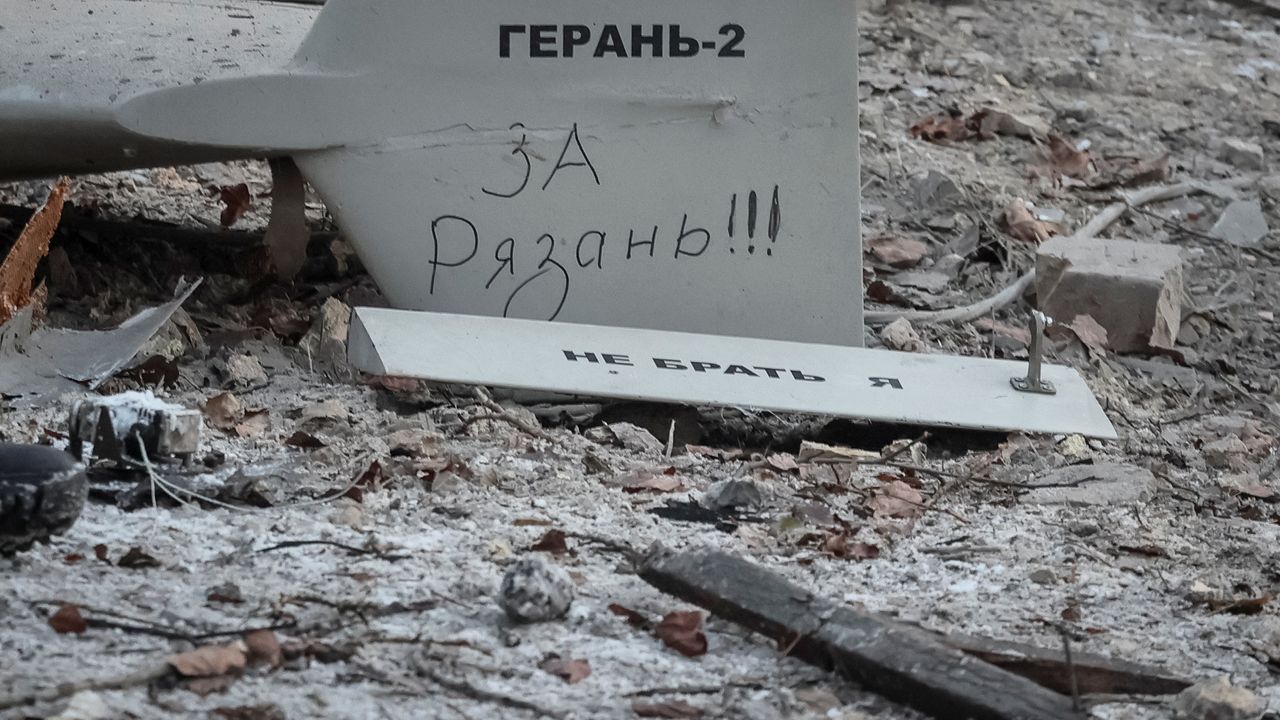
On September 7, 2025, Russian forces launched 823 air vehicles at Ukraine — 810 of them Shahed-type drones — in the largest single aerial assault recorded in 2025. The number is striking not just for its scale but for what it represents: three years of continuous tactical refinement that transformed a crude attrition weapon into a multi-layered air-assault system optimized to exhaust defenses rather than evade them.
By late 2025, monthly launch totals reached approximately 5,300–5,450 Shahed-type UAVs, based on ISIS Reports tracking for October–November 2025. Across the full year, 54,538 were deployed against Ukrainian territory, including approximately 32,200 strike variants. These are not the numbers of a campaign groping for effect; they are the numbers of a campaign that has found its operational logic and is scaling it deliberately.
The Cost-Kill Calculus
Russian doctrine tolerates losing more than 75 percent of drones per salvo. That figure — often cited by critics as evidence of inefficiency — is in fact the mechanism. The underlying cost-kill math is deliberately asymmetric. A single Shahed runs $20,000–$50,000 in Iran-sourced form. The interceptor missiles used to defeat them cost multiples of that per round. At scale, Russia spends far less on each offensive sortie than Ukraine spends to stop it, while simultaneously depleting interceptor stocks that take years and substantial allied support to replenish.
This is not a precision campaign. It is a capacity-degradation campaign — designed to exhaust Ukrainian air-defense reserves through sustained volume. The operational tempo reflects the doctrine: across a seven-month tracking period, fewer than three consecutive uninterrupted days passed without a Shahed launch. Approximately 75 percent of all launches occurred on consecutive days, maintaining a rhythm that forces Ukraine to keep layered defenses fully manned and expendables loaded around the clock.
The industrial infrastructure sustaining that tempo has proved durable. Russia's Alabuga facility in Tatarstan serves as the primary final-assembly site for domestically produced Geran-2 variants, providing the industrial throughput to sustain and expand the campaign's operational tempo.
Swarm Architecture and the Gerbera Deception
A mass Shahed attack is not a single stream of drones on one heading. Documented attacks involve simultaneous launches from up to seven geographic directions, originating from a distributed network of sites: Primorsko-Akhtarsk in Krasnodar Krai (312 launches in one tracked period), Kursk Oblast (248), Chauda Airfield in Crimea (160), Oryol Oblast (130), Bryansk Oblast (113), and Millerovo in Rostov Oblast (100), among others. Multi-directional geometry forces Ukrainian air-defense assets to manage simultaneous threats across their entire airspace, preventing the sector concentration that makes layered defenses most effective.
A mid-2025 tactical innovation compounded the management problem: "Wolfpack" grouping formations that coordinate individual tracks as a unified tactical unit. Where earlier swarms presented parallel independent tracks that defenses could address serially, Wolfpack tactics require accounting for emergent group behavior — the possibility that individual drones in a cluster are cued off each other's engagement status.
The deeper structural innovation, however, is the Gerbera decoy. Built from plywood and painted foam, assembled at Alabuga using airframes from Chinese manufacturer Skywalker Technology, and costing approximately $10,000 per unit — a fraction of a strike Shahed's cost — Gerbera exists to deceive rather than destroy. Up to 50 are assembled daily. The drone is engineered to mimic both the visual and radar signature of the Shahed-136, carrying Luneberg lens arrays that actively inflate its radar return to the apparent size of a cruise missile.
"They are equipped with so-called Luneberg lenses, which increase their radar signature to appear larger, mimicking the appearance of cruise missiles or other aerial threats." — Serhii Kuzan, chairman of the Ukrainian Security and Cooperation Center
Roy Gardiner, an open-source weapons researcher, described the mechanism directly: "Gerbera is smaller and cheaper, but has radar reflecting devices installed to mimic the Shahed to distract and saturate Ukrainian air defenses." BattlePolicy's analysis characterized the operational function as "deliberately inflating the apparent size of strike packages and drawing protective fire away from the true weaponised Gerans."
Gerbera first appeared over Kyiv in late July 2024. Subsequent production runs added cameras, mesh-network modems, fuel bladders, and advanced anti-jam antenna arrays — converting what began as a passive decoy into an active battlefield sensor node. By mid-2025, decoys constituted a significant and growing fraction of incoming salvos. The operational consequence is that Ukrainian air defenses must engage the entire incoming package: they cannot reliably distinguish armed Gerans from unarmed decoys in real time, which amplifies interceptor expenditure per confirmed strike drone destroyed.
The decoy layer integrates with a broader multi-weapon architecture. Mass Shahed strikes are routinely combined in the same package with ballistic missiles, cruise missiles, and aeroballistic weapons. Shaheds serve a dual function in these combined strikes: direct target destruction, and deliberate saturation of point and area defenses to create engagement windows for the higher-value missiles following behind. Lancet loitering munitions have been deployed ahead of Shahed swarms specifically to suppress Ukrainian mobile fire groups before the main wave arrives.
Flight Profile and the Countermeasure Arms Race
The baseline Shahed-136 is not stealthy in the technical sense. Its radar cross-section of approximately 0.01–0.05 m² (X-band) is minimized through a honeycomb radar-absorbent internal structure and a dark carbon-loaded exterior coating, but its piston engine running at 180–185 km/h initially made acoustic detection viable at medium range.
More recent attack profiles have shifted some trajectories higher, compressing the terminal intercept window and, critically, taking threats above the effective engagement ceiling of Ukrainian mobile fire groups, which operate reliably only below 2 km. Navigation remains pre-programmed GPS waypoint routing.
But the electronic architecture is maturing. Newer production incorporates the Kometa-M and Controlled Reception Pattern Antennas (CRPA) that significantly harden the navigation link against jamming. A cell-tower relay network — including infrastructure in Belarus — enables real-time bidirectional data links between select drones and Russian command centers. Most significantly, fiber-optic spool drones have been deployed alongside Shaheds in strike packages; because guidance runs on a physical cable rather than radio frequency, these are completely immune to electronic warfare jamming regardless of output power.
Ukraine's counter-Shahed architecture has grown into a layered stack. At the detection level, an acoustic sensor network feeds into the DELTA common operating picture for real-time multi-track correlation. The electronic warfare layer involves more than 140 Ukrainian companies producing dedicated EW systems; the Bukovel-AD platform detects drone signatures at ranges up to 100 km and can jam within a 20 km radius. EW remains effective at disrupting targeting and forcing missed waypoints, but is inherently limited against pre-programmed routes and large swarms where jamming one drone does not degrade the rest.
Kinetic intercept runs through several tiers. Mobile fire groups — approximately 1,000 crews equipped with ZU-23-2 autocannon, Igla and Stinger MANPADS, and thermal imagers — once accounted for 80 percent of successful intercepts; as attack profiles shifted to higher altitudes, that contribution fell to roughly 40 percent. Dedicated counter-drone interceptors, operational since March 2025, cost $5,000–$10,000 each and achieve a 70 percent effectiveness rate per engagement — a figure cited publicly by Commander-in-Chief Oleksandr Syrskyi. Ukraine planned production of hundreds of thousands of these in 2025. The aggregate interception rate since March 2024 has averaged 91 percent, up from a prior six-month average of 80 percent. Also in use: ZU-23-2 and Gepard guns, APKWS laser-guided rockets, and NASAMS and IRIS-T systems held in reserve for the highest-value penetrators.
The 91 percent figure requires context. At 800 incoming drones, a 9 percent leakage rate means roughly 72 impacts — per night.
Why It Matters
Ukrainian intelligence chief Kyrylo Budanov stated that Russia "is incapable of launching 450–500 drones daily, although it can do so on occasion" — an assessment that acknowledges a real production ceiling while confirming that ceiling sits comfortably above what Ukrainian defenses can absorb on a sustained basis. By end of 2025, the cumulative weight of the campaign had significantly depleted Ukrainian air-defense capabilities, even as interception rates climbed.
The Shahed campaign constitutes the largest-scale live test of mass drone saturation doctrine against a motivated, technologically sophisticated, and extensively supplied defender that has ever been conducted. The findings carry direct implications for any military developing counter-UAS architecture: a 91 percent interception rate at scale still means sustained ground impact; a growing decoy fraction can double or triple interceptor expenditure per strike drone destroyed; multi-directional swarms integrated with ballistic and cruise missiles impose simultaneous coordination demands that no single air-defense system is built to manage alone; and emerging fiber-optic guidance variants close the radio-frequency jamming gap entirely.
What began as Iranian technology transferred under geopolitical pressure has matured into a systematic doctrine built around production-line economics, deception at scale, and the deliberate exploitation of the interceptor cost curve. The central operational question — whether any nation's industrial capacity can produce counter-drone interceptors fast enough to outpace an adversary explicitly optimizing for cost-per-intercept exhaustion — remains, heading into 2026, unresolved.
Sources
- CSIS — Drone Saturation: Russia's Shahed Campaign
- C4ISRNET — Russia's Shahed-type drones are losing their bite in Ukraine
- CEPA — The Phony War: Ukraine and Russia's Decoy Drones
- ISIS Reports — A Comprehensive Analytical Review of Russian Shahed-type UAVs Deployment Against Ukraine in 2025
- BattlePolicy — Gerbera Decoy Drone Analysis
- Ukraine's Arms Monitor — Stopping Shaheds: Ukraine's Solutions
- drone-warfare.com — Shahed-136 Research
