
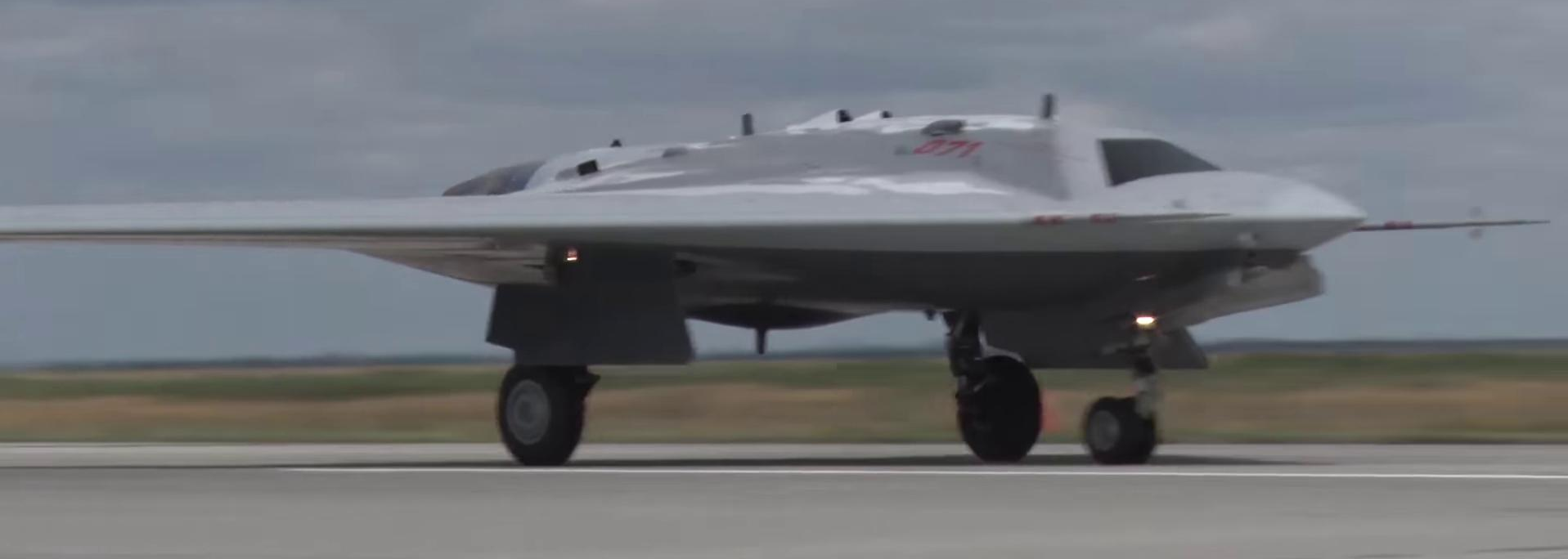
On October 5, 2024, what video evidence and open-source analysis indicate was likely a Su-57 Felon — Russia's fifth-generation fighter — fired a short-range air-to-air missile at a drone flying over Donetsk Oblast. The drone it destroyed was Russia's own S-70 Okhotnik-B ("Hunter-B"), the most advanced UCAV Moscow has ever developed. The wreckage came down approximately 10 miles behind Ukrainian lines near Kostyantynivka, and within hours overhead video had captured two contrails and a missile streak that made the incident unmistakable.
Russia's MoD-aligned sources quickly moved to manage the narrative: the Okhotnik "had malfunctioned during a test and evaluation flight" and was deliberately neutralized for safety reasons. The wreckage told a different story. It carried a live weapon.
A Flying Wing Built for Low Observability
The Okhotnik-B began development in the early 2010s as a project led by the Sukhoi design bureau, with an unambiguous goal: produce a heavy, jet-powered stealth UCAV capable of penetrating contested airspace. The resulting airframe is a tailless flying wing — the configuration that defines the B-2 Spirit and the X-47B — sized roughly comparable to a MiG-29. At approximately 14 meters in length with a wingspan of 19–20 meters and a maximum takeoff weight in the 23–25 tonne range, the Okhotnik is not a tactical surveillance drone. It is a heavy combat platform with a payload capacity of 2 to 3 tonnes of guided and unguided munitions.
The low-observability architecture is comprehensive. Weapons are carried in internal bays rather than on external pylons, eliminating the radar returns that stub-mounted stores generate on conventional strike aircraft. The composite airframe is coated in radar-absorbent material. There are no vertical tail surfaces to generate angle-dependent corner reflectors. Unlike every other Russian combat aircraft type currently in service, NATO has not assigned the Okhotnik a reporting name — an unusual omission suggesting intelligence agencies remain uncertain enough about the type's status and quantities to justify the formality.
Conceptually, the S-70 is designed to fight as an extension of a manned pilot rather than as an autonomous platform. Russia's framing is the "sensor-amplifier" role: the drone flies ahead of a Su-57, pushing sensor data — radar returns, targeting cues — back to the pilot operating behind it. The architecture maps directly onto what U.S. planners call manned-unmanned teaming (MUM-T), the same concept behind the U.S. Collaborative Combat Aircraft program. The degree of actual autonomy embedded in the Okhotnik versus hardcoded data-link dependency remains publicly unresolved.
The Engine Question Russia Has Not Answered
Propulsion is where the gap between program rhetoric and prototype reality is sharpest. All existing Okhotnik airframes — approximately four as of the October 2024 shootdown — are powered by the AL-31F turbofan, the same engine family used in the Su-27 Flanker. That engine is mature and serviceable and decidedly not stealthy: its round, visible nozzle is a significant infrared source and radar reflector that substantially undermines the flying-wing configuration's signature reduction.
Developers originally pledged to equip production-model Okhotniks with an upgraded AL-41F engine designed for fifth-generation fighters. Production models are expected to feature a Saturn-developed turbofan with a flat nozzle design intended to reduce both infrared signature and radar cross-section compared to the AL-31F's conventional round exhaust. Whether that timeline is achievable — given sustained sanctions pressure on Russian aerospace supply chains — is an open question underscored by the foreign components found in the recovered wreckage.
At the upper end of propulsion ambition sits the Izdeliye-30, the new-generation turbofan designed for the Su-57M that produces approximately 19,000 kgf thrust versus 15,000 kgf for the AL-41F1 predecessor, and which first flew on a Su-57 in December 2017. It has been discussed as a potential eventual powerplant for the Okhotnik but has not been confirmed for the program. Each step up the propulsion ladder represents a production dependency on Russian industrial capacity that is already stretched across the Su-57 program itself — the Okhotnik and the Felon compete for the same engine technology roadmap.
Donetsk and What the Wreckage Exposed
The Okhotnik's maiden flight took place in August 2019 and lasted approximately 20 minutes. In late September 2019, it completed its first joint flight with a Su-57, briefly validating the MUM-T concept in the air. The test program ran through 2019–2023 with limited sorties — not surprising for a first-of-type advanced UCAV program operating under sustained economic and supply-chain pressure.
Then came October 5, 2024. Overhead video captured what appeared to be a Su-57 Felon firing a short-range air-to-air missile that downed an Okhotnik near Kostyantynivka — the same aircraft type the S-70 was designed to team with. The reaction from Russian milbloggers was immediate and unguarded.
"That is, we could have f'ed up not only the Okhotnik, but also the Su-57 escort." — FighterBomber Telegram Channel, prominent pro-Russian military blogger
The outer wing sections recovered were largely intact. The engine was mostly in one piece despite crush damage. Getty Images photographed the nose section of a single partially destroyed glide bomb in the crash debris — specifically an UMPB D-30SN precision-guided glide bomb, a weapon with inertial and satellite navigation analogous to the U.S. GBU-39 Small Diameter Bomb. A former senior U.S. Air Force official pushed back on the MUM-T framing entirely, characterizing the S-70 not as an escort but as "a UCAV that lost control" — but the presence of a live armed munition onboard all but ruled out the Russian MoD's "test flight" characterization regardless of how the malfunction occurred.
Unconfirmed reports suggest Russia may have subsequently fired an Iskander-M ballistic missile at the crash site in an attempt to destroy the recovered hardware. It was too late. Ukrainian and NATO forces had already received the wreckage for technical exploitation. Analysis of recovered components in late 2024 revealed residual Western-origin components — evidence that Russian indigenization of aerospace supply chains, a stated priority since 2014, remains incomplete a decade on. A former Pentagon official, cited by Air & Space Forces Magazine, was direct about the intelligence value: the wreckage could provide "tremendous insight" into Russian drone technology capabilities.
The production picture emerging from open-source and recovered evidence is sobering. Serial production was assigned to the Novosibirsk Aviation Plant, a Rostec/Sukhoi subsidiary. Timelines have slipped three times — from 2023 to 2024 to 2025. In January 2024, Novosibirsk Vice-Governor Sergei Semka indicated that mass production of the Okhotnik could begin in the second half of 2024. Russia's publicly available plan as of the shootdown called for only three experimental prototypes and three associated control stations by 2025 — a far more modest scope than the program's promotional framing suggested. A refined second-generation Okhotnik variant featuring a stealthier engine exhaust has been unveiled but not yet confirmed in production. Total development cost is reported at approximately $18 million (1.6 billion rubles) — modest by Western advanced-UCAV standards, and reflective of both the program's ambition and the fiscal constraints under which it has operated.
Why It Matters
The S-70 Okhotnik represents the most credible Russian attempt to field a heavy stealth UCAV capable of operating in contested airspace alongside fifth-generation fighters — a category where the United States has invested heavily and China has accelerated development with the GJ-11 Sharp Sword. The October 2024 shootdown simultaneously confirmed that Russia has actually deployed the type in an operational role and handed NATO a technical intelligence windfall that will inform Western understanding of Russian stealth materials and manufacturing quality for years. That the program has missed three production deadlines and relied on foreign components through at least late 2024 illustrates the persistent gap between Russia's UCAV rhetoric and fielded capability — but the Okhotnik's existence, and its loss, proves that gap is narrowing.
Sources
- Janes — Ukraine conflict shootdown reveals Russian stealth drone operating over Ukraine
- The War Zone — Russia's S-70 Hunter Drone Was Armed When Shot Down by Friendly Fighter Over Ukraine
- Air & Space Forces Magazine — Why Russia Shot Down the S-70 Drone Over Ukraine
- The Aviationist — S-70 UCAV Shot Down Over Ukraine
- Army Recognition — S-70 Okhotnik-B Hunter UCAV (specs/overview)
- Army Recognition — Russian Sukhoi S-70 Okhotnik Ready for Mass Production as Soon as 2025
- Defence Express (Ukraine) — Russia Announces Arrival of Serial S-70 Okhotnik Heavy Jet-Powered Drones in 2024
- Frontliner.ua — The Downed S-70 Okhotnik-B: Debunking Developers' Claims
- GlobalSecurity.org — Izdeliye-30 engine reference
