
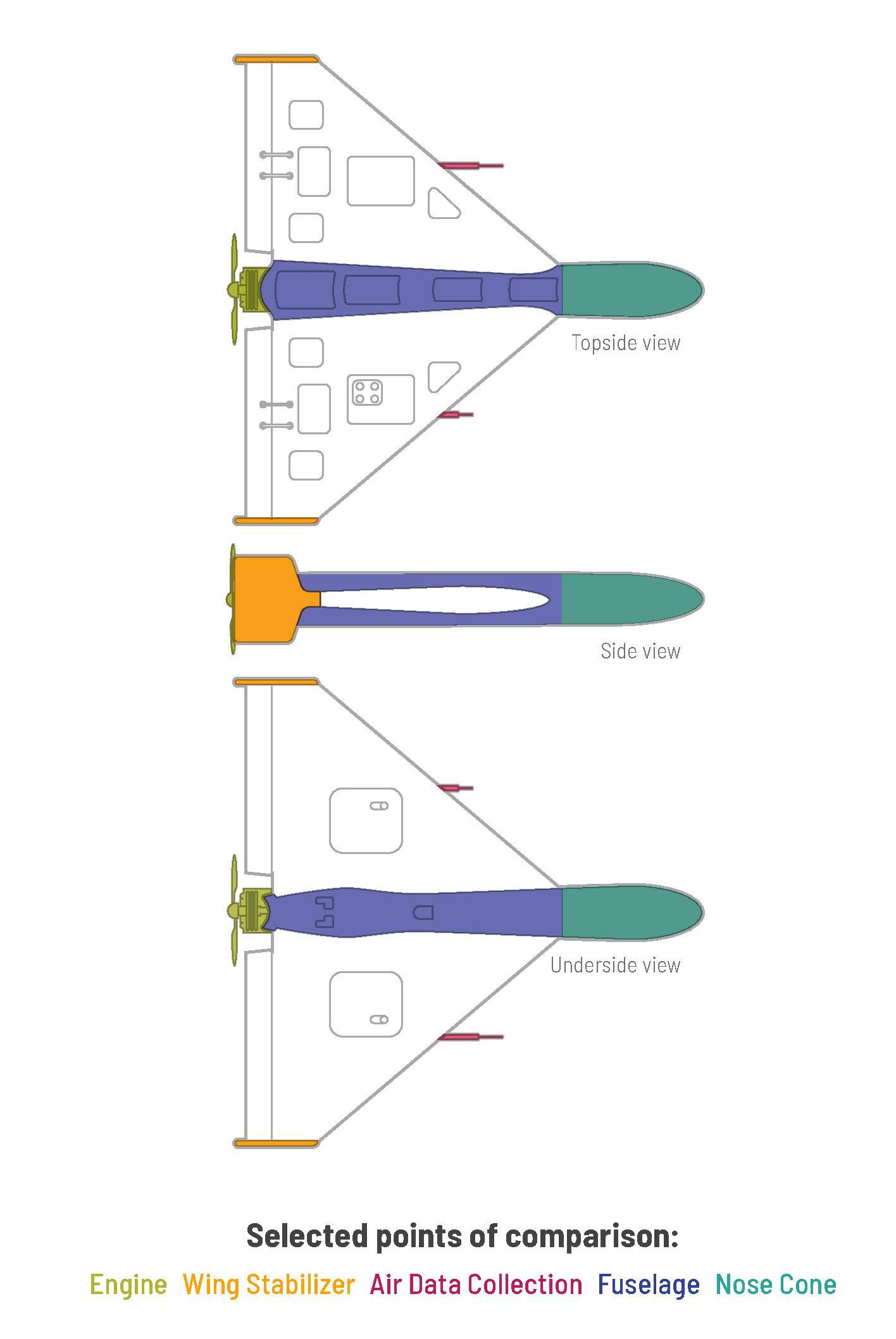
In the spring of 2022, Russia was buying drones. By early 2026, it was manufacturing them at 170 per day from a sprawling industrial complex in Tatarstan, some 1,100 kilometers from the Ukrainian front. The Geran-2—Russian for geranium, officially a rebranded Shahed-136 loitering munition designed in Iran—has become the highest-volume strike weapon of the conflict, employed in sustained strike campaigns across nearly the entire span of 2025. That transformation—from imported Iranian airframes to a 17-facility production complex turning out munitions faster than they can be intercepted—is one of the more significant defense-industrial escalations of the modern drone era. It was executed despite coordinated sanctions from eight countries and blocs, and it is still accelerating.
From Iranian Kits to Russian Factory Floor
Iran's Shahed-136 is a one-way attack loitering munition: 3.5 meters long, 2.5-meter wingspan, launch weight approximately 200 kilograms. Its Mado MD-550 four-cylinder two-stroke engine produces roughly 50 horsepower and sustains cruise speeds of 160–220 km/h. With a warhead of 40–50 kilograms of high explosive and guidance combining civilian inertial navigation with GPS, the airframe trades sophistication for cheapness and reproducibility. Operational range estimates span 970 to 2,500 kilometers depending on configuration; endurance runs approximately 11.5 hours.
Iran began supplying Russia with complete Shahed-131 and Shahed-136 units in 2022, delivering at least 1,000 drones in the initial tranche. The Defense Intelligence Agency confirmed the lineage in detail, finding that “Waid 2 wing stabilizers displayed by the Houthis in Yemen are consistent with the size and shape of the winglets on the Shahed-136 displayed in Iran and debris from the Geran-2—the Russian name for the Shahed-136—recovered after Russian attacks in Ukraine.” The same design family was simultaneously equipping Russian strikes on Kyiv and Houthi attacks on Red Sea shipping, a convergence the DIA treated as evidence of a single supply ecosystem rather than independent parallel programs.
That initial delivery was the surface of a deeper arrangement. General Michael Kurilla, CENTCOM Commander, described the arc to Congress: “They started providing complete systems, and they built an actual factory in Russia” producing at “a rate of over 100 a week from Russia into Ukraine.”
The Alabuga Build-Out
The Alabuga Special Economic Zone occupies approximately 50 square kilometers of the Yelabuzhsky District in Tatarstan. By early 2021 (visible in March satellite imagery), two buildings were under construction at the UAV production complex. By February 2026, CSIS Beyond Parallel documented a 17-facility complex exceeding 2.82 square kilometers—approximately 15 percent of the entire Yelabuga SEZ's footprint.
The build-out proceeded in distinct phases. Facility #5 (38,500 sq m) was completed in April 2023. Facility #11 (52,200 sq m of warehouse space) was done by September 2023. Facilities #8 and #9—combined 41,600 sq m—followed in September 2024. As of February 2026, Facility #15, a 71,200 sq m warehouse complex, remained under construction. The two main fabrication buildings, designated 8.1 and 8.2, each run approximately 38,000 square meters. Earth-covered explosive magazines appeared in satellite imagery by February 2026. Security hardening tracked alongside production growth: anti-drone screening netting went over factory roofs in June–July 2023; a concrete outer wall and inner security fence were completed that September. Approximately seven kilometers away, the Deng Xiaoping Logistics Terminal—a China-operated node—supports the complex with dual-use components and industrial supplies.
The workforce assembled to fill these buildings reflects the coercive economics of a war-footing production surge. The complex includes 67 finished housing units with capacity for approximately 20,000 workers; roughly 350 vehicles were visible in parking areas in available imagery. Alabuga recruited students as young as 14 and 15 directly from ninth grade—Russian state media featured a 16-year-old named Darina earning approximately 150,000 rubles monthly (about $2,000 USD) on the assembly lines. Young women recruited from African nations arrived with subsidized housing and starting wages of roughly $550 per month; reports of passport seizures to prevent departures have emerged. Approximately 12,000 North Korean workers were planned for recruitment by end of 2025, at wages estimated at $2.50 per hour on 12-hour shifts.
The production numbers track the expansion directly. Initial targets ran 7–10 drones per workday; two-shift operations raised output to 20 per day within months. Internal documents analyzed by the Institute for Science and International Security show Alabuga planned to deliver approximately 1,400 drones by October 2023, with monthly capacity targeting 226 units by 2024. By July 2023, the complex had delivered roughly 600 complete Iranian-import units and assembled approximately 300 domestically produced airframes. Production at Alabuga reached 170 units daily as of January 2026, a pace far exceeding its original design targets.
Domestic Production Against a Foreign-Component Ceiling
The early production model relied on complete kits or airframes shipped from Iran. By mid-2023, Yelabuga had shifted to producing its own airframes. By late 2023, internal lines for navigation systems, piston engines, and propellers were operating at or near the site. Russian state media footage showed Alabuga producing MD-550 engine clones, composite airframes, and electronics domestically. Warhead contracts went to established Russian defense enterprises: approximately 3,000 thermobaric units from the Scientific Research Institute of Applied Chemistry; 5,000 fragmentation-HE-incendiary from JSC NPO Basalt; 2,000 specialized warheads from the same institute; and 1,030 test and production units from JSC GosNIIMash. Three documented types span from the standard BCh-50 (approximately 53.5 kg, with a copper-funnel cumulative section) to the BCh-90—described as “170 percent more powerful” at 92 kilograms, with zirconium incendiary elements—to a thermobaric design combining 30 kg HE, 20 kg thermobaric mixture, and 2,300 SHX steel balls.
Electronics tell a different story. Despite international export controls, Russian Geran-2 drones contain over 100 foreign-manufactured components per unit. OCCRP documented 19 European companies from eight countries with components identified in downed debris: Infineon Technologies (Germany), STMicroelectronics (Switzerland), u-blox (Switzerland), NXP Semiconductors (Netherlands), Nexperia (Netherlands), AMS Osram Group (Austria), Taoglas (Ireland), and TE Connectivity (Ireland), among others. STM32 microcontrollers from STMicroelectronics appeared consistently across examined drones.
The evasion infrastructure is as layered as the sanctions meant to stop it. Between January 2024 and March 2025, trade data revealed at least 672 shipments of sanctioned European-made components destined for Russia, originating from 178 companies primarily in China and Hong Kong. One documented pathway: u-blox GNSS receivers shipped via Yusha Group Ltd. in Jingzhou, China; imported by Norkap LLC in St. Petersburg; recovered from Geran-2s downed over Kyiv. Methods include pre-sanction inventory brokered through intermediaries, component extraction from civilian products, cryptocurrency payments, and multi-country transshipment chains. In October 2024, Acting Under Secretary of the Treasury Bradley T. Smith stated that “Russia increasingly relies on the expertise of foreign professionals and the import of sophisticated technologies to sustain its weapons program”—the same month the US Treasury added Chinese firms Xiamen Limbach Aircraft Engine Co. and Redlepus Vector Industry Shenzhen, marking the first US sanctions on Chinese entities directly producing complete weapons systems alongside Russian defense manufacturers. JSC Alabuga has now been sanctioned by Ukraine (December 2023), the EU (December 2023 and February 2024), the UK (February 2024), Switzerland (March 2024), the United States (January 2025), Australia (February 2025), Japan (September 2025), and New Zealand (February 2026). The designation cascade has not stopped production.
Why It Matters
Russia has demonstrated both the willingness and the industrial capacity to fire at scale—over 26,000 Geran-series drones deployed since mass production began across sustained campaigns throughout 2025. The exchange ratio between a mass-produced loitering munition and a high-cost interceptor is financially untenable for the defender at scale.
The technology trajectory compounds the problem. The Geran-2 has evolved from civilian GPS to GLONASS with Controlled Reception Pattern Antennas for jamming resistance. The Geran-2 MS variant—first recovered near Sumy in June 2025—integrates an Nvidia Jetson Orin AI processor, a 1920×1080 60fps electro-optical camera, a Xilinx Spartan FPGA for sensor fusion, an IR thermal camera, and an upgraded multi-constellation navigation system with a four-element CRPA array. It executes Automatic Target Recognition, enabling terminal-phase engagement of moving targets—vehicle convoys, air defense radars, troop concentrations—without pre-programmed coordinates. A Starlink-enabled Geran-2 strike on a passenger train near Kharkiv in January 2026, in which three drones successively hit the same moving vehicle, demonstrated the mode in operation.
For Western planners, the Alabuga case makes a structural argument: export controls and entity sanctions have not kept pace with the adversary's ability to reroute supply chains through China and Hong Kong at industrial volume. The facility that appeared as two construction sites in early 2021 satellite imagery now produces loitering munitions at a daily rate that exceeds sustained Ukrainian intercept capacity. The intelligence picture is clear and well-sanctioned. The gap is in enforcement machinery and counter-production capacity that can operate at comparable speed.
Sources
- C4ISRNET — Attack drones at heart of military partnership between Russia, Iran
- C4ISRNET — Houthis, Russians wield same Iranian-supplied drones, DIA studies show
- Ukraine GUR War Sanctions Database — JSC Alabuga
- CSIS Beyond Parallel — A Closer Look at the Yelabuga UAV Factory
- Institute for Science and International Security — Visible Progress at Russia's Shahed Drone Production Site
- Institute for Science and International Security — Alabuga's Shahed-136/Geran-2 Warheads: A Dangerous Escalation
- OCCRP — Made in the EU, Dropped on Kyiv
- The Observation Post — Geran-2 MS: The AI-Equipped Shahed Changing the Conflict
- DronexL — Russia Shahed Drones Teen Alabuga
- GlobalSecurity.org — Shahed-136
- Kharon — US Imposes Sanctions on Russian Industrial Zone Involved in Drone Production
- GlobalSecurity / US Treasury — Treasury Sanctions Action, October 17, 2024
- OpenSanctions — JSC Alabuga entity record
