
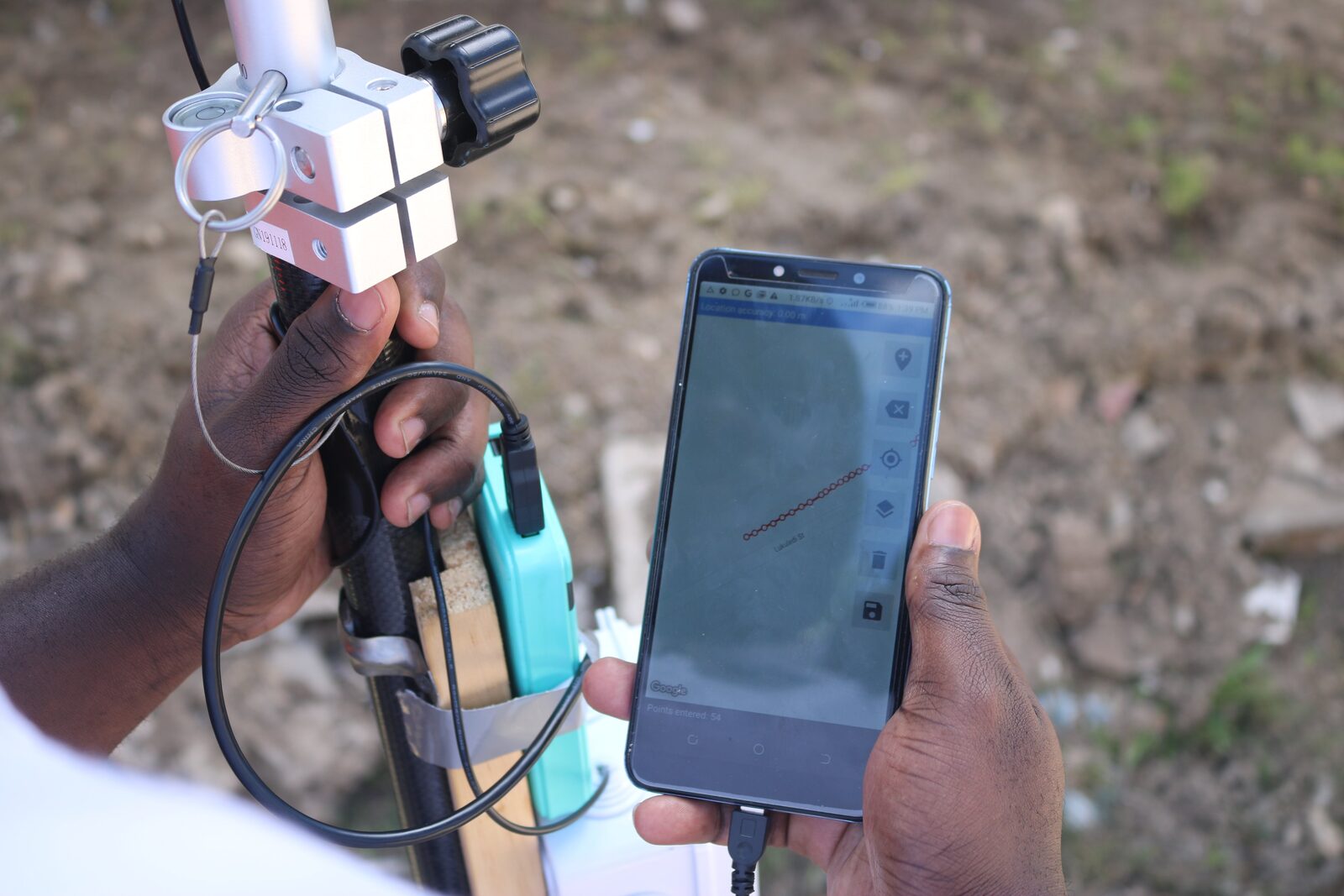
The GPS receiver in your phone resolves its position by timing how long a satellite signal takes to arrive — code-phase ranging, in the jargon. Under good sky conditions that gets you to within two to five meters. For navigation, that's fine. For drone mapping, stockpile volumetrics, or precision agriculture, it's useless. A surveyor who delivers a five-meter horizontal error to a client doesn't stay a surveyor for long.
The breakthrough that closes that gap is carrier-phase measurement. Rather than timing the signal envelope, a carrier-phase receiver tracks the underlying radio wave itself — a sinusoid at roughly 19 cm wavelength for the GPS L1 band. Because a cycle of that wave is far shorter than the code chip used in standard ranging, resolving position against the carrier is approximately 100 times more precise than code-phase techniques. The catch is ambiguity: the receiver can measure a fractional phase offset with high precision, but it doesn't know how many whole cycles of the 19 cm wave lie between it and each satellite. Resolving that integer ambiguity is the core mathematical problem that Real-Time Kinematic (RTK) and Post-Processed Kinematic (PPK) both solve — they just solve it at different points in the workflow.
Fix, Float, and the Base Station
RTK works by pairing a stationary ground receiver — the base station — with a moving receiver on the drone, the rover. The base sits over a point with known or carefully surveyed coordinates and continuously transmits correction data, formatted as RTCM messages, to the rover over a radio or cellular link. The rover uses those corrections to narrow the integer ambiguity candidates until it converges on a unique solution. When it does, the receiver reports a FIX — horizontal accuracy of 1–2 cm, vertical 2–4 cm under typical conditions. Before that convergence it reports FLOAT, where corrections are applied but the integer ambiguity remains unresolved, yielding 10–50 cm accuracy. Without any differential corrections at all, the receiver falls back to SINGLE mode — standard GNSS, several-meter accuracy. Most professional workflows require confirmed Fixed status before collecting mission-critical data.
As Point One Navigation summarizes it, RTK is "a carrier-phase form of Differential GNSS (DGNSS). Where standard DGNSS operates at the code-phase level and delivers sub-meter accuracy, RTK resolves integer carrier phase ambiguities to deliver centimeter-level accuracy" — suitable for precision workflows.
A local base station — say, a DJI D-RTK 2 — maintains effective RTK range up to about six kilometers under unobstructed line-of-sight. Setup takes 5–15 minutes of position averaging for adequate accuracy, or 30–60 minutes for enhanced precision. Single-band receivers tap out around 10–20 km from the base; beyond that, atmospheric path differences between base and rover compound faster than the corrections can compensate, degrading accuracy by approximately 1–1.5 cm per additional 10 km. Multi-band receivers, which track L1/L2 or L1/L5 simultaneously, extend useful RTK range to roughly 60 km.
Correction Networks: Trading a Radio for an Internet Connection
Deploying a base station for every mission is operationally expensive. NTRIP — Networked Transport of RTCM via Internet Protocol — addresses that by streaming corrections from permanent, continuously operating reference stations over a cellular data connection. The infrastructure behind those streams is national CORS networks.
In the United States, the NOAA National Geodetic Survey operates the CORS Network (NCN), a cooperative of hundreds of government, academic, and private organizations running reference receivers across the country. NGS analyzes and distributes carrier phase and code range measurements from NCN stations free of charge. According to the NGS CORS program page, "NCN enhanced post-processed coordinate accuracies can approach a few centimeters, both horizontally and vertically." For RTK workflows, NTRIP taps this infrastructure via Virtual Reference Station (VRS) technology, synthesizing a virtual base station at the drone's approximate location from the surrounding network — eliminating the need for any field equipment beyond the drone itself.
Modern commercial RTK networks push this further. Point One Navigation, for instance, operates more than 3,000 owned-and-operated base stations with claimed 99.9% uptime, covering the continental US with overlapping baselines. The practical effect is that for most survey missions near populated areas, a field base station is now optional, not required.
PPK: Same Math, Different Timing
Post-Processed Kinematic applies identical carrier-phase mathematics — but after the fact. Instead of streaming corrections to the drone in real time, both the base station and the rover log raw GNSS observations throughout the mission (typically in RINEX format). After landing, the two logs are combined in post-processing software to compute a precise position track for every image exposure.
The workflow differences are significant in practice. Because PPK requires no live data link between base and rover, it sidesteps the failure modes that plague RTK in the field — intermittent cellular coverage, radio link dropouts, re-initialization delays after signal loss. As JOUAV puts it bluntly: "PPK is a more robust and accurate solution because it does not rely on a continuous data chain." DroneDeploy's field guidance agrees: PPK "can edge out RTK in environments with signal disruption."
PPK also extends the practical baseline. Where RTK accuracy tapers beyond about 35 km from the correction source, PPK baselines can reach 100 km with multi-band receivers. And because the logs can be reprocessed — with different software settings, or combined with newly available CORS data — PPK provides a second chance to recover accuracy that a real-time connection failure would have lost permanently. The tradeoff: corrections are unavailable until post-processing completes, and a minimum flight time of approximately 10 minutes is needed for the solver to achieve a stable solution.
Heliguy summarizes the operational asymmetry well: PPK provides a "more reliable and simple workflow" by removing the need to maintain a rover-base connection during flight, at the cost of delayed deliverables.
What This Does to Ground Control Requirements
Traditional aerial photogrammetry depends heavily on ground control points — physical markers placed across the survey area with coordinates measured to centimeter precision by a total station or GNSS rover. Effective implementation requires a minimum of five or more well-distributed markers; for large or complex sites the count climbs fast. Setting and measuring GCPs consumes field time and introduces its own error sources.
RTK and PPK substantially reduce that burden. With PPK, projects can be completed with as few as one ground validation point. RTK, when maintaining a stable Fix throughout the mission, can eliminate the need for multiple GCPs entirely. But Esri's ArcGIS Drone2Map documentation carries an important caveat: "without check points, there is no way to validate the accuracy of the products." The distinction matters — a check point is a GCP used purely for validation, not as a constraint in the photogrammetric bundle adjustment. Even with RTK or PPK, at least one check point is the standard of care for deliverables where accuracy claims matter.
In photogrammetry software, RTK and PPK metadata arrive differently. RTK-tagged images embed accuracy and orientation fields directly in image EXIF/XMP metadata. PPK positions are typically stored as an external file — TXT, CSV, or MRK format, depending on the drone platform — that the software ingests at import. Either way, the software must be configured to treat those positions as fixed rather than refining them through bundle adjustment, or the RTK/PPK accuracy advantage is partially discarded.
Failure Modes Worth Understanding
Neither RTK nor PPK is immune to degradation. For RTK, the most common failure mode is Fix loss — if obstructions, RF interference from the drone's own electronics, or link dropout interrupts the correction stream long enough that the integer ambiguity estimate collapses, the solution reverts to Float until re-acquisition, with accuracy degrading to 10–50 cm in the interim. Dense tree canopy and urban canyons cause the same problem from the satellite side. Accuracy also degrades predictably with baseline distance — roughly 1–1.5 cm per 10 km from the base station in single-baseline RTK configurations.
PPK shifts those failure modes rather than eliminating them. The base station log must be continuous and complete; gaps invalidate that portion of the rover track. Post-processing workflow errors — mismatched time references, wrong antenna heights, incorrect constellation selection — can produce georeferenced shifts or silent precision loss that isn't visible until check points are measured.
Both techniques benefit from multi-constellation receivers. Hardware that simultaneously tracks GPS, GLONASS, Galileo, and BeiDou satellites has a substantially larger pool of ranging measurements to draw from at any given moment, accelerating integer ambiguity resolution, improving Fix reliability under partial sky occlusion, and providing redundancy when any single constellation has a satellite outage. For drone applications — where flights happen on schedules, not when satellite geometry is optimal — constellation diversity is increasingly a baseline requirement rather than a premium feature.
Sources
- Emlid Blog — Introduction to RTK GPS
- DroneDeploy — RTK vs PPK vs GCP: What's the Difference and Why Does It Matter
- GeoNadir — RTK Explained
- Point One Navigation — Drone RTK
- Esri ArcGIS Drone2Map — Real-Time Kinematic Processing
- NOAA National Geodetic Survey — Continuously Operating Reference Stations (CORS)
- CHC Navigation — GNSS PPK and RTK for Precision UAV Mapping
- Heliguy — RTK vs PPK for Surveying
- JOUAV — RTK Drone