
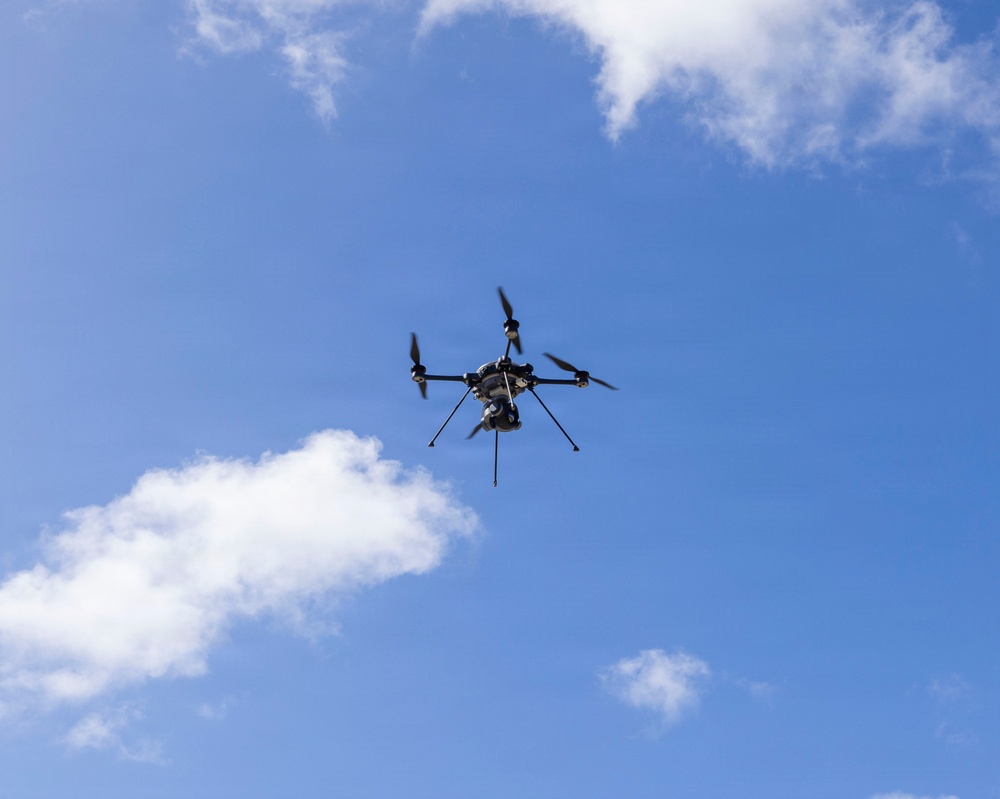
Red Cat Holdings pulled the wraps off its new Hellcat small unmanned aircraft system on June 15, 2026 at Eurosatory, the biennial land and air defense trade show held in Paris. The system is built on the foundation of the company's Black Widow platform — purpose-built for the U.S. Army's Short Range Reconnaissance program — but Hellcat is no simple product refresh. According to the company and independent reporting, its design changes were driven in substantial part by direct feedback from Ukrainian drone operators working in active combat conditions.
The result is a system that looks similar to its predecessor on paper but departs from it in ways that matter on a contested battlefield: a quieter visual signature, an expanded sensor payload, and navigation capabilities that do not depend on GPS availability from the moment the aircraft powers on.
From Black Widow to Hellcat: What Changed and Why
The Black Widow established Red Cat's credibility with the U.S. military. It is a rucksack-portable, field-repairable small UAS purpose-built for Army requirements. Hellcat keeps those core attributes — the same portability, the same repairability philosophy — while addressing specific deficiencies that emerged from real-world combat observation.
Red Cat's team traveled to Ukraine and embedded with drone operators in-theater, deploying its own engineers to the front lines. That direct exposure produced two immediately visible changes. First, the motor arms. Black Widow's arms are black. Hellcat's are gray. That single material choice reduces visual contrast against overcast skies, terrain, and building facades — environments where small UAS frequently operate at low altitude and where visual detection by an adversary can end a mission or expose a position. It is the kind of tweak that sounds minor in a press release but reflects genuine operational thinking.
Second, the payload. Black Widow flies with a two-camera setup. Hellcat introduces the Ocellus 3CP, a three-camera system. Adding a third camera expands situational awareness — wider simultaneous coverage, potential for different spectral or orientation configurations — without requiring the operator to reposition the aircraft as frequently. In an ISR role, where dwell time and position exposure both carry risk, that matters.
These are not features Red Cat's engineers invented at a whiteboard. They are changes that Ukrainian operators asked for, and that Red Cat's team observed were needed. That feedback loop is increasingly rare in defense procurement, where requirements are often written years before a system reaches users and rarely updated quickly enough to reflect what combat actually reveals.
The Technical Picture
Beyond the Ukraine-informed changes, Hellcat carries a performance specification that positions it above many commercial-derived small UAS currently in military inventories.
Flight endurance exceeds 50 minutes — meaningful for persistent ISR in a target area without requiring frequent operator repositioning or aircraft swaps. Range extends to 6.8 miles (11 kilometers), sufficient to keep operators well back from a target while maintaining datalink integrity.
The datalink itself is the WEB Standoff Radio, a link architecture designed for contested electromagnetic environments. Radio frequency jamming and GPS spoofing are standard features of the modern battlefield in Ukraine and are increasingly assumed in any near-peer conflict scenario. Hellcat addresses the GPS problem at the system level: it operates in GPS-denied conditions from the moment it is powered on, and its return-to-home function uses azimuth-based navigation rather than GPS coordinates. That means if an operator loses the datalink or GPS is jammed, the aircraft can still execute a meaningful recovery without depending on satellite positioning.
The payload architecture follows Modular Open Systems Architecture (MOSA) principles, which in practice means the system is designed to swap payloads and components without requiring proprietary integrations or vendor lock-in. For international customers operating with different command-and-control infrastructure, that flexibility is not a nice-to-have — it is often the difference between a system that can be fielded in a coalition context and one that cannot.
The airframe itself retains Black Widow's field characteristics: rucksack-portable and field-repairable, meaning a small unit can carry it without a dedicated transport vehicle and fix common failures without depot-level support. The overall finish is described as a low-visibility tactical configuration, consistent with the gray arms and the broader design philosophy of reducing the aircraft's observability.
Why It Matters
Eurosatory is not a trade show where companies go to sell to Americans. It is where European and global defense ministries shop, where NATO partners compare notes, and where the broader international defense market sets direction. Red Cat chose Eurosatory deliberately, and the Hellcat's design reflects that choice.
The platform is explicitly built for coalition partners with varying C2 preferences. That language signals Red Cat is pursuing international sales in markets where the U.S. ITAR regime, proprietary systems, and incompatible datalinks have historically frustrated interoperability. MOSA architecture is the technical mechanism; Eurosatory is the market signal.
More broadly, Hellcat represents a model of defense acquisition that the conflict in Ukraine has pushed to the foreground: rapid, iterative development driven by warfighter feedback rather than multi-year requirements cycles. The specific changes — gray arms, three cameras, GPS-denied navigation from power-on — are not transformational on their own. But the process that produced them is significant. Red Cat sent its team to Ukraine, watched operators work, listened to what they said didn't work, and built the changes into the next system. That is a faster and more grounded development loop than most defense programs manage.
The GPS-denied navigation capability deserves particular attention. RTH Azimuth — returning to a launch point using directional bearing rather than GPS coordinates — is a direct response to the electromagnetic environment in Ukraine, where Russian jamming has rendered GPS unreliable across large areas. A small UAS that cannot navigate without GPS is not a reliable asset in that environment. Designing GPS-denial tolerance into the base platform, rather than treating it as an add-on, reflects a realistic assessment of where future conflicts will be fought.
For the broader small UAS market, Hellcat's launch at Eurosatory with a Ukraine-informed design lineage also carries a competitive dimension. The conflict in Ukraine has become a live evaluation ground for small UAS from multiple countries and manufacturers. Systems that perform there carry credibility that no demonstration event can replicate. Red Cat is explicitly leveraging that credibility — and the specific lessons it generated — as a selling point for international customers.
CEO Jeff Thompson framed it in two statements in the company's announcement. On the development process: "it's been an ongoing honor to work side by side with Ukrainian drone experts in theater, continuously transforming our ISR drones to meet the ever-evolving demands of the battlefield." On the broader philosophy: "Hellcat reflects Red Cat's approach to working directly with warfighters, incorporating feedback from operational environments, and folding those lessons back into the platform so users can adapt as the mission changes." In this case the hardware changes back it up. The gray arms are on the aircraft. The third camera is on the aircraft. The GPS-denied navigation is in the aircraft. The feedback loop produced tangible, documented results.
Pricing was not disclosed at launch. Red Cat has not specified which international customers or programs Hellcat is targeting beyond the coalition partner framing, and no delivery timelines have been announced. What the company has established is a platform with a clear operational pedigree, a design process grounded in combat observation, and a launch venue chosen to maximize exposure to the international defense market. Whether Hellcat converts that positioning into sales will depend on procurement decisions that play out over months or years — but its Eurosatory debut puts it in front of the buyers who will make those calls.
