
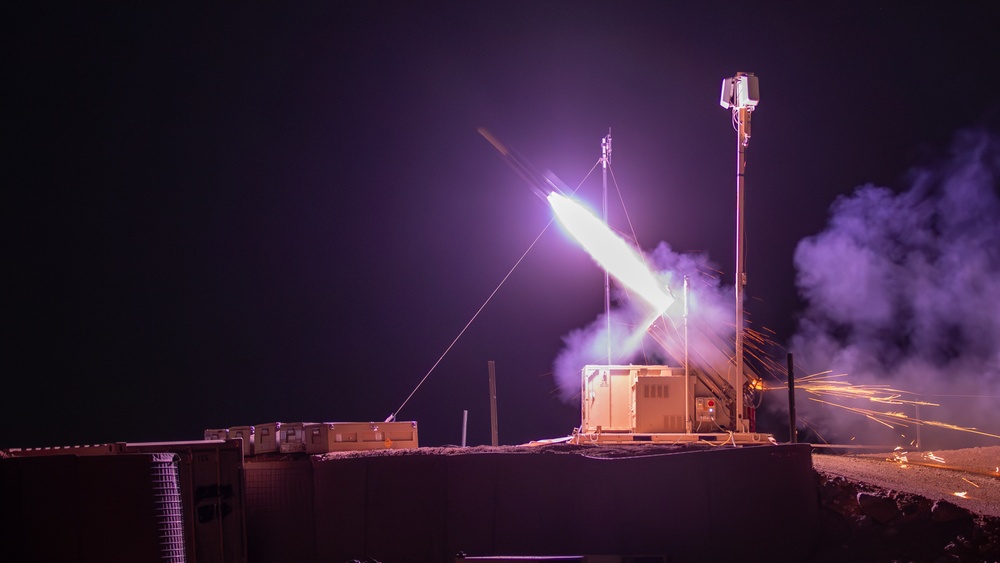
In early 2024, an Iranian-backed drone struck Tower 22, a U.S. military outpost in Jordan, killing three American soldiers. The weapon was cheap. The Army's answer cost approximately $125,000 per round. That math — attacker spending hundreds to thousands, defender spending six figures — is the central tension the Raytheon Coyote program has been navigating for over a decade, and understanding the system means understanding how that tension shapes every design choice, every contract, and every operational limitation.
What the Coyote Was: Disposable ISR Platform, Not a Weapon
The Coyote reportedly entered service around 2014 as something entirely different from the interceptor it became. Block 1 was an expendable ISR platform: electric-motor driven and folding-winged. It could be air-deployed from manned aircraft, keeping the host platform in safe airspace while the Coyote flew intelligence-collection routes over contested terrain. The Office of Naval Research's LOCUST (Low-Cost UAV Swarming Technology) program used Block 1 airframes to demonstrate autonomous multi-UAS coordination, positioning the Coyote as a disposable node in an emerging concept of cooperative drone operations.
The design philosophy was about economy and expendability in the ISR role: lose the drone, keep the aircraft, get the data. Nobody designed Block 1 to kill anything.
The Pivot: Turbojet, Warhead, Kinetic Kill
Block 2 represents the program's transformation into an interceptor, driven by the proliferation of weaponized small UAS across multiple theaters. The electric motor is replaced by a turbojet engine that pushes the Coyote to approximately 345–370 mph, making it capable of pursuit engagements against faster targets at ranges out to 10–15 km. A kinetic warhead replaced the sensor payload. The airframe remained compact, launching from the same pneumatic tube infrastructure as its predecessor, easing integration with existing platforms.
Where Block 1 watched, Block 2 kills. Raytheon describes the variant as capable of defeating drones "at longer ranges and at higher altitudes than similar class effectors" across targets ranging from small commercial quadcopters to larger tactical UAVs. The company designates the system as "combat proven," acknowledging operational deployment history without specifying theater or adversary.
Block 2's kinetic approach is effective against individual targets and small formations. At approximately $125,000 per round, it is also expensive in a way that scales badly against adversary tactics built around volume and attrition.
Block 3NK: Reusable, Non-Kinetic, Built for Swarms
The Block 3NK variant attacks the cost problem from a different direction. "NK" denotes non-kinetic: instead of a warhead, Block 3NK carries a non-kinetic payload that disables drones without explosive fragmentation. Instead of a turbojet, it uses a propulsion system optimized for endurance over sprint speed, allowing it to loiter over a threat area across an extended engagement window. Critically, it is designed to be recoverable — recalled after an engagement, refurbished, and redeployed for additional sorties.
In February 2026, Raytheon reported results from a U.S. Army exercise in which Block 3NK defeated multiple drone swarms varying in size and maneuverability, confirming "exceptional launch, flight, intercept, and recovery capabilities." The non-kinetic defeat mechanism also changes the collateral-damage calculus in complex environments: a non-kinetic engagement drops a drone without explosive fragmentation, reducing risk to nearby infrastructure or personnel.
"Coyote provides warfighters a cost-effective defense for individual drones and swarms." — Tom Laliberty, president of Land & Air Defense Systems, Raytheon
The reuse principle is conceptually sound. Whether Block 3NK achieves meaningful cost savings in practice depends on figures Raytheon has not disclosed: per-engagement operating costs, refurbishment cycle times, and logistics overhead for the HPEM energy system. But the underlying logic — one platform, many engagements versus one round per target — represents a fundamentally different answer to the swarm attrition problem that Block 2 cannot offer.
The Kill Chain: KuRFS, FAAD C2, and How LIDS Works End-to-End
Neither variant operates as a standalone weapon. The Coyote's targeting backbone is the KuRFS — Ku-band Radio Frequency Sensor — a precision radar providing 360-degree persistent detection, identification, and tracking of UAS targets including dense swarms, while simultaneously performing conventional rocket, artillery, and mortar (RAM) surveillance. KuRFS and Coyote together constitute the core detect-and-defeat layer of the U.S. Army's LIDS — Low, Slow, Small Unmanned Aircraft Integrated Defeat System — coordinated through the FAAD C2 fire-control architecture.
LIDS deploys in two configurations tailored to different protection requirements. Mobile LIDS (M-LIDS) mounts on a 4x4 M-ATV with a two-round Coyote launcher and a 30mm cannon for close-in backup — a forward-deployable system for maneuver force protection. Fixed-site LIDS (FS-LIDS) uses a palletized four-round launcher paired with a larger sensor array, suited to base and critical-infrastructure defense. The Army's FY2025–2029 plan calls for 252 fixed launchers and 52 mobile launchers alongside the interceptor buys, plus 118 fixed KuRFS radars and 33 mobile KuRFS units — the infrastructure of a scaled counter-drone network, not a one-off procurement.
During summer 2024 testing at Yuma Proving Ground, Arizona, Block 2 defeated single and swarming targets with reduced engagement timelines; Block 3NK defeated multiple drones of varying sizes and maneuverability in the same evaluation period. The Army also awarded $374.8 million in LIDS contracts that year, including equipment for a fourth Army division.
The contract timeline tells the scaling story plainly. In January 2024, the Army awarded RTX $75 million for 600 Coyote 2C interceptors under rapid acquisition authority, completing the award in under 30 days through the Program Executive Office for Missiles and Space — the contract awarded roughly twelve days before the Tower 22 attack — an attack that would underscore its urgency. By September 2025, the Pentagon had issued a $5.04 billion IDIQ contract for combined Coyote and KuRFS production running through September 2033, the largest counter-drone contract in Raytheon's history. The company had already increased Coyote production capacity ahead of schedule to meet surging demand. The FY2025–2029 plan calls for approximately 6,000 Block 2 interceptors and 700 Block 3 non-kinetic variants.
Why It Matters
The Coyote program's trajectory is an object lesson in how the U.S. military has adapted — and where it remains exposed — in the counter-UAS domain. Cheap, proliferated drones have forced a complete reconceptualization of ground-based air defense, and the Coyote's evolution from disposable ISR node to a $5 billion production program happened across roughly a decade of compressed operational urgency.
The unresolved problem is economic. Bill LaPlante, the Pentagon's undersecretary of defense for acquisition and sustainment, has articulated a target of "tens of thousands of dollars" per engagement, with interest in systems reaching $10,000 per round. The Coyote 2C sits at approximately $125,000 per round — two to twelve times above that threshold. LaPlante's framing that the "cost curve matters" is understated: against an adversary manufacturing armed drones for $500 to $5,000 each, a $125,000 interceptor makes the attacker economically rich in the kill-chain accounting that ultimately determines whether a counter-drone strategy is strategically sustainable.
Block 3NK's reusability addresses this partially. Directed-energy systems — laser, high-power microwave — are a longer-horizon answer the Army is pursuing in parallel. Anduril's Roadrunner-M, a reusable kinetic interceptor under SOCOM development, represents a potential future competitor to the Block 2 concept. The Marine Corps' MADIS (Marine Air Defense Integrated System), which uses a similar vehicle-mounted architecture on Joint Light Tactical Vehicles but fires Stinger missiles rather than Coyote rounds, shows that inter-service convergence on a single solution has not happened and may not.
Army Maj. Gen. Sean Gainey, formerly the service's C-UAS lead, put it plainly: the Army planned to acquire "thousands" of Coyote interceptors over FY2025–2029 — an unprecedented scaling of the program — while simultaneously acknowledging that "no one system is going to be able to defeat all these threats." Coyote is the most fielded and highest-volume kinetic and non-kinetic interceptor in the U.S. Army's counter-drone arsenal, with proven combat use, a decade of development, and an eight-year production contract behind it. What it does not have is an answer to the fundamental economics of drone warfare. That problem remains open — and every adversary with a consumer-grade remote controller knows it.
Sources
- RTX/Raytheon — Coyote Integrated Air and Missile Defense (OEM product page)
- U.S. Army — Army Announces Rapid Acquisition Authority Contract for Coyote Interceptors
- C4ISRNET — RTX to Supply 600 Coyote Drone Interceptors to Army
- RTX/Raytheon — Raytheon Demos KuRFS and Coyote Performance Against Complex UAS Threats
- Army Recognition — Pentagon Awards Raytheon $5.04B Army Contract for Coyote Counter-UAS and KuRFS Radars
- RTX/Raytheon — Raytheon's Non-Kinetic Coyote Variant Defeats Multiple Drone Swarms
- C4ISRNET — Drone-Killing Costs Must Come Down, Says Pentagon's Chief Weapons Buyer
- Army Technology — Raytheon Coyote Block 3NK Demonstration
- The War Zone — Drastic Increase in Army Coyote Drone Interceptor Purchase Plans