
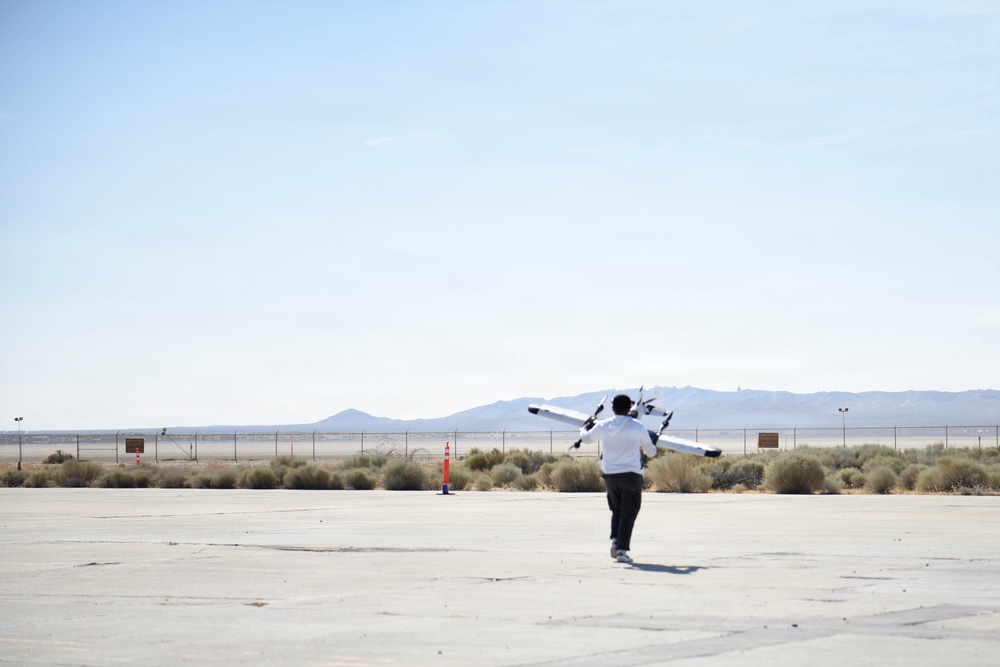
For seven months, the Department of War's Drone Dominance Program has been an exercise in buying things that are meant to be destroyed. The premise — an iterative $1 billion plan to purchase small, lethal drones over two years, with a stated intent to buy more than 200,000 drones by 2027 — is the arithmetic of attrition applied to procurement. Buy cheap, buy enormous quantities, accept that most of what you buy will be expended on its first and only flight.
On July 21 and 22, 2026, the program quietly added a category that does not fit that logic at all.
The new solicitation — a Phase 2.5 "Mission C" Request for Solutions issued under the S2MARTS vehicle — seeks reusable bomber and dropper platforms: drones that carry munitions to a target, release them, and fly back to be reloaded. Not once. Not a handful of times. The RFS states an expectation of flying a minimum of 30 missions, with a preference for achieving 150 missions before loss.
That single number is the story. Everything else in the document is engineering detail arranged around it.
What the Pentagon is actually asking for
The technical envelope is tight and specific. The government assumes most systems will be 55 pounds Gross Takeoff Weight or smaller, excluding payload weight, and capable of hauling upwards of 8 kilograms (17.6 pounds) of ordnance. Mission range is 15 to 30 kilometers — roughly 9.3 to 18.6 miles. The system has to be man-packable or transportable in a light-duty combat vehicle — meaning a small team carries it in, sets it up, and flies it without a launch rail, a runway, or a support truck.
The munitions are named outright: 60mm and 81mm mortar shells. An 81mm round weighs nine to ten pounds; a 60mm round about 3.7 pounds. This is not an abstract "payload interface" requirement. The Department of War is describing an aircraft that carries infantry mortar rounds to a point 15 to 30 kilometers away, drops them on something, and returns.
The capability list reads like a compressed summary of everything the last two years of drone warfare have taught anyone paying attention:
- Multi-warhead delivery, engaging single and multiple moving and stationary targets in succession — personnel, light armor, maritime craft, heavy armor and other assets
- All-weather, all-lighting operation, including night-vision equipped operation
- Resilience to communications and navigation jamming
- Advanced target recognition
- Autonomous behaviors, with data feeds and interoperability with other systems
Notably, the RFS nowhere requires a multirotor vertical-lift platform. The door is explicitly left open to fixed-wing and other UAV types — a framing that acknowledges the range and endurance advantages of wings even as the mission profile, hover and aim and drop and return, reads like a rotorcraft brief.
The price ceiling, and the arithmetic hiding behind it
Approximately $32 million has been allocated for initial prototype orders covering up to 1,200 prototype systems with logistics packages. The per-unit cost is capped at $20,000 maximum per UAV, plus a $5,000 logistics package covering batteries, spare parts and inert payloads. Vendors must also supply durable components at a 1:10 spares-to-ordered-UAV ratio.
Do the multiplication and the shape of the deal becomes clear. At the caps, 1,200 systems come to $30 million in airframes and logistics kits, comfortably inside the roughly $32 million envelope. There is no room in that budget for a boutique aircraft. There is also no room for the kind of gold-plating that traditionally arrives with the word "reusable."
The orders will not go to a single winner. The award splits 600, 400 and 200 units across the top three rated vendors — a deliberate three-way industrial hedge that keeps at least two backup production lines warm while the top scorer builds out.
Now run the other calculation, the one that explains why this solicitation exists. A $25,000 system that flies 150 missions works out to roughly $167 per sortie in airframe cost. The same $25,000 spent on a one-way attack drone buys exactly one delivery. Even at the minimum 30-mission bar, the reusable platform is amortizing its cost across an order of magnitude more engagements than anything the program has bought to date. The expendable munition becomes the mortar round — cheap, mass-produced, already in the supply chain — rather than the aircraft carrying it.
That is a genuinely different economic proposition, and it is worth noting that it sits inside the same $1 billion, 200,000-drone envelope. Divide the program's headline figures and the implied average is about $5,000 per drone. A $25,000 Mission C system costs roughly five times that average. The Pentagon is not replacing the disposable-mass strategy. It is buying a small, expensive fleet of aircraft that earn their premium by not being consumed.
The schedule is the hard part
Responses are due August 5, 2026 — a two-week window from publication. That pace is characteristic of the program, which has run on a challenge-based acquisition model since its original RFS was published on December 17, 2025, with official acquisition correspondence routed through the NSTXL consortium portal. The program is sponsored by the Office of the Secretary of War, jointly administered by the Test Resource Management Center and the Defense Innovation Unit, with contracting authority held by NSWC Crane.
What follows the deadline is where vendors will be separated. A qualifying event comes first, and it demands physical hardware: a minimum of six complete UAS systems plus two durable component sets per vendor, on the table, ready to fly. Approximately eight vendors are expected to advance from the qualifier into the competitive "Gauntlet" evaluation proper — which is held 48 hours after the qualifier, in October 2026.
Forty-eight hours. There is no window to fly home, rebuild, and return with the fixed version. Whatever a company brings to the qualifier is what it flies in the Gauntlet.
Production terms are equally compressed. Prototype delivery runs five months from order, with half the units due within two and a half months. For a company that has never built 600 of anything, that schedule is the real test — arguably a harder one than the flight evaluation.
Mission C runs as Phase 2.5, sequenced after Gauntlet 2 — scheduled for August 2026 — and ahead of Gauntlet 3, which the program's published timeline places roughly six months after Gauntlet 2. Gauntlet 1, which concluded on February 17, 2026, resulted in 30,000 drones ordered from its winners. The program explicitly states this is not a down-select process: vendors not selected in one phase may apply to participate in future phases, and the program continues into Phases 3 and 4.
Why It Matters
Mission C is the first structural admission inside Drone Dominance that attritable mass is not a universal answer.
The one-way attack drone is an extraordinary weapon for the engagement it was built for: a single target, a single flight, a cost low enough that trading the aircraft for the target is a favorable exchange. But it is a terrible fit for the mission where a squad needs to put four mortar rounds on four different positions over the course of an afternoon. Doing that with expendables means consuming four airframes. Doing it with a reusable bomber means consuming four mortar rounds and landing the aircraft.
The 150-mission preferred figure is what makes this a different acquisition rather than a variation on the existing one. Thirty missions is a rugged airframe. One hundred and fifty missions is a maintainable weapon system — one that needs a spares pipeline, a battery cycle-life story, a repair concept, and the kind of durability engineering that cheap disposable drones are specifically designed to omit. The 1:10 spares ratio and the $5,000 logistics package are not administrative line items; they are the program acknowledging that reusability is a sustainment problem wearing an airframe.
The $20,000 cap is where that ambition meets resistance. The requirement list — advanced target recognition, jam resilience, all-weather and night operation, autonomy with interoperability, 8 kilograms of payload on a 55-pound airframe — describes a capable military aircraft. Delivering all of it at consumer-electronics unit economics, with half of a 600-unit order out the door within roughly ten weeks, is a demand that will filter the field faster than any flight test.
Watch the qualifier. Six complete systems and two durable component sets is a small number that quietly asks a large question: can you actually build these, or do you have one hand-assembled prototype and a rendering? The answer to that, more than any spec-sheet claim, determines who gets to the Gauntlet 48 hours later.
