
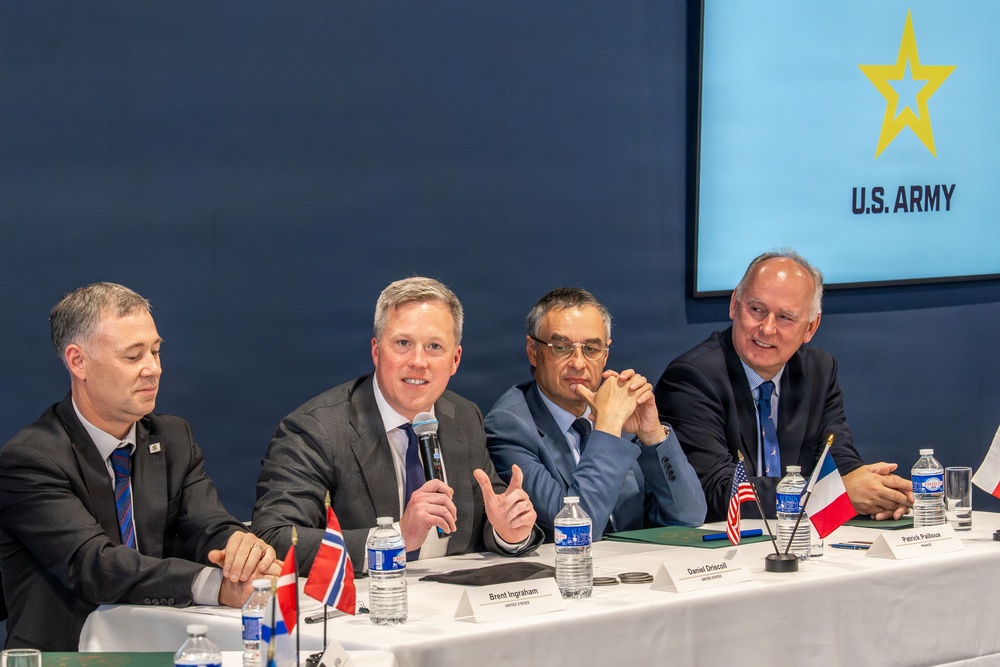
The Netherlands has signed a letter of intent to join the US Army's UAS and Counter-Unmanned Aircraft Systems Marketplace Initiative, with Lieutenant General Harold Boekholt, Netherlands National Armaments Director, participating in the June 16 signing ceremony at the Eurosatory 2026 defense exhibition at Paris Nord Villepinte. The Netherlands was among nine nations that signed letters of intent at that ceremony, which included Sweden, Denmark, Norway, France, Poland, the United Kingdom, Italy, and Lithuania. The Army is pressing to reach 25 allied and partner members by end of summer 2026 — a timeline that implies most of the remaining slots are already pre-negotiated.
The Marketplace, administered by Joint Interagency Task Force 401 (JIATF-401), is a centralized, virtual procurement platform that gives member nations access to drone and counter-drone systems pre-validated through US Army operational testing. According to army.mil, earlier partners in the initiative include the UK, Romania, Australia, Poland, and the Republic of Korea. At Eurosatory, all nine nations — including the Netherlands — signed the same letter of intent; there is no source-confirmed distinction between tiers of participation among the June 16 signatories.
What the Marketplace Actually Is
The Marketplace is not a joint purchasing cooperative in the traditional NATO-agency sense. It functions more like a curated, pre-validated vendor catalog with interoperability guarantees baked in at the procurement level. In the current phase, participating nations buy counter-UAS systems of US origin; the longer-term architecture is designed so that allied nations can eventually submit their own systems for evaluation and offer them to other members, though that reciprocal channel is not yet operational. The distinction matters: right now it is a US export facilitation tool with interoperability dressing; later it could become a genuine multilateral capability exchange.
The validation pipeline feeding the catalog was shaped in significant part by Operation Jailbreak, a US Army evaluation exercise that reviewed approximately 100 systems in 30 days — a pace that suggests a stress-test environment rather than a deliberate milestone review. A March 2026 US–UK joint declaration on common C-UAS data standards provides the interoperability backbone: without agreed data formats, sensor output protocols, and command interfaces, a catalog of mixed-vendor systems deployed across multiple national militaries would produce integration overhead that defeats the purpose of the initiative entirely.
"To do things like air defense, we need all of our equipment to be interoperable at a minimum." — Army Secretary Driscoll, Eurosatory 2026
Secretary Driscoll's framing at the June 16 ceremony was explicit about the feedback-loop procurement model underlying the initiative: "What we think will work is to allow everyone here to offer their products to Soldiers around the world and us to just listen to Soldiers, get their feedback, and then scale the things that work." That is a materially different philosophy from traditional milestone-based acquisition — it implies iterative fielding with real operational data driving which systems scale rather than which systems clear a specification gauntlet on paper. Whether that model survives contact with ally procurement bureaucracies is an open question, but the intent is clearly to treat the Marketplace as a living catalog rather than a static approved-vendor list.
The Netherlands' Position in NATO C-UAS
The Netherlands' signing at Eurosatory did not occur in isolation. On the same day, the Netherlands and Sweden separately agreed to procure Smart-L radars from Thales, according to reporting by Unmanned Airspace citing the Netherlands Ministry of Defence. Smart-L is a long-range air and missile defense radar — its inclusion alongside the Marketplace signing signals that the Netherlands is deliberately threading together its lower-tier C-UAS capability (the Marketplace systems) with its upper-tier air surveillance architecture in a single compressed procurement sprint at one exhibition.
That layered approach reflects a pattern visible across the broader membership. Several signatories operate under the acute threat calculus of direct proximity to Russia, making rapid C-UAS fielding a near-term operational requirement rather than a planning horizon. Others bring significant existing C-UAS programs and industrial bases of their own. Nations with their own counter-drone systems are relevant precisely because the Marketplace's long-term design allows participants to eventually list their own products for allied purchase. Each nation's accession changes the political economy of what the catalog eventually contains.
Why It Matters
The Marketplace model, if it scales to 25 nations, would represent one of the more consequential shifts in how allied C-UAS procurement gets structured since drone threats moved from a niche counterterrorism concern to a NATO-wide force design problem after 2022. The underlying dysfunction it addresses is real: bilateral agreements and ad-hoc national purchases leave allied units with incompatible sensor outputs, mismatched engagement authorization protocols, and no shared operational picture of what systems actually work at scale. A validated, interoperable catalog with a data-standards backbone attacks all three of those problems simultaneously — at least in principle.
The 25-nation target by end of summer 2026 is aggressive. The nine nations signing letters of intent at Eurosatory represent a significant single-ceremony expansion. Whether the initiative maintains meaningful interoperability standards as it scales — or whether the catalog drifts toward a lowest-common-denominator list padded with political signatories — will determine whether the Marketplace becomes a durable procurement architecture or an ambitious announcement.
For the Netherlands specifically, signing the letter of intent at Eurosatory sets a path toward access to a validated system pool at a moment when Dutch defense budgets and acquisition timelines are under sustained pressure to accelerate. The simultaneous Smart-L agreement indicates the Netherlands is using Eurosatory to compress what would ordinarily be a multi-year C-UAS procurement sequencing problem into a single exhibition week: joining the US-led framework for lower-tier systems while independently securing the long-range radar layer. That is coherent procurement strategy, and it fits the pattern of smaller NATO members moving faster than their larger allies to lock in modernized air defense architectures before the political window narrows.
Sources
- U.S. Army — US Army, Allies and Partners to Expand Drone and Counter-Drone Marketplaces at Eurosatory Defense Exhibition
- DVIDSHUB / U.S. Army — Army Secretary Highlights Counter-UAS Cooperation, Acquisition Reform at Eurosatory 2026
- Unmanned Airspace — Netherlands joins US marketplace for UAS and C-UAS (citing Netherlands Ministry of Defence)
