
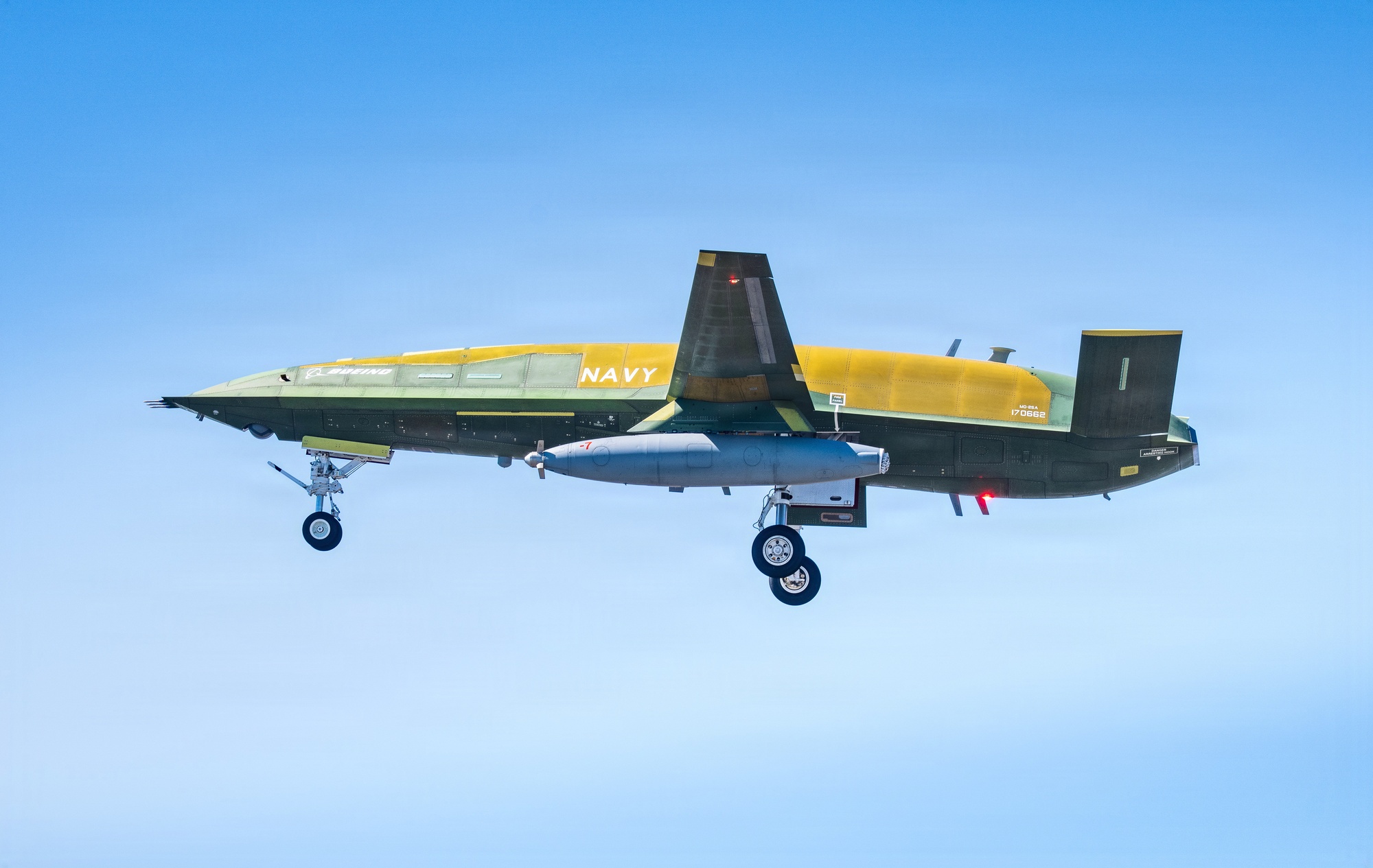
The U.S. Navy has formally reopened its hunt for a carrier-based drone wingman, posting a Request for Information on SAM.gov on Aug. 31, 2026, that asks industry for two "fully functional, unmanned autonomous prototype air vehicle(s)" capable of operating from Ford- and Nimitz-class carriers. Responses are due Sept. 18, 2026 — an 18-day window for a program with an unusually specific set of demands baked in from the start.
The solicitation, issued by Naval Air Systems Command's Future Advanced Capability Program Office, covers what the service is calling Collaborative Combat Aircraft (CCA) Increment 1. According to reporting from DefenseScoop, which reviewed the notice (SAM.gov ID 9f1ccd7a09b847a684806128b982bec3), the Navy wants mature, flight-tested hardware rather than paper concepts or digital designs. Companies must be able to demonstrate catapult takeoff and arrested landing — the two defining stresses of carrier aviation that have sunk more than one unmanned aircraft program before it reached the flight deck — and integrate with the MD-5 Unmanned Carrier Aviation Mission Control System, the Navy's existing command-and-control backbone for shipboard drones.
What the Navy Is Actually Asking For
The RFI's requirements read less like an early-stage feeler and more like a program office that already knows what it wants:
- Two prototype aircraft, not concept studies, able to fly from Ford- and Nimitz-class carriers.
- Four externally mounted weapons, each up to 2,500 pounds.
- A $30 million price cap per aircraft, confirmed by both DefenseScoop's and Stars and Stripes' reporting on the RFI.
- First flight within two years of contract award, with full shore-based carrier certification required by year three, per DefenseScoop's account of the notice.
- A footprint no larger than a fourth-generation fighter on the flight deck and in the hangar bay — Aviation Week reports the RFI references the Boeing F/A-18E/F Super Hornet as the size ceiling, a constraint central to how the Navy is scoping the fleet it eventually wants to buy.
Aviation Week headlined its coverage of the RFI as the Navy's search for a "larger, carrier-based CCA fleet" — framing that reads as a signal this isn't a token experimental buy but a program aimed at meaningful numbers of airframes integrated into the carrier air wing.
A Second Attempt at an Old Idea
The Navy has been here before. Roughly a decade ago, the service walked away from a carrier-based unmanned combat aircraft after early efforts — most notably the X-47B demonstrator program — proved the technology could work but stalled before turning into a program of record with a defined mission set and acquisition strategy. The Navy instead redirected its unmanned carrier ambitions toward the MQ-25 Stingray, an aerial refueling tanker drone with no strike role. This new RFI marks the clearest sign yet that the Navy is going back for the mission it deferred. Where the earlier effort got tangled in unresolved questions about whether a carrier drone should be a stealthy strike platform or something more modest, this solicitation sets hard numbers up front: a firm price ceiling, a firm weapons payload, and a firm schedule. That specificity suggests NAVAIR wants to avoid a repeat of the requirements churn that stalled the previous attempt.
How It Fits Into the Carrier Air Wing
Per Stars and Stripes' reporting, the CCA is meant to augment — not replace — the F-35C Lightning II, the Navy's carrier-based fifth-generation fighter, and the future F/A-XX, the sixth-generation fighter the Navy is developing separately. The pairing follows the manned-unmanned teaming concept the Air Force has pursued with its own CCA program: a piloted fighter directing one or more autonomous drones that extend sensor reach, add weapons capacity, or absorb risk in contested airspace, all while the pilot stays out of the most dangerous engagement envelope. The $30 million target price is the number that makes that concept survivable at scale. A drone priced well below a crewed fighter's cost can be built, fielded, and — if the mission calls for it — lost in greater numbers than a manned fighter, which is the entire premise behind treating CCAs as attritable rather than exquisite assets.
Why It Matters
This RFI is the clearest evidence yet that the Navy intends to field an armed, carrier-qualified drone as a program of record rather than a demonstrator. The specificity of the requirements — a hard price cap, a defined weapons payload, a three-year certification clock, and a mandate for flight-proven hardware rather than paper designs — signals the service wants vendors who can move fast, not ones still refining a concept. It also positions the Navy to catch up with the Air Force's CCA effort, which DefenseScoop reports has already moved into production agreements with General Atomics and Anduril. For industry, the Sept. 18 deadline gives companies with existing unmanned carrier aviation experience — or hardware already flying in other programs — a real edge, since the RFI's demand for "mature" prototypes effectively rules out anyone starting from a blank sheet. How the Navy structures the follow-on competition, and which companies respond by the deadline, will show whether this second attempt at a carrier strike drone finally turns into hardware on the flight deck.
