
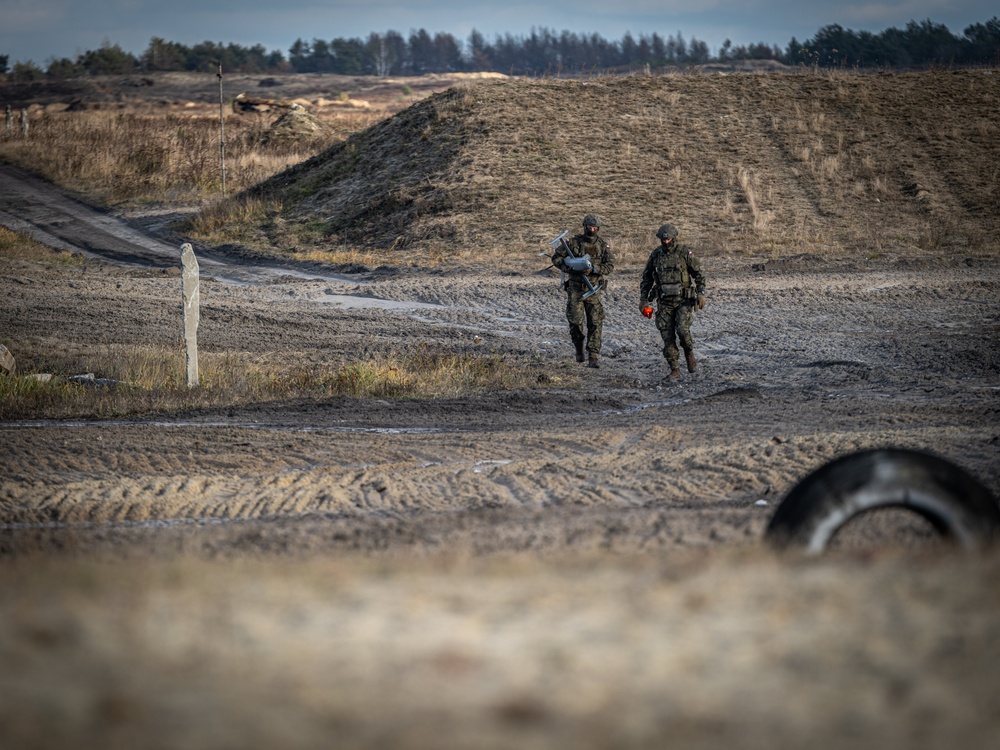
Ramstein Air Base has hosted plenty of gatherings built around fighter jets and airlift. Last week's was about something smaller, cheaper and increasingly dangerous: the one-way attack drone. On June 30 and July 1, 2026, NATO's Allied Air Command (AIRCOM) convened its second AIRCOM Industry Day, pulling in roughly 34 to 35 companies from more than 20 countries to work a single problem — how to build counter-uncrewed aerial systems (C-UAS) technology fast enough, and cheap enough, to matter.
The event was explicitly tied to Eastern Sentry, AIRCOM's ongoing shift from traditional Air Policing — the peacetime mission of intercepting stray aircraft near NATO airspace — toward a broader, multi-domain air-defense posture built to counter Russian drone incursions along the alliance's eastern flank. According to coverage of the gathering, the industry day focused on the full C-UAS engagement chain: detection, identification and tracking through to mitigation and neutralization. That is the language of an alliance that has concluded shooting down a drone is the easy, and least important, part of the problem.
The Math NATO Can't Ignore
Lieutenant General Guillaume Thomas laid out the stakes to attendees in blunt terms, telling the assembled industry representatives that NATO must "stay ahead of three key curves: cost, production and innovation." It's a framing that sounds like a business-school slide until you put numbers next to it.
Per reporting from Euronews, a Shahed-style one-way attack drone — the kind Russia has fired into Ukraine by the thousands — costs under €100,000 to build. A single NATO fighter jet scramble against such a drone can already run tens of thousands of euros per hour, and a typical two-jet interception costs more than €85,000 in total before a missile ever leaves the rail. Multiply that gap across a sustained drone campaign and the arithmetic turns against the defender fast: cheap, mass-produced attackers versus expensive, exquisite interceptors that were never designed to be spent on cardboard-and-plywood threats.
That asymmetry is precisely why AIRCOM's second Industry Day wasn't a showcase of exotic new weapons so much as a working session on production economics. The message to the roughly three dozen firms in the room was less "build us something clever" and more "build us something you can build a lot of, quickly, at a price that doesn't bankrupt the mission."
Who Showed Up, and With What
The exhibitor list read like a cross-section of Europe's air-defense industrial base. Per Euronews's coverage of the event, MBDA, Hensoldt, Aselsan and Alta Ares were among the roughly 35 companies present, bringing radars, interceptor drones and missile systems built for the detect-through-neutralize chain AIRCOM says it needs.
The most concrete program to emerge from the event involves MBDA's counter-drone missile, which is being integrated into Rheinmetall's Skyranger 30 gun/missile system — a turreted, vehicle-mounted platform already positioned as a frontline answer to drone and cruise-missile threats. Under the configuration described by Euronews, each Skyranger 30 vehicle will carry nine of MBDA's missiles, meaning a six-vehicle battery fields 54 ready-to-fire rounds. First deliveries are slated for 2027 to 2028, bound for Germany's brigade based in Lithuania — a unit sitting directly astride NATO's most exposed eastern approach.
That timeline matters as much as the hardware. A battery of 54 ready rounds sounds substantial until it's measured against the volume of drones Russia has demonstrated it can launch in a single night over Ukraine. The Skyranger/MBDA pairing is a real capability, but it's also a multi-year fielding plan against a threat that isn't waiting.
Detection, Not Destruction, Is the Bottleneck
If Industry Day had a single unifying theme beyond cost, it was that killing a drone is no longer the hard part. Senior Lt. Oleksandr Vorobiov, a Ukrainian officer who spoke at the event, told attendees that reliable detection remains "the one thing" standing between current systems and fully autonomous intercept.
That's a notable statement coming from an officer with direct combat experience against the exact threat NATO is now organizing to defend against. Ukraine has spent more than three years refining counter-drone tactics under fire, and its representatives at NATO industry events have increasingly become a de facto reality check on Western assumptions. Vorobiov's comment suggests that missiles, guns and interceptor drones are advancing faster than the sensor networks meant to cue them — a gap that limits how much of the engagement chain can be handed off to automation without a human still doing the hardest job: finding the thing in the first place, reliably, in time to act.
Eastern Sentry's Bigger Shift
AIRCOM has framed all of this within Eastern Sentry, its move away from the Cold War-era Air Policing mission — built around intercepting the occasional stray aircraft — toward a standing, multi-domain air-defense posture. Coverage of the event from Defence Industry Europe underscores that framing: this isn't a one-off procurement sprint but a structural reorientation of how AIRCOM organizes its mission against one-way attack drones crossing or approaching allied airspace.
That distinction explains why NATO brought industry to the table twice now rather than issuing a single requirements document. Air Policing was built for rare, discrete events. Countering a sustained drone threat requires a defense-industrial relationship that behaves more like a subscription than a purchase order — one where companies are expected to keep pace with an adversary that iterates its drone designs cheaply and often.
Why It Matters
NATO's own officers are now saying the quiet part out loud: the alliance cannot win a war of attrition against €100,000 drones by scrambling fighter jets that already cost tens of thousands of euros per hour to fly, with a two-jet intercept running north of €85,000 before a shot is fired. AIRCOM's second Industry Day was an attempt to bend that cost curve before it bends the alliance's air-defense budgets first — by pushing European industry toward interceptors and sensor networks that can be mass-produced rather than hand-built.
The Skyranger 30/MBDA missile program shows what a production-minded answer looks like in practice: a vehicle-mounted system designed to carry dozens of ready rounds per battery rather than a handful of exquisite, expensive shots. But the 2027-2028 delivery window for just one brigade is a reminder of how long defense-industrial timelines run, even when everyone agrees on the urgency. Meanwhile, a Ukrainian officer with firsthand experience against the exact threat set is telling NATO that detection — not missiles, not guns, not even production volume — is still the limiting factor standing between today's systems and the fully autonomous counter-drone shield the alliance ultimately wants along its eastern flank.
Sources
- AIRCOM Industry Day advances counter-drone innovation in support of NATO's Eastern Sentry — NATO Allied Air Command
- NATO's drone problem: Can European industry close the gap? — Euronews
- NATO AIRCOM Industry Day advances counter-drone innovation for Eastern Sentry and wider multi-domain air defence posture — Defence Industry Europe
