
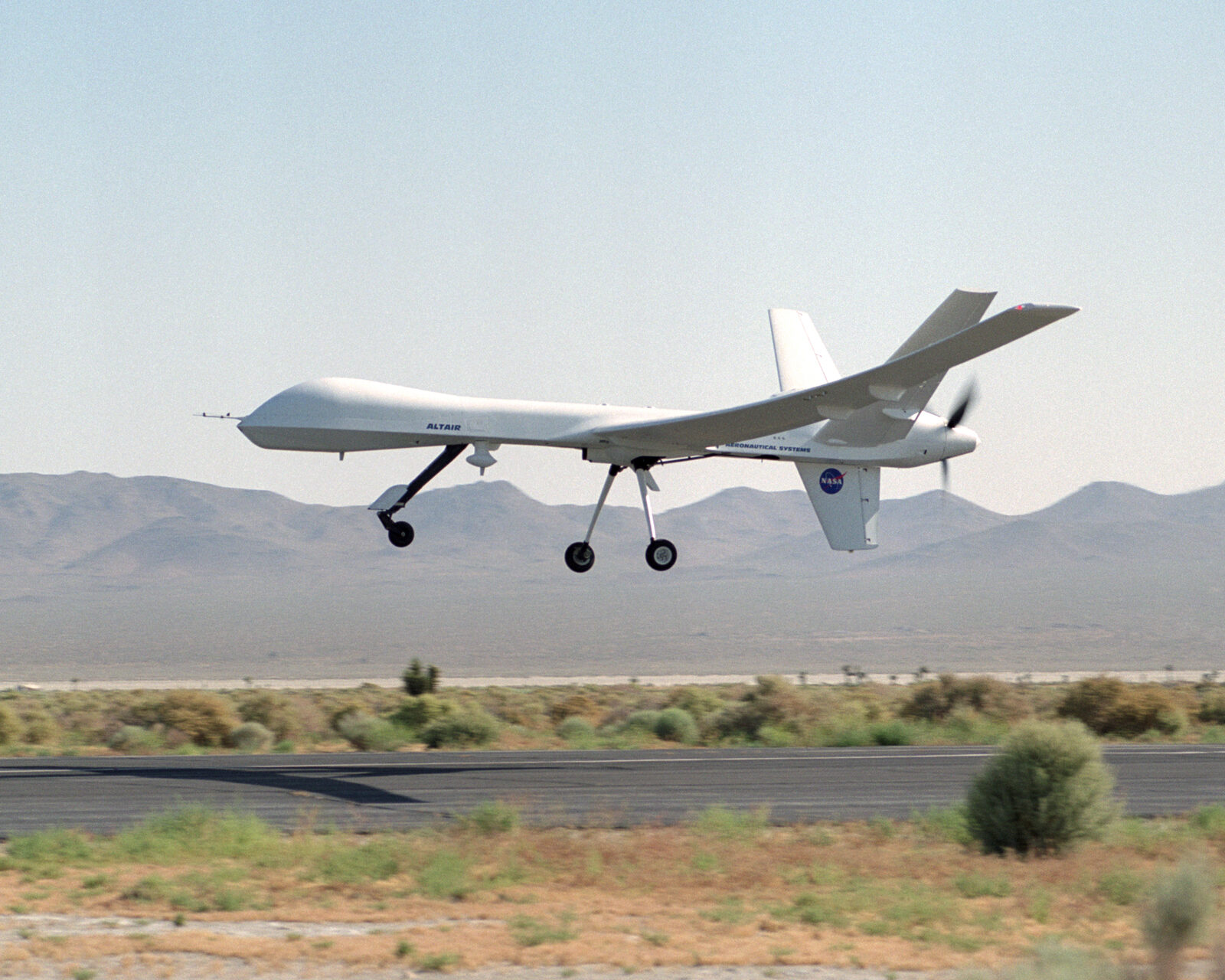
Every drone, regardless of marketing language, makes the same core engineering compromise: hover capability costs endurance; endurance costs hover. Gravity does not negotiate. The three dominant airframe classes — multirotor, fixed-wing, and hybrid VTOL — each resolve this tension differently, and the resolution defines everything downstream: where the platform can operate, how long it can stay up, how much it can carry, and what missions it can actually accomplish.
How Each Type Stays Airborne
A multirotor generates lift the same way a helicopter does — by pushing air downward with spinning blades. The difference is distribution: instead of one large rotor, power is split across three, four, six, or eight smaller ones. Each rotor is connected to a dedicated motor, and flight control is achieved by varying individual motor speeds. Speed up the rear rotors relative to the front, and the platform pitches forward. Differential torque between clockwise and counterclockwise rotors produces yaw. The elegance is real — no complex swashplates, no tail rotor, no mechanical coupling — but the physics is punishing. Every joule of energy goes toward fighting gravity in real time. The moment the motors stop, the aircraft falls.
Fixed-wing platforms sidestep this constraint entirely. Once moving fast enough, the airfoil shape of the wing creates a pressure differential — lower pressure above, higher below — and the resulting net upward force is aerodynamic lift. The propulsion motor's only job at cruise is to overcome aerodynamic drag, which is a fraction of the force required to hover the aircraft's weight. As Mississippi State University Extension's agricultural drone guidance states: "Since the wing provides lift, the motor doesn't have to spend all the battery power to maintain flight." The energy savings are not marginal — they fundamentally change the mission calculus.
Hybrid VTOL platforms attempt to combine both modes in a single airframe. They take off and land on rotor power, then transition to fixed-wing aerodynamic lift for cruise. The transition is the hard part, and how different manufacturers handle it defines the two main sub-categories examined below.
The Endurance and Range Gap
The numbers expose the tradeoff starkly. Consumer multirotors typically achieve 20–30 minutes of flight time. High-end commercial multirotors push further: DJI's Matrice 300 RTK, widely used for professional inspection work, manages approximately 55 minutes without payload. Fixed-wing platforms begin where multirotors end. The WingtraOne Gen II maps at 60 minutes with its 42MP camera; the JOUAV CW-30E, a commercial ISR platform, achieves 480 minutes of continuous flight. At the military extreme, Kraus Hamdani's K1000ULE — a solar-electric fixed-wing that recently won a $270 million ISR contract from U.S. Air Forces Central — sustains 75 hours at 20,000 feet across ranges exceeding 700 nautical miles. The K1000ULE surpassed Lockheed Martin's Stalker VXE's 36-hour endurance record in 2023.
"When beyond-line-of-sight operations are critical, the K1000ULE's secure SATCOM capability enables both ISR and resilient connectivity for U.S. forces and partner nations across the Middle East." — Stefan Kraus, Kraus Hamdani Aerospace cofounder and CTO
Hybrid VTOL platforms occupy the middle ground. The Avy Aera, a Dutch-built medical logistics and inspection VTOL, cruises at 100 km/h and covers up to 100 km per flight. The Autel Dragonfish Pro achieves up to 180 minutes at up to 18.6 miles range. These numbers exceed typical multirotors substantially while remaining below dedicated fixed-wing performance — the expected consequence of carrying propulsion hardware that serves no aerodynamic purpose during cruise.
The Dead Weight Problem and Deployment Freedom
The hybrid VTOL's central engineering liability is parasitic mass. During forward flight, the vertical lift motors, their electronic speed controllers, and the associated propellers do nothing except add weight and drag. As MoneyPro UAV's engineering analysis describes it: "During forward flight, the vertical lift motors, electronic speed controllers (ESCs), and vertical propellers serve no aerodynamic purpose." The airframe hauls them the entire mission. Stationary vertical rotors also create parasitic drag in cruise, making the platform less aerodynamically pure than a traditional glider of identical weight.
This effect is measurable in payload-endurance curves. The WingtraOne Gen II drops from 60 to 45 minutes when swapping its 42MP camera for a heavier LiDAR module. The DJI M300 RTK falls from 55 to 40 minutes with a comparable sensor swap — a larger proportional hit because multirotors bear payload weight entirely through rotor thrust rather than wing lift.
What hybrid VTOL platforms gain in exchange is deployment freedom. They can operate from cleared forest patches, ship decks, or confined urban rooftops without runways, catapults, or net recovery rigs. If forward propulsion fails mid-mission, the vertical rotors can engage for a controlled descent rather than a catastrophic airframe loss — a redundancy architecture pure fixed-wing cannot match. The Avy Aera operates in winds above 30 knots and rain with full propulsion redundancy during transition.
Tail-Sitters vs. Quadplanes
Within the hybrid VTOL category, two architectures compete on different tradeoffs.
A quadplane looks like a conventional aircraft with additional rotors — typically four — mounted on the wings or fuselage. Dedicated hover rotors and cruise propulsion are fully separate, allowing each to be optimized independently. The liability is mechanical complexity. Wingtra's engineering analysis is direct: "A quadplane has 3x more points of failure (actuators) than a tailsitter." Assembly typically requires two people; setup times are longer.
A tail-sitter stands vertically on its tail for launch, uses its main rotors — the same rotors that will drive forward cruise flight — to achieve hover, then pitches the entire aircraft forward to transition into fixed-wing mode. Wingtra's WingtraOne uses only four actuators and weighs 4–4.5 kg, compared to a comparable quadplane at 14 kg. One operator completes preflight in approximately five minutes. The WingtraRAY is a larger mapping tail-sitter with extended range. The tradeoff is transition complexity: pitching through 90 degrees while maintaining controllable flight through the intermediate aerodynamic regime demands sophisticated flight control algorithms.
Anduril's Omen — a twin-rotor tail-sitter in development since 2019, with first VTOL flight in January 2020 and more than 30 prototypes accumulated — applies the same configuration at military scale. Classified as an upper-end Group 3 platform, Omen operates at 100–250 knots, 3,500–18,000 feet altitude, with claimed range three to four times and payload three to five times that of typical Group 3 designs. The program has drawn $850 million from Anduril and $200 million from UAE defense conglomerate EDGE Group, with a firm order for up to 50 units. As Anduril's Dr. Shane Arnott confirmed of the platform's positioning: "It is a heavy Group 3, so we are at the upper end of Group 3."
Mission-First Selection Logic
The airframe choice should follow the mission profile, not the inverse.
- Inspection and close-proximity work is multirotor territory. Holding station beside a bridge pier, transmission tower, or wind turbine blade — maintaining a fixed point while a sensor dwells — is something neither fixed-wing nor hybrid VTOL replicates cleanly. Multirotors are compact, quick to deploy, and require no launch infrastructure. Their 15–45 minute endurance windows are adequate for structure-by-structure inspection workflows.
- Large-area mapping, agriculture, and surveying strongly favor fixed-wing or hybrid VTOL. Fixed-wing platforms can cover hundreds to over 1,000 acres per battery charge. The per-acre cost of flight time, at fixed-wing endurance levels, drops dramatically versus multirotor alternatives. MSU Extension's guidance is explicit: since rotors provide all lift on a multirotor, "the battery life is greatly reduced" — 15–20 minutes typical in agricultural use.
- Logistics delivery and emergency response are increasingly hybrid VTOL's domain. The combination of vertical deployment and efficient cruise fits delivery networks that neither extreme handles as cleanly. Avy operates medical supply delivery from rooftops and quaysides; the Autel Dragonfish serves similar roles commercially.
- ISR at range splits by hover requirement. Persistent wide-area surveillance with no station-keeping requirement — border monitoring, maritime patrol, theater-level reconnaissance — favors high-endurance fixed-wing. The K1000ULE's solar architecture enables drone constellations spanning thousands of miles under single-operator control. When the mission requires loitering over a specific point, the calculus shifts toward platforms with genuine hover capability.
The selection logic, stripped to essentials: if the mission requires precision hovering at a fixed point, choose multirotor. If it requires maximum time on station or maximum ground coverage per flight, choose fixed-wing. If it requires both vertical deployment freedom and meaningful cruise range, choose hybrid VTOL — then decide between tail-sitter efficiency and quadplane modularity based on operational tempo and mechanical-reliability priorities.
No airframe class is universally superior. The K1000ULE's 75-hour solar ISR endurance is irrelevant if the mission is inspecting a cell tower. A DJI M300's five-minute setup is irrelevant if the mission covers 50 kilometers of pipeline. What has changed over the past decade is that the gaps between categories have narrowed: hybrid VTOL platforms now cover distances that were exclusively fixed-wing territory five years ago, and improved battery density has pushed multirotor endurance past the 45-minute mark on professional platforms. The physics of lift and gravity remains unchanged. The engineering to work around it continues to improve.
Sources
- Wingtra — Tailsitters vs. Quadplanes: Why a VTOL Tailsitter Is the Best Surveying Drone
- UAV Coach — VTOL Drones In-Depth Guide 2026
- MoneyPro UAV — Fixed-Wing Hybrid VTOL Drone: An Expert Engineering Analysis
- The War Zone — Anduril Unveils Omen Hybrid-Electric Tail-Sitter VTOL Drone
- Anvil Labs — Fixed-Wing vs. Multi-Rotor Drones: Endurance Comparison
- Air & Space Forces Magazine — AFCENT Awards Contract for Ultra-Long-Range Solar-Powered ISR Drones
- Avy — VTOL Technology
- Mississippi State University Extension — Types of UAS
- Grepow — Multirotor vs Fixed-Wing vs VTOL UAV: What Is the Difference?
- Environmental Science Associates — Emerging Technology in Aviation: UAV, UAS, and Drones
