
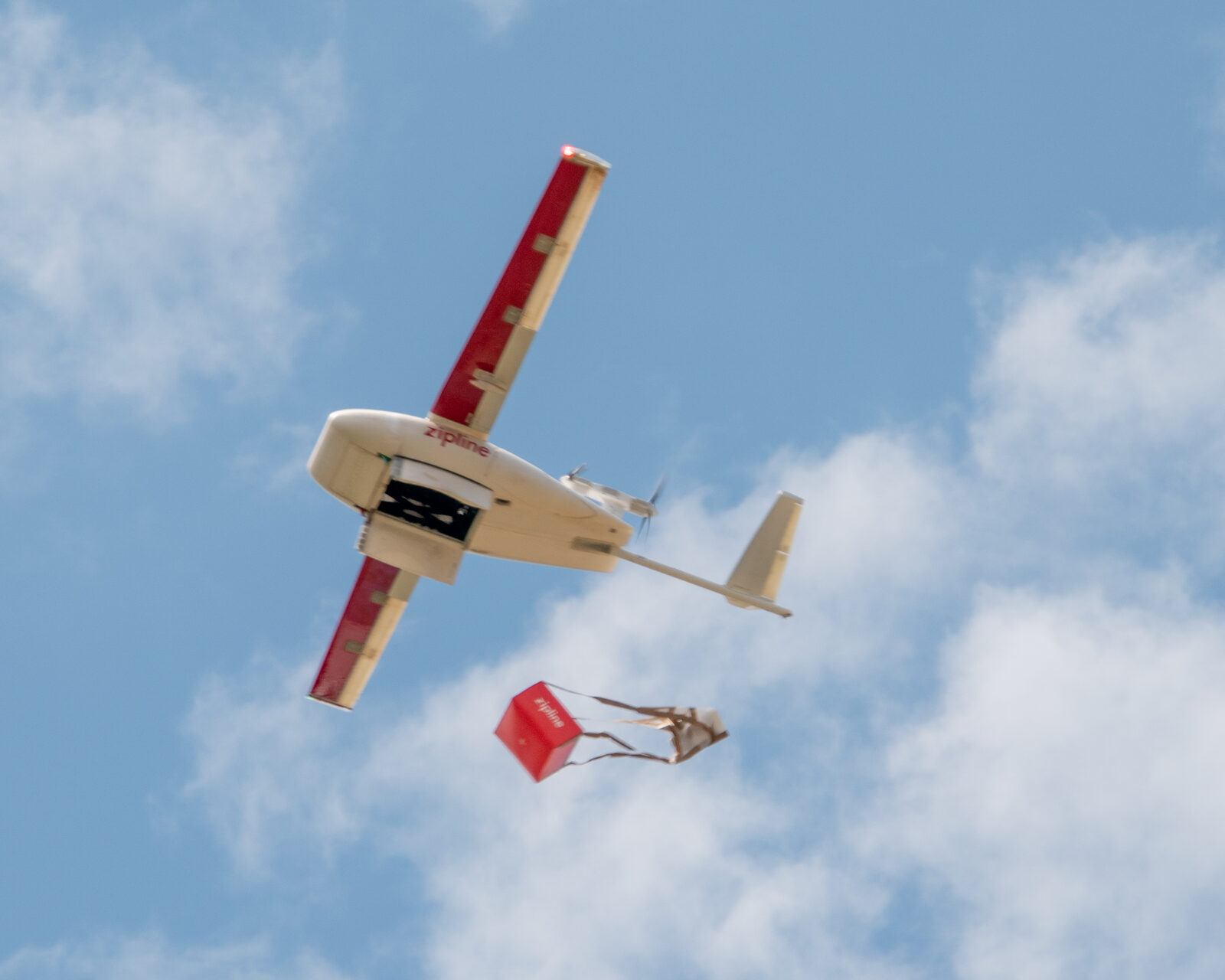
Time is the constraint that drone delivery was built to attack. A rural clinic in Ghana's Ashanti Region running short of blood during a postpartum hemorrhage faces a supply chain measured in days. A drone covers 100 kilometers in under 30 minutes. That gap—between what traditional logistics can deliver and what a hemorrhaging patient needs—is the entire humanitarian and commercial case for medical UAS.
From Rwanda to a Delivery Every 60 Seconds
Zipline—founded in 2014, operational in Rwanda by 2016—built the template. As of 2024–2025, it serves more than 4,800 health facilities across five countries: Rwanda, Ghana, Nigeria, Kenya, and Côte d'Ivoire, reaching approximately 49 million people. At scale, the network makes a delivery every 60 seconds.
What it carries: blood products, vaccines, antiretrovirals, and medicines ordered on demand via mobile phone. The logistics innovation is as much about ordering behavior as aircraft. Traditional supply chains push bulk inventory to remote clinics, which over-order to avoid stockouts and discard expired product. On-demand drone ordering eliminates the rationale for bulk stocking—and its consequences. In Rwanda, blood wastage at Zipline-served facilities declined by 67 percent. In Ghana's Ashanti Region, healthcare workers and patients reported blood and medicines arriving within 30 minutes of ordering, versus days under traditional resupply.
The health outcome data is striking, though methodologically bounded. A mixed-methods study of 103 facilities in Ghana's Ashanti Region—pre-exposure 2017–2020, post-exposure 2021–2022—found a 56 percent reduction in maternal deaths at drone-served facilities versus non-served (risk ratio 0.44, 95% CI 0.27–0.70). Antenatal visits rose 20 percent, facility deliveries rose 26 percent, and referrals increased 3.41-fold. In Rwanda, a University of Pennsylvania Wharton School study found a 51 percent reduction in in-hospital maternal mortality from postpartum hemorrhage at Zipline-served facilities.
The cold-chain dimension is underappreciated. Most vaccines require continuous 2–8°C storage at every distribution node—a requirement that, in low-infrastructure environments, means equipping hundreds of remote clinics with functional refrigeration. Drone delivery centralizes cold storage at the distribution hub and ships on demand, eliminating distributed cold-chain requirements entirely. In Ghana's Western North Region, drone delivery raised immunization coverage by 13.1 to 37.5 percentage points depending on vaccine type.
The Data Ceiling and the Economics
The honest read: there is no randomized controlled trial. The Ashanti Region study uses a quasi-experimental design comparing treatment and control facilities via administrative data—the strongest available methodology short of an RCT, but not an RCT. GiveWell, which funded a $54,620 scoping grant in December 2024 to evaluate drone-based vaccine delivery expansion, assessed existing cost-effectiveness models at only a "shallow" review level and placed just a 27 percent probability on funding follow-on pilots by March 2026, citing data quality limitations.
Scaling to the hardest-to-reach communities has also proved elusive. A Ghana Ministry of Health review found only 12 percent of the country's designated hard-to-reach communities were actually being reached by Zipline, and flagged potential closure of three of its six distribution centers. The communities Zipline serves most effectively sit within 100 kilometers of a hub in relatively clear airspace—not at the true geographic margin.
On cost: 68 percent of Ghana healthcare professionals surveyed identified high operational costs as a significant barrier. Zipline's unit economics depend substantially on multi-sector deployment—food, e-commerce, retail—which cross-subsidizes health-sector operations. Per Zipline's own cost modeling, the platform delivers health benefits below the willingness-to-pay threshold from both governmental and societal perspectives, though whether that holds without cross-sector revenue remains an open question. Gavi, announcing in June 2024 a commitment to deliver 250 million vaccine doses by drone over five years, framed the initiative as a validation of the platform's maturity.
US Pilots and the BVLOS Waiver Bottleneck
The United States has no Zipline-scale network—it has an accelerating cluster of hospital pilots operating under FAA authorizations ranging from on-campus visual line-of-sight (VLOS) to case-by-case BVLOS waivers. BVLOS operations, where the operator cannot maintain direct visual contact with the aircraft, are necessary for any meaningful rural coverage. As of January 2024, DroneUp held one of the few FAA BVLOS waivers specifically for medical deliveries, enabling autonomous operations for Riverside Health System without ground-based visual observers.
Four programs span the current range. Northwestern Medicine Delnor Hospital (Geneva, Illinois) launched a pilot in October 2024 transporting blood samples and blood products between buildings, replacing 40-plus monthly manual staff walks and four scheduled courier runs daily—VLOS only, constrained by FAA prohibitions within five miles of airports. Munson Healthcare, which serves 540,000-plus residents across 29 northern Michigan counties and logs more than 90,000 staff-driven miles annually on specimen transport, completed a May 2025 pilot: 67 flights, 91 percent success rate, average payload temperature 17.3°C. Phase 2, targeting BVLOS, is planned for 2026.
Most ambitious is Mid-America Transplant's 160-mile BVLOS corridor launched April 2026: Springfield to Rolla to St. Louis, Missouri, at 300–350 feet AGL. The aircraft—a fixed-wing VTOL, 8-foot wingspan, 80 mph cruise, 12-pound payload—requires a mid-route battery swap in Rolla and transports blood samples from potential organ and tissue donors. Transport time drops from over three hours to under two; cost falls approximately 90 percent versus ground transport. The organization facilitated 799 organ transplants in the prior year; more than 1,400 individuals in the region currently await an organ.
"In our work, every second counts, and faster, more reliable transport of lab samples helps us honor each donor's gift to its fullest potential." — Kevin Lee, President and CEO, Mid-America Transplant
The gating constraint is identical across all four programs: BVLOS waivers are adjudicated case by case. Battery range limits single-leg distance—hence Mid-America's mid-corridor swap. Airspace near airports and population centers remains restricted. Until the FAA moves from waivers toward a rule-based BVLOS authorization pathway, US medical drone infrastructure will scale incrementally. The clinical case is built on a decade of documented operations. The regulatory calendar is the open variable.
Sources
- PMC / PLOS ONE — Drone delivery and maternal health outcomes, Ghana Ashanti Region (peer-reviewed)
- PMC — Zipline operations, healthcare worker perceptions, and barriers in Ghana (peer-reviewed)
- GiveWell — Scoping grant: drone-based vaccine delivery expansion (December 2024)
- Stanford Social Innovation Review — Zipline's health innovations in Africa
- Unmanned Airspace — FAA approves DroneUp BVLOS waiver for medical deliveries (January 2024)
- DroneLife — Mid-America Transplant opens 160-mile drone corridor (April 2026)
- Northwestern Medicine — Delnor Hospital drone pilot for medical supply and lab specimens (2024)
- DroneLife — What a medical drone delivery pilot reveals about rural healthcare logistics (December 2025)
