
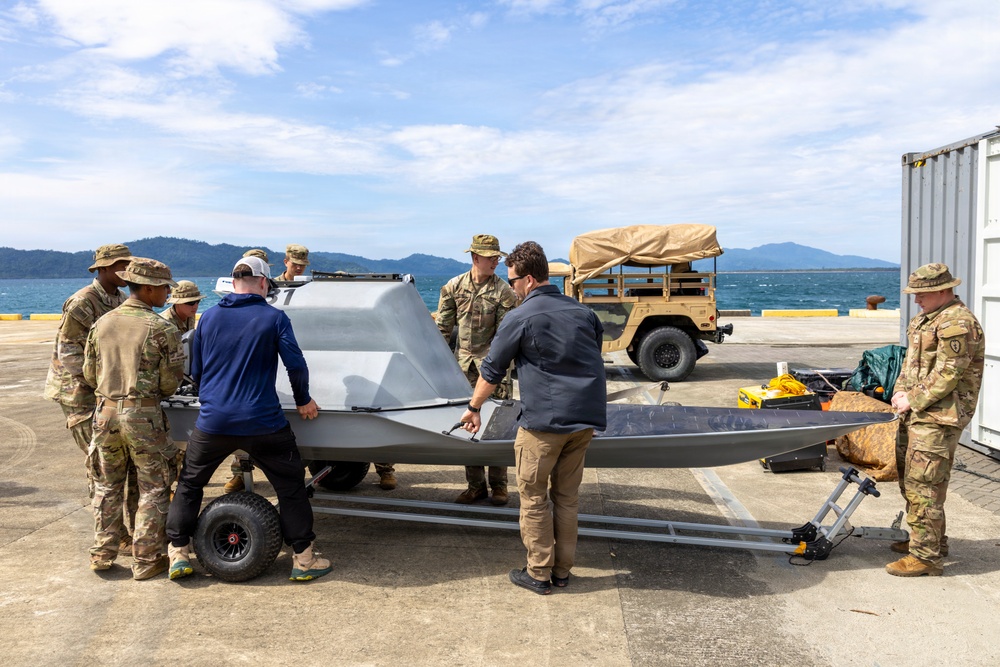
A Ukrainian-designed uncrewed surface vessel that has spent two years hunting Russian warships in the Black Sea has now sunk its first target on the other side of the planet. During Exercise Balikatan 2026 off the Philippine island of Itbayat, U.S. Army Green Berets used a Magura-class drone boat to put a decommissioned target ship on the seafloor — the first confirmed use of Ukrainian naval-drone technology in the Indo-Pacific theater.
The strike was carried out with a Magura V7-series USV as part of MARSTRIKE-N, a maritime live-fire component of the annual U.S.-Philippines military exercise. Uforce — a London-based startup that builds the Magura for Ukraine's military intelligence directorate (GUR), according to C4ISRNET — confirmed the sinking, and the U.S. Department of Defense subsequently released photos of the drone through its DVIDS distribution service — imagery that naval-OSINT analyst H I Sutton (Covert Shores) used to detail the boat's warhead and origin. Trade outlet C4ISRNET separately reported the event on July 1, framing it as evidence that Washington is now exporting combat-proven Ukrainian maritime-drone doctrine to a theater where a future Taiwan Strait contingency looms largest.
Notably, sourcing on the exact date of the strike is not fully consistent. Defence Blog, citing Uforce's own confirmation, places the sinking on April 24, 2026 — within the window of the actual Balikatan 2026 exercise, which DVIDS records as a 19-day drill that concluded with a closing ceremony on May 8, 2026. C4ISRNET's July 1 report, however, dates the sinking to June 24, 2026. UASFeed is presenting both figures as reported; the April 24 date aligns with the confirmed exercise timeline, while the June 24 date comes from a widely cited trade-press account. Readers should treat the precise date as unresolved pending further clarification from official channels.
What Exactly Is a Magura?
The Magura is not the same drone boat that has become famous for hunting the Russian Black Sea Fleet. That distinction belongs to the "Sea Baby," a larger uncrewed vessel operated by Ukraine's domestic security service, the SBU. According to C4ISRNET, Sea Baby is essentially a floating strike platform: it can carry six to eight first-person-view (FPV) attack drones plus thermobaric rockets, has a range of roughly 930 miles (1,500 km), uses AI-assisted targeting, and launches fiber-optic-guided drones that are immune to radio jamming. Brig. Gen. Ivan Lukashevych, who oversees the program, has said the SBU "became the first in the world to pioneer this new kind of naval warfare" — a claim backed by Sea Baby's real-world record of striking targets hundreds of miles from Ukrainian shores.
The Magura is a separate, smaller system, built by Uforce — a London-based startup, per C4ISRNET — for the GUR, Ukraine's military intelligence directorate, rather than the SBU. Each unit reportedly costs "hundreds of thousands of dollars," according to C4ISRNET, positioning it well below the price of a crewed patrol boat or missile, let alone a warship. Uforce CEO Oleg Roginsky characterized the Philippines demonstration as a natural extension of the platform's combat record: "Magura's successes on the Ukrainian-Russian front confirm their value for use in the Indo-Pacific region."
Inside the Warhead
Sutton's analysis of the DoD-released imagery gives the clearest public look yet at how the Balikatan Magura is armed. The boat carried a shaped-charge warhead built around one large, forward-facing explosively formed penetrator (EFP) flanked by seven smaller, angled EFPs — a configuration designed to punch through a hull and spray fragments across a wide arc rather than simply detonating on contact. Three impact fuses mounted on the forward hull matched the pattern seen on other Ukrainian-built Magura examples, according to Sutton, tying the Balikatan boat directly to the lineage that has operated against Russian shipping.
Sutton's report adds a wrinkle to the "Ukrainian drone" narrative: the specific variant used at Balikatan, the Magura V7.2, is actually manufactured in Portugal, and it was not new to NATO waters — the same design was previously demonstrated at NATO's REPMUS 25 exercise in September 2025. That earlier appearance suggests the Balikatan sinking was less a debut than a second act, this time performed in front of a Pacific audience and with a live target rather than a demonstration range.
Sutton also reports that the Magura family can be configured to carry the Sea Dragon "FrankenSAM" air-defense system, arming the boat with rails for either the U.S.-made AIM-9M Sidewinder or the Soviet-era AA-11 Archer missile. That modularity — swap a strike warhead for an air-defense package on the same hull — is part of what has made the Magura line attractive beyond Ukraine's own war.
Who Pulled the Trigger
Perhaps the most significant operational detail is who operated the drone. According to Sutton's reporting, the Maguras used in American service at Balikatan were operated by soldiers of 1st Special Forces Group (Airborne) — U.S. Army Green Berets, not a Ukrainian crew and not a Navy unit. That detail matters: it indicates the U.S. is training its own special operations forces, rather than relying on Ukrainian personnel or contractors, to employ the platform. Special Forces groups are regionally aligned, and 1st SFG(A) is oriented toward the Indo-Pacific, making it a logical unit to pioneer the tactic in a Philippine archipelago exercise.
The Exercise Behind the Demonstration
Balikatan — Tagalog for "shoulder to shoulder" — is the largest annual U.S.-Philippines military exercise. Per DVIDS' official after-action coverage, Balikatan 2026 was its 41st iteration and, per U.S. officials, the "most expansive Balikatan to date": a 19-day exercise spanning five archipelago sites, with participation extending beyond the two host nations to include Australia, Japan, Canada, France, and New Zealand, plus community engagement reaching more than 60,000 Filipinos. The closing ceremony was held May 8, 2026.
U.S. Navy Adm. Samuel J. Paparo, commander of U.S. Indo-Pacific Command, described the drill's trajectory in stark terms, calling it "a strategic evolution from a bilateral exercise to a full-scale, multinational mission rehearsal for the defense of the Philippines." The MARSTRIKE-N live-fire event — the specific serial in which the Magura sank its target — was one component of that broader, multinational rehearsal.
Why It Matters
The Black Sea has functioned, in effect, as a live laboratory for naval drone warfare: Ukraine's Sea Baby and Magura platforms have driven a Russian fleet with no meaningful surface navy of its own into a defensive crouch, sinking and damaging warships without Ukraine possessing a traditional navy capable of contesting the sea by conventional means. That lesson has not been lost on U.S. planners eyeing the Western Pacific, where a potential Taiwan Strait crisis would similarly pit a comparatively modest set of naval assets against a much larger conventional fleet — China's.
The Balikatan demonstration signals that the Pentagon is not merely observing Ukraine's naval-drone innovations from a distance; it is importing the actual hardware and testing it with the unit most likely to employ it in a real Indo-Pacific contingency. Using U.S. Army Green Berets, rather than a Navy surface unit, to operate a naval strike drone also reflects how uncrewed systems are blurring traditional service lines — a small boat with an EFP warhead is now within reach of a special operations team rather than requiring a warship or a naval air asset.
Cost is central to the calculus. At a reported price of hundreds of thousands of dollars, a Magura is a fraction of the cost of the vessels it can threaten, echoing the asymmetric math that has already reshaped the Black Sea. If the tactic proves exportable to Pacific waters — where distances are far greater and sea states often harsher than the relatively enclosed Black Sea — it could offer treaty allies and partner forces in the First Island Chain a low-cost way to complicate an adversary's freedom of maneuver at sea, without needing to match it hull for hull.
