
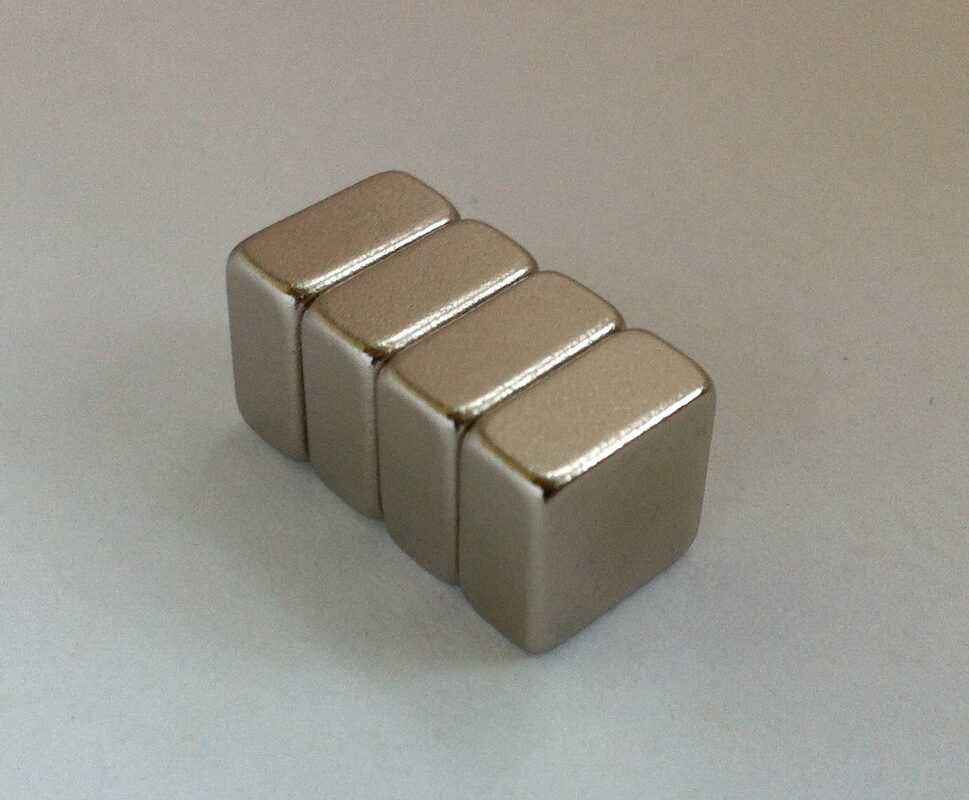
Every policy lever Congress has pulled against Chinese drone manufacturers — the FCC Covered List, NDAA procurement bans, the pending DJI litigation — operates at the product layer. None of it touches the material layer underneath. An all-American drone, assembled in Indiana from domestically sourced electronics and airframe composites, still spins on neodymium-iron-boron magnets processed in China. The brushless motors in virtually every commercial and defense UAS depend on rare-earth permanent magnets. So do the gimbals. So do the servos. Beijing controls more than 90 percent of global rare-earth permanent magnet production, and in 2025 it reminded Washington exactly what that leverage looks like: export restrictions on dysprosium and terbium — the heavy rare earths that give high-coercivity magnets the thermal stability brushless motors require — disrupted U.S. supply lines in a way no tariff schedule had prepared anyone for.
The Magnets Value Chain Support Act of 2026, introduced June 10 by Rep. John Moolenaar (R-MI), chairman of the House Select Committee on China, and Rep. Ro Khanna (D-CA), the committee's ranking member, is designed to attack that dependency from both ends of the supply chain simultaneously. The bill's structure is worth understanding in detail, because the dual-sided approach is explicitly what its sponsors flag as novel.
How the Credits Work
The production-side mechanism is a tiered per-kilogram tax credit that escalates with processing depth and domestic content. Rare-earth oxide processing qualifies at the low end — $5 per kilogram — while advanced defense-grade permanent magnets with high U.S. or allied-nation content reach $40 per kilogram at the top tier. The ladder logic is deliberate: it rewards the hardest, most capital-intensive steps in the value chain, not just initial extraction or basic refining, which has historically been where U.S. investment stalled.
The demand-side mechanism is a credit on the purchase price for OEMs — including drone manufacturers — that source from U.S.-produced magnet suppliers. That credit is the structural innovation. Prior rare-earth legislation has focused almost exclusively on incentivizing producers, leaving OEMs with no direct financial reason to pay the domestic price premium over Chinese alternatives. Wire coverage of the bill summary describes the dual structure as a first: incentives aimed at both sides of the permanent magnet supply chain — the domestic producers making the magnets, and the OEMs incorporating them into their products.
The entity bar closes an obvious arbitrage route: credits are blocked for materials tied to prohibited foreign entities. Eligible partner nations — NATO allies, Japan, Australia, South Korea, Canada, and Mexico — provide the allied sourcing on-ramp that lets OEMs diversify without being forced to wait for fully domestic supply at scale. Credit recipients on the production side must also maintain defense capacity reserves, a condition that codifies the national-security rationale directly into the incentive structure rather than leaving it as legislative preamble.
Industry coverage points to a handful of companies positioned to benefit from the production credits: MP Materials, eVAC Magnetics, USA Rare Earth, Noveon Magnetics, Niron Magnetics, and Vulcan Elements. Several of these have existing relationships with defense primes; the OEM credit creates a commercial pull that, in theory, lets them build volume contracts rather than surviving purely on government procurement commitments.
The 2025 Squeeze That Made This Urgent
The dysprosium and terbium restrictions Beijing imposed in 2025 were not surprising to anyone who had been watching Chinese critical-mineral policy — but they were clarifying. Dysprosium and terbium are added to neodymium-iron-boron magnets specifically to raise their maximum operating temperature and coercivity. Without them, motor magnets demagnetize under sustained load or elevated ambient conditions. For drone brushless motors operating at high duty cycles — long-endurance ISR platforms, heavy-lift logistics UAS, tethered systems running near continuous operation — that's not a theoretical risk.
The restrictions exposed the gap between the U.S. rare-earth mining position and its magnet manufacturing position. The U.S. has domestic rare-earth ore resources and has invested in mid-stream processing capacity, but the finishing steps — alloy production, sintering, magnetization — remain overwhelmingly concentrated in China. A supply chain that terminates in Chinese magnet factories is vulnerable regardless of how American the upstream looks on paper. The Moolenaar-Khanna bill is designed to incentivize capital formation at those finishing steps specifically.
Wire reports, citing bill summary language, frame the stakes as "a dangerous dependence on China for components essential to economic and national security" — language that tracks directly with the Select Committee's broader posture on dual-use supply chains.
Where This Sits in the China-Drone Policy Stack
The magnet bill lands in an already crowded policy environment. The FCC's Covered List restricts authorization for new communications equipment from designated Chinese manufacturers. DJI's legal challenge to its Covered List designation remains pending. The outcome matters for the firmware waiver question as much as anything else: the FCC in May extended the foreign drone firmware authorization waiver to January 1, 2029 — DA-26-454, as reported by DroneXL — superseding the prior January 2027 date, which buys time for operators dependent on legacy Chinese hardware but does nothing to resolve the underlying supply-chain exposure those bans were meant to address.
That tension — bans that acknowledge a problem, waivers that acknowledge the bans aren't yet operationally viable — is precisely the gap the magnet bill is trying to fill at a different level. Import restrictions and entity-list designations can shut off the flow of finished Chinese drones. They cannot rewind the materials dependency that makes an independent U.S. drone industrial base a still-theoretical proposition. The Covered List logic assumes a future in which domestically sourced alternatives exist at scale; the Magnets Value Chain Support Act is an attempt to fund the construction of that future rather than simply legislating it into existence by fiat.
Whether the credits are large enough to move the needle is the real question. The $40-per-kilogram ceiling for defense-grade magnets is meaningful but the gap between domestic and Chinese production costs reflects more than a simple subsidy offset — it reflects decades of industrial policy, environmental permitting divergence, and labor economics. The OEM demand-side credit creates a tangible financial incentive for drone manufacturers to qualify domestic suppliers, which changes the commercial math without requiring the production side to compete purely on price. That combination — supply-push credits plus demand-pull credits plus an allied-partner on-ramp — is a more complete package than previous single-sided approaches. Whether it clears the Senate, and at what eventual credit levels, is the next question.
Sources
- House Select Committee on the CCP — Moolenaar, Khanna Introduce Bipartisan Legislation to Reshore America's Magnet Supply Chain
- DroneLife — Drone Motor Supply Chain: Rare Earth Magnets (June 10, 2026)
- Social News XYZ / wire — US Lawmakers Unveil Bill to Curb China Magnet Grip (June 9–10, 2026)
- DroneLife — Federal Drone Policies Summer 2026 (June 12, 2026)
- DroneXL — FCC Extends Foreign Drone Firmware Waiver to 2029, DA-26-454 (May 11, 2026)
