
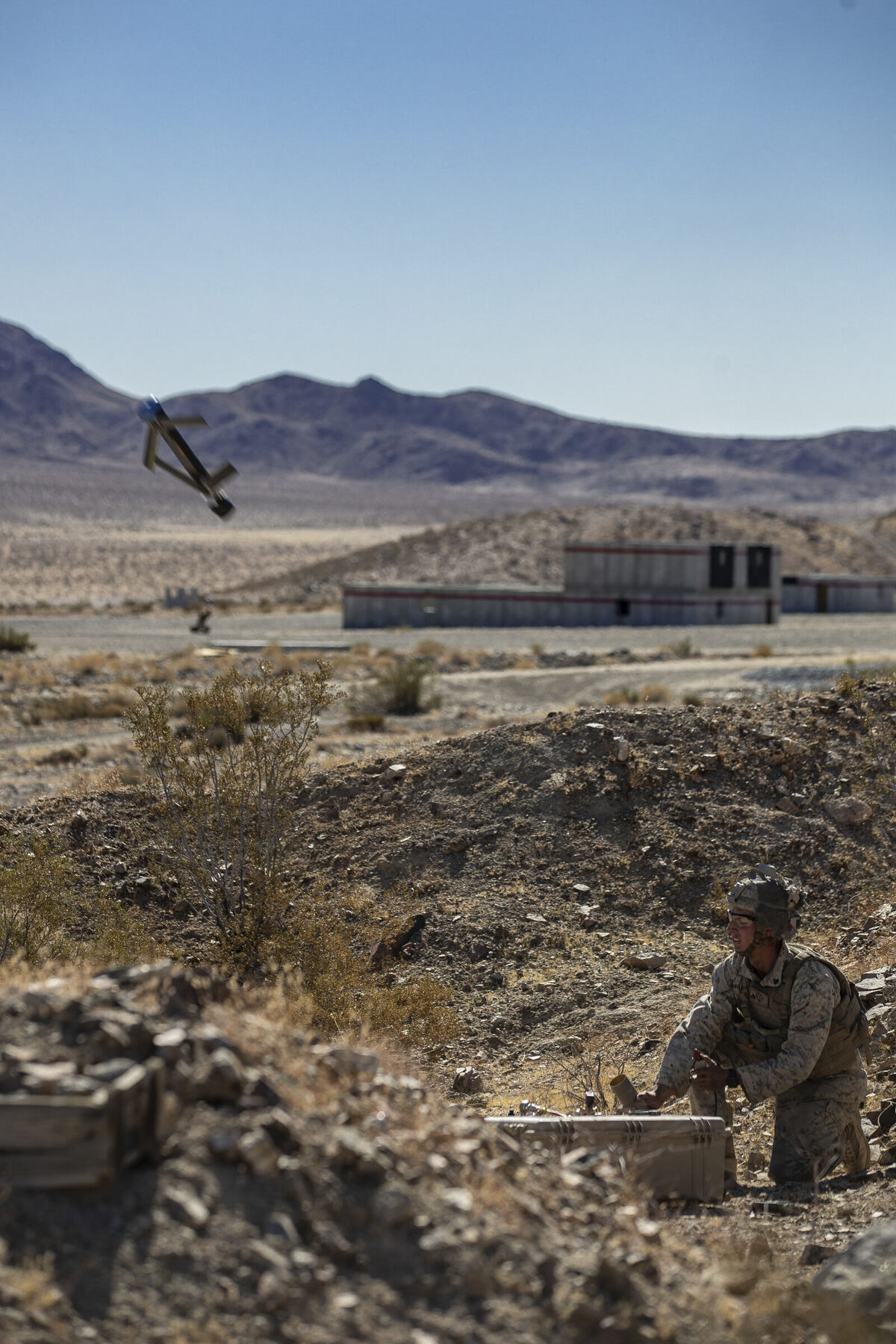
The commander's choice is immediate: he launches a munition not at a target, but at a grid square. Twenty minutes later, loitering over the search area, its electro-optical sensor finds a tank crew repositioning between tree lines. The operator designates the vehicle, commits the strike -- or aborts and redirects to a second contact half a kilometer east. Contrast this with a Tomahawk cruise missile: the instant it leaves the tube, its destination -- a fixed GPS coordinate up to 2,500 kilometers away -- is already locked. The weapon cannot negotiate. It knows only the address it was given at launch.
That single operational difference -- whether a weapon hunts its own target or flies to coordinates handed to it before departure -- defines the fundamental split between loitering munitions and cruise missiles. The terminology now bleeds across defense reporting with increasing frequency, often interchangeably, and almost always imprecisely. That imprecision carries real consequences: it shapes which arms control regimes apply, how international law assigns accountability, and what battlefield commanders can actually demand from a weapon system.
Platform, Munition, or Both: Getting the Taxonomy Straight
The International Committee of the Red Cross defines loitering munitions as "expendable uncrewed aircraft that can integrate sensor-based analysis to hover over, detect, and explode into targets." Three operational subcategories appear in its 2023 analysis: anti-radar systems (the IAI Harpy, progenitor of the type at 135 kilograms, operational since 1990), multi-target platforms such as Russia's Lancet-3, and anti-personnel weapons -- 14 of the 24 systems the ICRC examined fell into that last category, suggesting the most rapid proliferation is at the smallest, cheapest end of the spectrum.
A cruise missile requires target coordinates to be programmed before launch. The Tomahawk -- in continuous service since 1983, 1,315 kilograms at launch, 454-kilogram payload, approximately 1,300 to 2,500 kilometers for modern variants -- navigates via inertial guidance, terrain-contour matching, and GPS to a fixed address. Once committed, it follows a flight path, not a sensor feed. The one-way attack drone (OWA-UAV) is the broadest umbrella: it encompasses both man-in-the-loop loitering munitions and pre-programmed fire-and-forget designs. The Shahed-136, widely labeled a loitering munition in press coverage, is more accurately an OWA drone -- it navigates to pre-programmed coordinates without terminal human guidance. The reusable UCAV, MQ-9 or Predator-class, completes the spectrum: the platform flies out, releases a discrete munition, and returns to fly again. In a loitering munition, by contrast, the platform is the munition -- expendable by design, with the cost of the airframe baked into each strike. U.S. Army analysts recognize that UAS platforms can serve either as delivery mechanisms or as the weapon itself, a doctrinal flexibility that maps directly onto this taxonomy problem.
Three Distinctions That Actually Separate Them
The first and most consequential difference is target acquisition timing. Loitering munitions do not need precision targeting ahead of time, unlike cruise missiles. They launch into an area of interest without a specific aim point, then transition into a loiter-and-hunt phase. The target emerges from the mission rather than preceding it -- a capability that compresses the sensor-to-shooter timeline to minutes against mobile or time-sensitive threats that pre-programmed weapons cannot address. Man-portable systems typically loiter 15 to 30 minutes; operational-class systems extend to 60 minutes or more -- enough persistence to wait out concealment or catch a vehicle breaking cover between positions.
The second distinction is terminal control. The HERO-30 -- 7 pounds total, 1-pound warhead, 3 to 25 miles range, sub-meter circular error probable -- can "abort a mission mid-flight and then be redirected to another target." No conventional munition once fired can do this. The abort capability matters beyond tactical convenience: it introduces a discrimination step at the terminal phase that international humanitarian law demands and that fire-and-forget weapons structurally cannot provide.
The third distinction is cost and payload, which governs the operational niche each system occupies. The Tomahawk Block V delivers a 454-kilogram payload to targets approximately 1,300 to 2,500 kilometers away -- a deep-strike mission profile that places it in a different operational category than tactical loitering munitions. Across the loitering munition category, airframe cost and size span orders of magnitude: from the IAI Harpy and its variants at roughly $300,000, down to the smallest anti-personnel systems. The miniaturization underlying this spectrum is dramatic -- from the original Harpy's 135 kilograms to post-2010 variants at 2 to 30 kilograms while adding significant onboard computing and networking capabilities.
Where the Labels Break Down
Tomahawk Block IV's two-way satellite datalink allows in-flight retargeting to preplanned or new targets via GPS coordinates, with a limited loiter mode added. The weapon retains its fire-and-forget character in practice, but the categorical boundary is no longer clean. The Delilah missile is classified simultaneously as a cruise missile and a loitering munition: a remote weapons officer can surveil an area and designate a specific target after launch, with the aircraft already airborne. The Kargu-2 rotary-wing platform adds a third ambiguity -- manufacturer claims describe man-in-the-loop operation, while earlier marketing materials referenced "autonomous and manual modes" backed by "deep learning algorithms." The ICRC notes that "some loitering munitions can integrate automated, autonomous, and AI technologies into targeting and mobility functions," which is precisely the feature that simultaneously complicates legal analysis, arms-control classification, and operational reporting. No agreed international taxonomy governs any of this, and the tempo of development offers no natural pause for one to emerge. The field's leading practitioners -- defense ministries, arms controllers, and humanitarian law scholars -- are working from incompatible definitions.
Proliferation, Arms Control, and the Regulatory Vacuum
Ukraine has produced the first sustained operational record of loitering munitions in high-intensity peer conflict. The 2020 Nagorno-Karabakh war -- where Harop and IAI systems systematically dismantled Armenian armor, radar infrastructure, and electronic warfare equipment -- was the proof of concept; Ukraine is the stress test at sustained scale. The performance validated what U.S. Army analysts had written about conventional air defense's structural vulnerability to cheap, numerous, intelligent threats. Samuel Bendett of the Center for Naval Analyses notes that both sides are leaning heavily on FPV-type drones -- light, portable, kamikaze, expendable systems -- with defending against swarms proving "stressful" and "expensive." The U.S. Army's LASSO (Low Altitude Stalking and Strike Ordnance) program, initiated in July 2023 drawing directly on Ukraine lessons, is the doctrinal response: tube-launched, EO/IR-equipped, and infantry-portable.
"No traditional A2/AD system can deal with threats this smart, small, cheap, and numerous." -- MSgt Daniel S. Nasereddine, writing for the Mad Scientist Laboratory blog (U.S. Army, 2021)
The proliferation curve is steep. The global market was valued at $529.9 million in 2024 and is projected to reach $815.3 million by 2029. Most tactical loitering munitions fall below the Missile Technology Control Regime's Category I thresholds -- 500-kilogram payload delivered 300 kilometers -- and face only the less restrictive Category II controls. The Convention on Certain Conventional Weapons Group of Governmental Experts on Lethal Autonomous Weapon Systems operates by consensus, enabling any state preferring voluntary measures to block binding rules. The ICRC has additionally flagged that, for small systems with limited optics, poor image quality compromises assessments of proportionality.
As ICRC researchers have concluded, "global development and diffusion of these weapons is far outpacing the stalling global regulatory debates on AWS." Whether a system earns the loitering munition designation, OWA label, or cruise missile classification determines which arms control regimes apply, which export licenses are required, and which legal frameworks govern its use in conflict. The technology has moved faster than the law, faster than doctrine, and considerably faster than the vocabulary used to describe it.
Why It Matters
The blurring line between loitering munitions, cruise missiles, and one-way attack drones is not a semantic quibble. The category a system falls into shapes how it is bought, who is cleared to operate it, which export-control regime governs its transfer, and how its battlefield use is judged under the laws of armed conflict. As cheap, autonomy-enabled systems collapse the old distinctions, doctrine, procurement, and arms-control frameworks built around tidy categories are struggling to keep pace.
Sources
- Mad Scientist Laboratory, U.S. Army -- The Dawn of the Loitering Munitions Era (2021)
- U.S. Army -- Munitions Modernization: The Family of Drone Munitions (2023)
- C4ISRNET -- Lightweight Loitering Munition Promises Sub-Meter Accuracy (2018)
- C4ISRNET -- U.S. Army Developing LASSO Tank-Killing Drone for Infantry (2023)
- ICRC Law & Policy Blog -- Loitering Munitions: Legally Binding Rules on Autonomy in Weapon Systems (2023)
- ICRC -- FAQ: International Humanitarian Law and Drones in Armed Conflict (2025)
- CSIS Missile Threat -- Tomahawk
- Maris-Tech -- Loitering Munitions: A Complete Guide to Unmanned Aerial Weapons
- YIP Institute -- Proliferation of Loitering Munitions in Modern Warfare (2023)
