
On the night of December 6, 2023, unidentified drones appeared over Langley Air Force Base in Virginia. They came back the next night, and the night after that — for 17 consecutive nights. Some measured roughly 20 feet across. F-22s were repositioned. Night training was cancelled. And for much of that stretch, the installation had no standardized protocol for what to do, because existing law restricts shootdowns absent an immediate threat. The aircraft responsible were never publicly identified.
That same autumn, the Navy was burning through surface-to-air missiles at a rate that had defense economists doing grim arithmetic. In FY2024 alone, the Navy expended roughly $1 billion in munitions in Middle East operations, much of it against Houthi drones and missiles over the Red Sea. By CSIS's accounting, the SM-2 missile costs roughly $2 million per shot, while the Houthi drones it was destroying cost around $2,000 each — a cost ratio of at least 1,000-to-1 against the defender.
Meanwhile in Ukraine, Russian forces were deploying Shahed-136 loitering munitions faster than air defenders could track them. NATO C-UAS experts identified detection and tracking of slow, small Shaheds as the single hardest challenge in the campaign. By RUSI's analysis, cited by CEPA, Ukraine itself was losing up to 10,000 UAS per month — mostly to Russian electronic warfare — and adaptation cut in both directions. Ukraine's response included industrializing FPV interceptor-drone production and fielding drone-on-drone engagements as a primary defensive layer.
These three theaters — a domestic air base, a contested maritime corridor, a grinding land war — each illustrate the same underlying problem. No single technology stops drones. The threat profile is too wide: commercial quadcopters, autonomous loitering munitions, fiber-optic-controlled platforms that defeat RF jamming, swarms of dozens moving simultaneously. Coherent counter-UAS defense requires a layered architecture that addresses each stage of what the military calls the kill chain: detect, track and identify, decide, defeat. Understanding how each layer works, where it fails, and what it costs is essential to evaluating any C-UAS investment.
Detect and Track: The Hardest Part No One Talks About
Detection is where C-UAS architecture either functions or collapses. A threat you cannot see cannot be engaged. The challenge is that no single sensor technology covers the full signature space of modern UAS.
According to GAO analysis, RF detection of control signals and radar are the most common detection technologies in fielded U.S. systems — the Raytheon KuRFS radar, the AN/TPS-80 (used in the Marine Corps' MRIC configuration), and the RPS-42 that anchors L-MADIS are all in this category. Infrared sensors and acoustic detection cover different parts of the spectrum: IR is effective against warm targets with propulsion signatures; acoustic arrays can detect small rotary-wing UAS that radar might miss at close range. The fielded picture is multi-sensor by necessity, not preference.
The GAO identified a persistent gap: many systems have limited ability to detect and track small UAS under 55 pounds — the exact category flooding both commercial and military threat environments. Effective jamming range for many systems is often around 1,000 feet or less, which is a short engagement window against a fast-moving or large-swarm threat. The Pentagon's July 2025 Replicator 2 Low-Cost Sensing competition named 10 finalists — BLUEiQ, CHAOS 1, Fortem, Guardian RF, Hidden Level, MatrixSpace, REVOBEAM, Squarehead, Teledyne FLIR, and Thalrix — with the DIU assessing that 50–80% total-cost-of-ownership savings are achievable relative to current sensor baselines. DIU Director Doug Beck framed the challenge as one that "directly supports DOD's strategic priorities by tapping into non-traditional defense companies to develop scalable, cost-effective sensing solutions."
Tracking feeds identification, which feeds the decision to engage. The command-and-control layer — FAADC2 for the Army, MEDUSA for the USMC and USAF, ADSI for the Air Force — integrates sensor feeds and presents operators with air tracks. FAADC2 has a documented limitation: it requires manual target selection, which distracts operator focus during high-density engagements. In December 2024, DIU issued an RFP for FCUAS C2, a potential FAADC2 replacement. Anduril's Lattice AI platform received an $87 million Army contract to link counter-drone systems across a network. The stated goal of Replicator 2 is to cut the operator requirement from four or five personnel per system to one through AI-assisted decision support.
The domestic decision problem is distinct from the combat problem. At Langley, the legal constraint was real — absent evidence of immediate threat, there is no standing authority to shoot down a drone over U.S. airspace. A Chinese national named Fengyun Shi was arrested in January 2024 after being caught with a drone 11 miles from Langley, having previously photographed Navy vessels. The gap between detection and lawful action is a policy problem that sensors and AI cannot solve.
The Defeat Layers: Costs, Limits, and the Right Tool for Each Threat
Once a target is detected, tracked, classified as hostile, and a decision to engage is authorized, the question becomes which defeat mechanism to apply. There are four distinct categories, each with different cost curves, limitations, and ideal target sets.
Electronic warfare (soft kill) is the cheapest layer and, in aggregate volume, the most widely used. Jammers like the Dronebuster (fielded since 2017), NINJA (deployed to 99 USAF locations by 2023), DRAKE (Navy backpack system), and CUAEWS break the RF control link between drone and operator, typically triggering a landing or return-to-home response. GAO identifies jamming as the most common mitigation technology in the U.S. inventory. The Ukraine data illustrates both the power and the limit: EW caused tens of thousands of UAS losses, but as CEPA reported, Russian operators adapted. Fiber-optic-controlled drones — which carry their own guidance wire and receive no RF signals — are immune to jamming by definition. Spoofing attacks on GPS can be countered by inertial navigation. EW is essential but not sufficient.
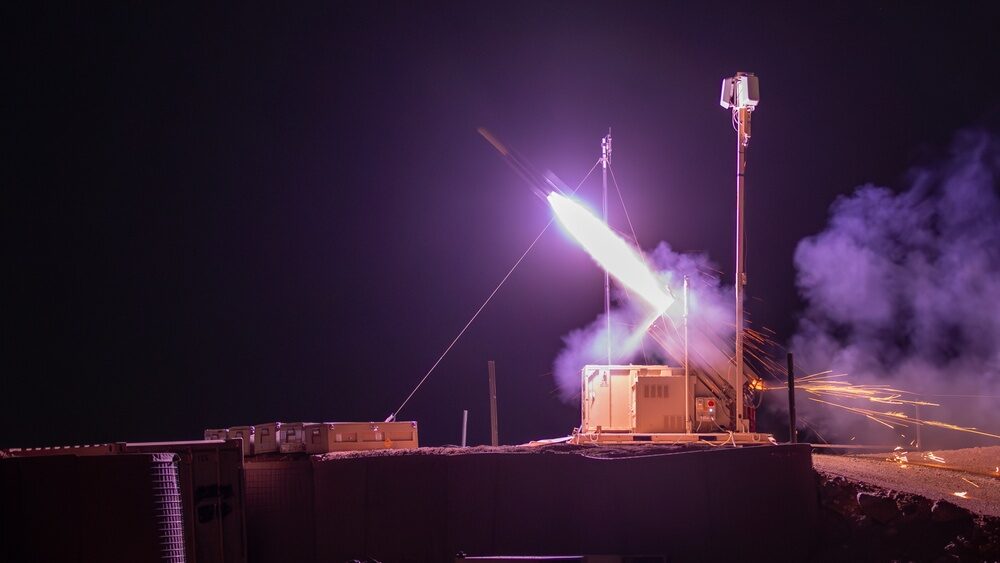
Kinetic intercept is reliable against a wide target set but carries the cost-asymmetry problem in concentrated form. The Coyote interceptor (Raytheon) has logged 170 confirmed interceptions through 2024 and is the backbone of the LIDS family — FS-LIDS and M-LIDS combine KuRFS radar, EO/IR, Coyote, and EW in an integrated package covering Groups 1–3 UAS. The Marine Corps' MADIS system layers Stinger missiles, 30mm cannon, and EW. The Army's SGT STOUT (formerly M-SHORAD) adds Longbow Hellfire and Stinger to a radar-equipped Stryker. For the mid-tier threat, APKWS laser-guided rockets offer a middle path: the guidance kit runs $15–20,000, bringing total round cost to roughly $35,000 — still multiples above the cost of the drone being destroyed, but far better than a $1 million AIM-120. Ukraine's Gepard 35mm with AHEAD programmable ammunition handles mid-tier threats; ZU-23-2 truck-mounted 23mm covers low-altitude FPV drones.
The Fortem DroneHunter F700 represents a distinct kinetic approach: an autonomous radar-guided interceptor drone that captures targets with a net system. It claims an 85% success rate, has captured roughly 5,000 drones worldwide, re-engages in under three minutes, and has recorded kills against Orlan-10 and Shahed-136 platforms. JIATF 401's first acquisition under Replicator 2 authority was two F700 systems — which points directly toward the drone-on-drone concept Ukraine has scaled industrially.
Directed energy is the most mature of the emerging defeat layers. High-energy lasers and high-power microwave weapons offer cost-per-shot economics measured in cents or dollars rather than thousands. The Israeli Iron Beam operates at 100 kW, engages targets at up to 10 km range, completes an engagement in four seconds, and reached operational status in September 2025 — cost per shot is essentially the price of electricity. The U.S. Army's M-SHORAD Increment 2 integrates a 50 kW laser on the Stryker under a Raytheon $123 million development contract. For HPM, the Epirus Leonidas system received a $66.1 million Army contract in January 2023, with four systems delivered by May 2024, a $43.5 million Generation II contract in July 2025, and a claimed 100% defeat rate against a 49-drone swarm in September 2025. Notably, Epirus also reported the first known HPM defeat of a fiber-optic-guided drone in late 2025 — a capability gap that EW cannot address. The Marine Corps received $14.4 million in FY2025 specifically for HPM C-UAS development. The limitation today is logistics: power generation, thermal management, and range in degraded atmospherics remain active engineering problems.
The Cost-per-Engagement Problem Is Structural
The economics deserve their own treatment because they are not an anomaly — they are a design constraint on any C-UAS architecture. As CEPA's analysis put it directly: "Intercepting a weaponized DJI quadcopter (worth a few hundred dollars) or even a ~$40,000 Iranian Shahed slow-flying munition with a million-dollar missile is not efficient or sustainable."
The rough cost-per-engagement spectrum as of 2025: lasers run £0.10–£10 per shot; HPM £5–£50; missiles range from roughly $35,000 for an APKWS-guided round to $500,000 for an AIM-9 to $1 million for an AIM-120 to $2 million or more for an SM-2. Against a $20,000–$50,000 Shahed, the only financially defensible intercept options are EW (if the drone is RF-dependent), kinetic intercept with small-caliber munitions or APKWS, drone-on-drone, or directed energy. The conclusion is not academic: the Navy spent close to $1 billion in munitions in the Middle East in FY2024, Congress passed a $2.4 billion supplemental (H.R. 815, P.L. 118-50) to replenish inventories, and the trajectory points toward an adversary strategy that is explicitly designed to drain expensive magazines with cheap attrition weapons.
Replicator 2 — announced in a fall 2024 SecDef memo — is the Pentagon's programmatic response to this calculus. Its stated goal: "meaningfully improved counter-small UAS protection to critical assets within 24 months of Congress approving funding," with specific emphasis on fixed-site protection and low-cost defeat. FY2025 funding levels catalogued by CRS reflect the institutional weight now behind C-UAS: roughly $300 million for Coyote interceptors — well above the Army's original request — alongside appropriations in the hundreds of millions each for IFPC, LIDS and dismounted C-sUAS systems, and M-SHORAD development and procurement.
The Organizational Architecture: From JCO to JIATF 401
The institutional history of C-UAS in the U.S. military is itself a lesson in how the threat forced organizational adaptation. The Joint Counter-Small UAS Office was established in 2020 as the lead joint C-sUAS organization. It ran a series of technology demonstrations at Yuma Proving Ground — the June 2024 iteration evaluated 9 systems from 8 vendors selected from 58 proposals, running 40-plus UAS targets per session — and stood up the Joint C-sUAS University at Fort Sill, Oklahoma (first operators course October 2023, two weeks long). In 2025, JCO was disestablished and replaced by Joint Interagency Task Force 401, which consolidated authority over requirements, testing, acquisition, and training under a single command. JIATF 401 director Brig. Gen. Matt Ross holds acquisition authority up to $50 million, and NORTHCOM remains the lead synchronizer for homeland C-sUAS. The DoD's December 2024 Counter-Unmanned Systems Strategy calls for unifying the department's approach — the reorganization is the operational expression of that directive.
Army doctrine ATP 3-01.81 captures where the institutional consensus has landed: counter-UAS is "not a stand-alone effort," is "part of local security," and is the "responsibility of every Soldier and unit." NORTHCOM commander Gen. Gregory M. Guillot has characterized drones as an "increasing threat," with an average of two to five sightings per week per installation across U.S. military facilities. As General Charles Collins of the British Army summarized the baseline condition: "The use of unmanned aerial systems has created a transparent battlefield where there is no sanctuary."
The doctrine, the dollars, and the operational record all converge on the same conclusion. Col. Michael Parent, JCO Acquisition Division Chief, made the point plainly after the 2024 swarm demonstration: no single capability, kinetic or non-kinetic, could defeat that threat profile on its own — only a full system-of-systems, layered approach. The layered model — sensors feeding C2, C2 feeding engagement authority, engagement authority feeding a tiered defeat stack optimized for cost and effectiveness at each threat tier — is not a planning preference. It is the only architecture the operational evidence supports. Getting to nine planned C-sUAS batteries (first activation expected FY2029) is the current program of record. Getting there faster, cheaper, and with directed energy and drone-on-drone layers mature enough to reduce the cost-per-engagement ratio — that is the unsolved problem the entire enterprise is now organized around.
Sources
- CRS R48477 — Counter-UAS: DoD Programs, Policy, and Issues for Congress (March 2025)
- CRS IN12418 — Counter-UAS: Recent Developments (Feb 2025)
- GAO-22-105705 — Counter-Unmanned Aircraft Systems: Challenges and Options for the Department of Defense (March 2022)
- U.S. Army — Learning Lessons from Ukraine: Cost-Effective Solutions to Counter Drone Operations (2025)
- CEPA — An Urgent Matter of Drones (2024)
- U.S. Army / JCO — JCO Conducts Successful Counter-Drone Swarm Demonstration (July 2024)
- CSIS — The Cost and Value of Air and Missile Defense Intercepts (2024)
- Inside Unmanned Systems — Counter-UAS: The Price of the Shot (2024)
- National Defense Magazine — Pentagon's Replicator Initiative Sets Sights on Counter-UAS (Dec 2024)
- Defense News — Pentagon Picks Finalists for Replicator 2 Counter-Drone Demo (July 2025)
- DIU — DIU, NORTHCOM, JCO Announce Solicitation for Joint Low-Collateral Defeat (May 2025)
- IDGA — JIATF 401 Explained: How the Pentagon's New Counter-UAS Task Force Is Changing Drone Defense (June 2026)
