
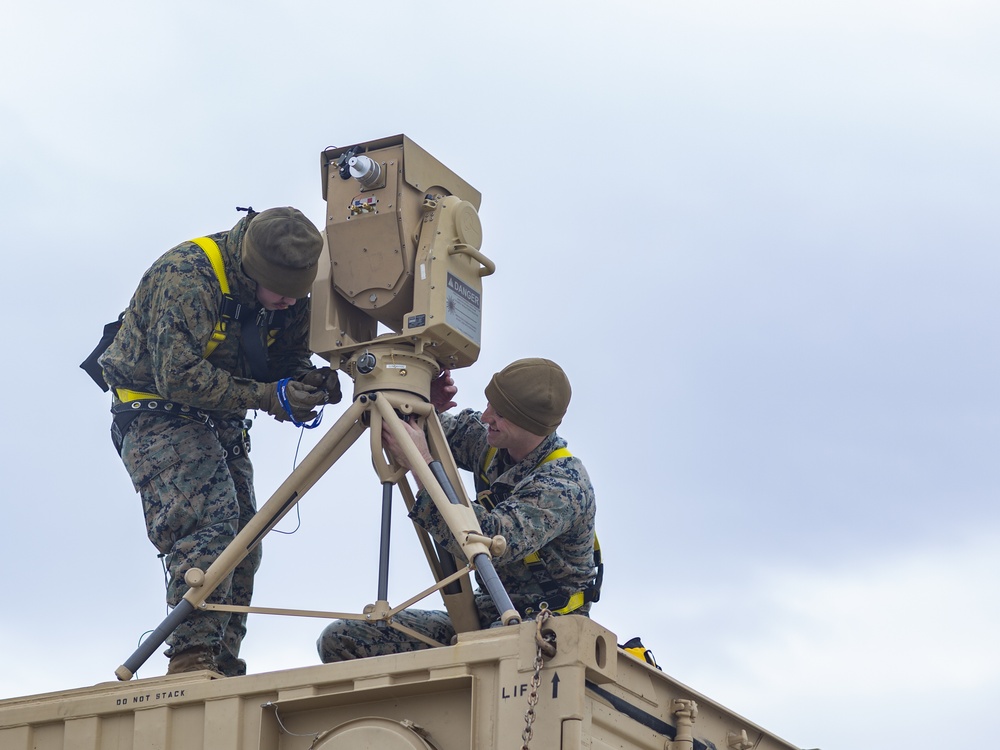
The US Air Force has put a laser into its base-defense architecture overseas. On 23 July 2026, US Air Forces in Europe – Air Forces Africa (USAFE-AFAFRICA) disclosed that the Compact Laser Weapon System, or CLWS, "has been recently assessed and deployed to locations across the theater" — a theater that spans both Europe and Africa. The command said the specific locations where the capability is in place are withheld for operational security reasons.
That single sentence is the most consequential part of the release. What USAFE-AFAFRICA is describing is not a one-off demonstration: it is a directed-energy effector the command says is already assessed, deployed, wired into an existing air defense network, and — if employed — coordinated with the authorities of the country it sits in.
What the command actually said
Per the USAFE-AFAFRICA release, CLWS "does not operate in isolation; it is integrated into the base's broader air defense network and if employed, coordinated with host-nation authorities." The system also does double duty as a sensor. An operator in the base defense operations center uses the CLWS to "visually identify and confirm if a detected contact is an unauthorized drone," a step the command says prevents "the misidentification of friendly aircraft or even birds."
That detail is worth dwelling on, because it describes the hardest part of the counter-UAS problem at a fixed base. Radar and RF sensors generate contacts; contacts are not targets. On an active airfield surrounded by civil aviation, birds, and host-nation air traffic, the gap between "something is out there" and "we are authorized to engage it" is where the entire kill chain lives. Putting the effector's own optics into the identification step collapses part of that gap — the same system that confirms what the contact is can also engage it.
Separately, USAFE-AFAFRICA said it has tested a ground-based interceptor system, also with coordination of host-nation authorities: the Advanced Precision Kill Weapons System, which "employs a laser-guided 2.75-inch rocket to intercept UAS threats up to six kilometers away." That is a guided kinetic option reaching well beyond the perimeter, and well beyond where a laser or a jammer can reliably work.
The effector mix
The command described its effectors as a spectrum rather than a single tool. Once sensors track and identify a threat, the release says, effectors "can be employed ranging from non-kinetic systems that jam the signal between a UAS and its operator up to directed energy capabilities and kinetic interceptors designed specifically to neutralize a UAS threat." In the command's own ordering:
- Non-kinetic. Jam the signal between the UAS and its operator.
- Directed energy. Capabilities such as CLWS.
- Kinetic. Interceptors such as the ground-launched APKWS.
Jason Parker, chief of the technology integration branch in Headquarters USAFE-AFAFRICA's Logistics, Engineering and Force Protection directorate, was blunt about why all three exist. "There is no single 'silver bullet' for the counter-UAS challenge," he said. "The capabilities of drones vary significantly in size, speed, altitude, and how they are controlled. Some can be disrupted through electronic means, while others are more resistant, requiring different approaches." The layered approach, he added, "allows us to detect, track, identify, and defeat potential threats while enhancing situational awareness and minimizing risk."
That framing is a tacit acknowledgment that the cheapest, safest, most politically frictionless option — jamming the control link — does not cover the whole target set. Parker's own words concede that some drones are "more resistant" to electronic attack. Once jamming is off the table, a defender is left choosing between burning a hole in something with a laser or putting a guided rocket into the air above a base that likely sits near a European or African population center. Both of those choices carry consequences the first option does not.
The host-nation problem nobody advertises
The phrase "coordinated with host-nation authorities" recurs throughout the release, and it is doing an enormous amount of work. A US installation in Europe or Africa is not sovereign US territory. The rules governing when American defenders may fire — at what, with what, over whose airspace, and into whose civil aviation environment — are negotiated, not assumed. Col. Benjamin Washburn, the command's security forces division chief in that same directorate, described host-nation law enforcement counterparts as "an indispensable part of our first line of defense," which is a diplomatic way of saying that the outer layers of base defense are frequently not American at all.
USAFE-AFAFRICA says the current effort builds on previous operational utility assessments of point defense — work the command has separately described as conducted together with German officials — and that the changes "align with the Department of War directive and U.S. Air Force initiatives to advance counter-drone capabilities, with a clear focus on overseas considerations including host-nation law enforcement capabilities and host-nation coordination." The imagery accompanying the release shows Air Force security forces personnel training on advanced defensive systems on 20 March 2026, described as part of a command-wide effort to enhance the layered defense of installations and personnel.
"The idea of a safe haven"
The most quotable line in the release came from Col. Victoria Habas of the USAFE-AFAFRICA Plans and Programs Directorate for Integrated Air and Missile Defense: "The modern threat has erased the idea of a safe haven; inexpensive and highly adaptable UAS technology can hold any installation or operating location at risk."
Read that as doctrine, not rhetoric. For much of the post-Cold War period, a main operating base in Western Europe was treated as rear area — a place you flew combat power from, not a place that needed layered air defense of its own. Habas is stating, on the record, that the assumption is dead.
Lt. Gen. Jason T. Hinds, the USAFE-AFAFRICA commander, tied that to authority: "Our ability to project combat airpower must be protected by layered, integrated air defense capabilities... We have equipped and trained our personnel with enhanced systems, and installation commanders have the authority and responsibility to defend our forces." Pushing the decision down to the installation commander matters, because a drone incursion over a runway is a minutes-long problem, not a staffing-cycle problem.
The human layer extends further than the wire. Airmen from Operations Support Squadrons and Security Forces defenders in base defense operations centers undergo continuous training to employ these capabilities, the command says, and Washburn noted that "everyone plays a role in securing our mission and people, including family members and civilians who can always report suspicious activity to the base defense operations center." In practice, the first sensor in the chain is often a person who notices someone flying something odd near the fence.
Why It Matters
This is a public confirmation that a directed-energy counter-UAS weapon is deployed and networked at USAFE-AFAFRICA locations rather than sitting in a test program. That crosses a line the C-UAS field has been approaching for years: for base defense in Europe and Africa, lasers are described by the command itself as fielded, integrated into the base air defense network, and part of the set of effectors a base defense operations center can reach for.
It also reframes what "base defense" means for the rest of NATO and for partner nations across Africa. If the US command responsible for two continents has concluded that no single countermeasure works, that installations and operating locations are inherently at risk, and that it needs an effector spectrum extending to guided rockets out to six kilometers, every host nation with an American presence now has the same conclusion sitting on its desk — along with the legal and airspace questions that come with permitting a foreign force to engage aircraft above its territory. The command's own summary of the problem is the honest one: there is no single silver bullet, and the safe haven is gone.
Sources
- USAFE-AFAFRICA strengthens defense through layered, integrated Counter-UAS approach — U.S. Air Forces in Europe – Air Forces Africa, 23 July 2026
- US Air Force deploys C-UAS Compact Laser Weapon System in Europe and Africa — Unmanned Airspace, 23 July 2026
- USAFE-AFAFRICA Expands Layered Defenses Against Growing UAS Threat — ExecutiveGov, 23 July 2026
