
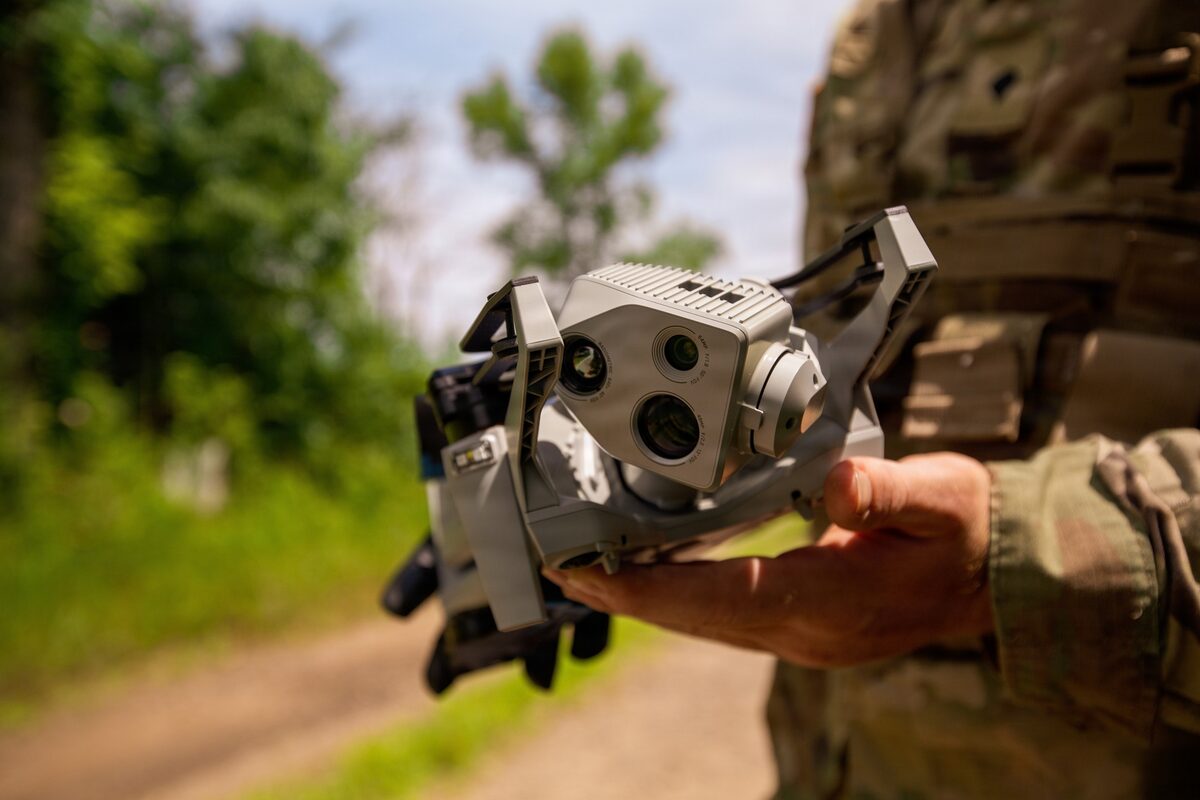
A bipartisan group of 29 governors has asked the federal government to widen the bottleneck that decides how fast state and local agencies can actually use their new counter-drone powers. In an Oct. 6 letter led by North Carolina Gov. Josh Stein and South Carolina Gov. Henry McMaster, the governors wrote to Attorney General Blanche, Secretary of War Hegseth and FBI Director Patel with three requests: more training seats, a counter-UAS curriculum built for corrections officers, and broader access for the National Guard.
The training-capacity complaint holds up. The prison request is a different story. The interim final rule that put the new authority in place already includes an abbreviated certification for correctional staff, and the letter does not mention it. The Guard request also runs into a limit the Justice Department can't fix on its own: according to DroneXL, the Guard isn't among the entities covered by the Safer Skies Act.
What the governors asked for
The letter makes three requests. First, more training seats, or regional versions of the course, at the FBI's National Counter-UAS Training Center (NCUTC), citing long wait times for state, local, tribal and territorial (SLTT) agencies. Second, that the agencies "urgently develop" a specialized counter-UAS curriculum for correctional officials covering legal authorities, evidence collection, coordination with law enforcement and safe response. Third, expanded National Guard access through NCUTC or Department of War programs.
The core argument is about capacity: "without sufficient training capacity, many jurisdictions will be unable to responsibly exercise the authorities Congress has provided," the governors wrote. AVweb reported that the corrections request focuses on drones delivering weapons, drugs, contraband and communication devices into secure facilities, and that the letter arrives as agencies implement the Safer Skies Act.
Signatories include Stein and McMaster plus Governors Hobbs (Arizona), Polis (Colorado), Lamont (Connecticut), Braun (Indiana), Beshear (Kentucky), Landry (Louisiana), Mills (Maine), Moore (Maryland), Healey (Massachusetts), Whitmer (Michigan), Kehoe (Missouri), Pillen (Nebraska), Lombardo (Nevada) and Sherrill (New Jersey). DroneXL reported that Washington Gov. Ferguson also signed, and the letter's signature list confirms it.
The prison course already exists
The governing document is the interim final rule Counter-UAS Authority for State, Local, Tribal, and Territorial Law Enforcement and Correctional Agencies, published in the Federal Register on July 6, 2026 (91 FR 41466–41516) and effective July 1, 2026. It already provides a corrections track:
"An abbreviated Correctional Mitigation Certification, limited to correctional-facility operations, is available for personnel who will operate only at correctional facilities."
The rule also explains why that course is shorter. It says "the fixed perimeter and persistent-threat environment of a correctional facility reduce the operational setup and mission-planning instruction required." The abbreviated certification covers mitigation, the tier that allows an agency to take down or take control of a drone. For detection and warning, the rule requires only an abbreviated, self-certified policy.
The rule says the correctional course addresses the persistent-threat environment, perimeter operations, and the legal and safety considerations of correctional settings. The letter's curriculum list also names evidence handling and coordination with police, which the rule text does not mention for the correctional course. But the letter asks agencies to develop a corrections curriculum from scratch, and a corrections-only certification already sits in the rule.
The rule also allows more training sites
The governors' request for regional offerings is also partly covered in the rule text. The rule says the mitigation course is delivered at NCUTC. It then lets the Attorney General, acting through the FBI Director, authorize the Federal Law Enforcement Training Centers (FLETC) or another qualified federal provider to deliver the course at additional sites.
That authority is limited. Additional sites are approved "at the sole discretion of the Attorney General," and the rule says the authorization confers no entitlement on any agency or training provider. So the governors are really asking the Attorney General to use a power the rule already gives him. They don't need the rule rewritten.
How tight the bottleneck is
The training numbers are small. According to DroneXL, the Huntsville school had certified 61 officers from about 46 agencies by July 6. DroneXL reported that the departments expect about 150 agencies at the mitigation tier, and about 1,500 at the online detection tier, within two years. Associate Attorney General Stanley Woodward said on Oct. 1 that the school would more than double its capacity in its second year, according to DroneXL, which noted he gave no baseline.
FedScoop reported that NCUTC expects to train 250 more UAS mitigation officers by the end of next fiscal year, citing FBI agent Mike Torphy, for about 1,000 trained over three years including those. DroneResponders' Charles Werner put the number of metropolitan cities at about 340, and said the forthcoming officers wouldn't cover even one per metropolitan city in the first year. Before the World Cup, Miami had a handful of FBI-trained officers and Tampa had one, FedScoop reported. Per Torphy, nearly 1,700 unauthorized drones were detected during the tournament and 700 seized. Matt Whitehead of the National Security Council told FedScoop that the message from a high-level meeting was "do more and do it faster."
Those numbers back the governors' first request. Werner's arithmetic suggests that at the planned output, a small certified team in every large city is a long way off, before counting county sheriffs or state prison systems.
The National Guard question
The third request has a legal problem. DroneXL notes that the National Guard is not on the list of entities the Safer Skies Act extended counter-drone authority to, so more seats at NCUTC wouldn't by themselves give Guard units the authority to mitigate drones. The interim final rule's title and scope cover SLTT law enforcement and correctional agencies.
Changing that would likely take legislation. DroneXL points to H.R. 8697, the "Guard the Skies Act," introduced by Rep. McCaul on May 7, which would let the Guard protect facilities from drones at a governor's request with the defense secretary's approval. Interest exists at the state level: DroneXL reported that the Washington Guard ran a tabletop exercise in November 2025 simulating a drone attack on Lumen Field in Seattle. Training would build Guard skills, but as DroneXL puts it, it would not by itself give them the power to act.
Why It Matters
The Safer Skies Act framework only means something if agencies have certified people to use it. DroneXL reported that the rule has been in force since July 1. About 46 agencies had certified officers by July 6, and the ramp-up the departments project still leaves most jurisdictions waiting. The pressure isn't hypothetical. Aubrey Richardson, who runs the State Law Enforcement Division's counter-drone unit in South Carolina, told state lawmakers this spring that hundreds of drones fly over the state's prisons and military bases every year, as DroneXL reported.
The letter's requests are actually three separate issues. Training capacity is a real resource shortfall, and the Attorney General can already address it by approving more sites. The corrections curriculum request largely overlaps with a certification the rule already offers, so the more useful question for state prison systems is whether that abbreviated course meets their needs and how quickly they can get seats in it. The Guard request appears to depend on Congress, not on the Justice Department or the FBI.
Sources
- October 6, 2026: Letter from Governor Stein to DOJ, Department of War and FBI (NC Governor's office)
- Counter-UAS Authority for State, Local, Tribal, and Territorial Law Enforcement and Correctional Agencies, interim final rule (Federal Register, July 6, 2026)
- Governors Seek Expanded Counter-Drone Training For Law Enforcement (AVweb)
- 29 Governors Ask DOJ for a Prison Drone Course Its Rule Already Offers (DroneXL)
- FBI counter-drone training isn't keeping pace with demand (FedScoop)
