
For most of the past two decades, the U.S. Air Force's answer to the question "who defends the airfield?" has been, functionally, "somebody else." Patriot batteries belong to the Army. Point defense of forward bases has been a joint-force hand-me-down. Two disclosures in late July 2026 suggest that arrangement is finally being unwound — not with a doctrine paper, but with a procurement notice and a new set of enlisted billets.
On 17 July, the Air Force Life Cycle Management Center's Command, Control, Communications and Battle Management directorate posted a Request for Information on SAM.gov for a Ground-Based Launcher. Five days later, Air & Space Forces Magazine published an early look at the service's new Point Defense Flights — roughly 20 enlisted Airmen apiece, trained at Fort Sill, built to travel light. Read together, they describe an organic base-defense layer the Air Force intends to own end to end: the sensors, the shooters, the people, and eventually the Air Force Specialty Code that would make it a career field rather than an additional duty.
What the RFI actually asks for
The notice (ID 253ba249cff34951a7f7ee5829b1f594, solicitation number FA8612_RFI_C3BM_2026_0002) went up at 15:35 UTC on 17 July 2026 with responses due 7 August 2026 at 5:00 p.m. Eastern and an auto-archive date of 22 August. There is no set-aside. The primary NAICS code is 336419 — other guided missile and space vehicle parts and auxiliary equipment — and the product/service code is 1440, launchers, guided missile. Those two classifications alone tell you the Air Force is not shopping for a jammer.
The issuing office resolves through SAM.gov's organizations data to org key 500155208, "FA8612 AFLCMC C3BM C3," sitting under Department of Defense > Department of the Air Force > Air Force Materiel Command > Air Force Life Cycle Management Center > Cyber and Networks. Points of contact are Christopher Core and Heather Bakker, both at Wright-Patterson AFB, Ohio. That the launcher effort is being run out of the battle-management shop rather than a weapons directorate is itself a signal: the government appears to care at least as much about how the effector plugs into a kill chain as about the effector itself.
Per the RFI and Air & Space Forces Magazine's reporting, the desired system must engage both cruise missiles and unmanned aircraft systems, and it must do so across a threat set running from Group 1 — quadcopters up to 20 pounds — all the way to Group 5, aircraft over 1,320 pounds, the MQ-9 Reaper class. That is an unusually wide span to ask of a single transportable launcher. A Group 1 intercept and a Group 5 or cruise-missile intercept are different physics problems with different cost curves, and vendors will have to explain how one magazine serves both.
The government wants the system to carry onboard sensors, laser illuminators, command-and-control technology, and kinetic weapons. Responses are directed to address munition types, firing rates, magazine capacity, how quickly sensor data can be disseminated, how weapons cueing integrates with existing C2, transportation logistics, manning requirements, and how fast the thing can be deployed. Those last three are the tells. This is a requirement written by people thinking about airlift sorties and crew ratios, not about a fixed site with a concrete pad.
The people side: Point Defense Flights
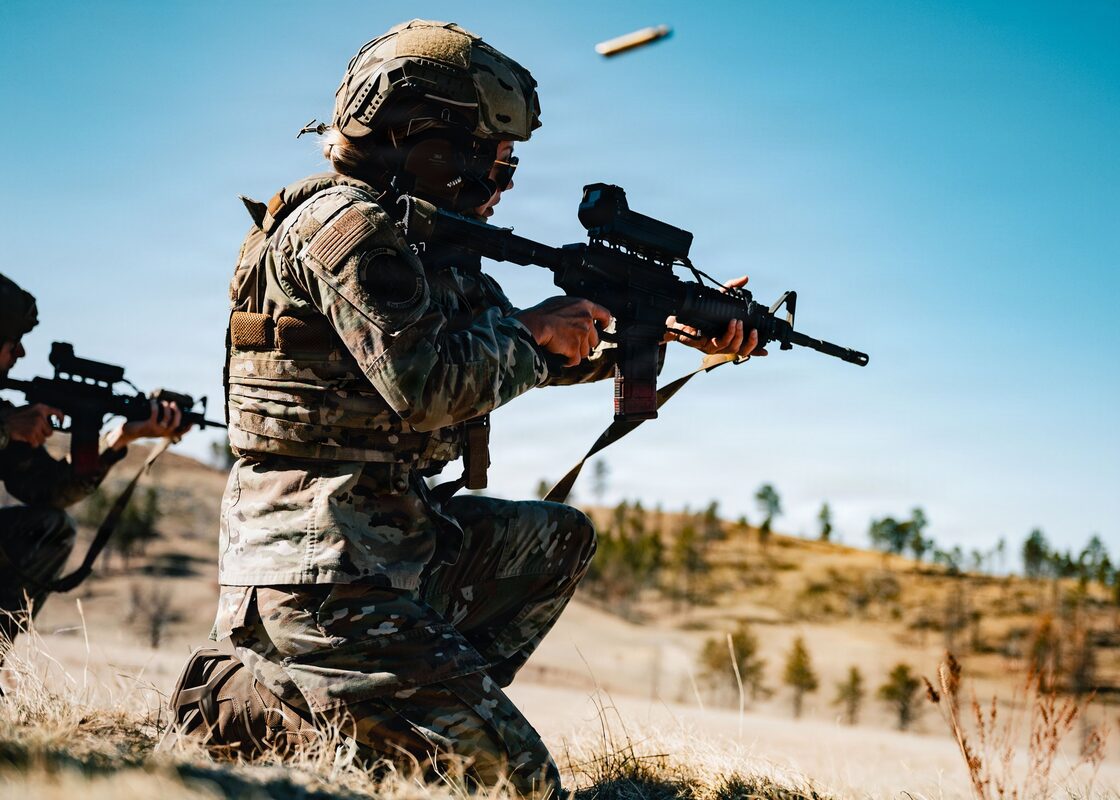
The complementary piece is manpower. According to Air & Space Forces Magazine's 22 July report, the Air Force is standing up Point Defense Flights of approximately 20 enlisted Airmen each, drawn initially from aviation and battle management backgrounds — the service is prioritizing enlisted aviators and enlisted air battle managers with operational experience. Their job is protecting air bases in the Pacific and other hotspots — explicitly including the remote, austere airfields that agile combat employment depends on.
Training runs about three weeks at the Joint Counter Unmanned Aircraft Systems University at Fort Sill, Oklahoma. Their primary kit is the Small Unmanned Air Defense System (SUADS), largely a detection system for identifying and tracking enemy drones of all sizes, fielded in two flavors: a fixed installation for established air bases, and a rapidly deployable variant built onto an aircraft pallet.
Michael Sheehy, Director of Future Operations under the Air Force Deputy Chief of Staff for Operations, framed the design constraint plainly: "It's an expeditionary capability, so we want it to be light and lean." The pallet variant exists so that "as teams are performing agile combat employment, they can have a rapidly deployable SUAD system that has a sensor, effector, and C2, kind of all-in-one box."
A dedicated base-defense AFSC is not a settled thing yet. Sheehy said the service is "in the very nascent stages of exploring the development of an AFSC," with open questions about "how are we going to do accessions" and initial qualification training — and an explicit warning that the Air Force cannot field an "AFSC that you top out at E-4." Fort Sill's C-UAS University is developing the technical training syllabus. That matters more than it sounds. Borrowed Airmen on temporary duty do not accumulate institutional expertise; a specialty code creates a training pipeline, a promotion path, and a constituency that argues for the mission inside the budget process.
Following the money
Rhetoric about base defense has outrun funding for years. The FY26–FY27 numbers suggest that gap is closing. SUADS procurement stands at $51.8 million in FY2026. In its fiscal 2027 budget request, the Air Force is seeking about $1.4 billion for a missile defense variant of the Air Base Air Defense Systems (ABADS) — the program family the Ground-Based Launcher would plausibly feed. Air Force Secretary Troy E. Meink has told lawmakers that air base defense has become "an increasingly high priority" for the service, and in 20 May 2026 testimony said the Air Force is "focusing on electronic warfare to directed energy to kinetic capabilities to defend our Airmen and Guardians."
Federal award records show the wider counter-UAS build-out is already moving cash to industry. USAspending data covering active counter-drone work includes an $87,713,060 Department of the Army order to Anduril Industries (award W9128Z26FA005 under IDV W9128Z26DA001, start date 16 March 2026) whose description states the order "is in support of JIATF 401 and will provide Anduril Lattice platform licenses" plus integration work. JIATF-401, the Pentagon's joint interagency task force established in 2025 to provide counter-drone support to deployed U.S. forces, is buying command-and-control software at scale — which is consistent with an RFI that spends as much text on sensor dissemination and weapons cueing as on the launcher.
The same records show the adjacent spending environment — and how much of it flows to one vendor. A U.S. Special Operations Command award to Anduril (H9240225FE017) worth $41,406,340 began 28 August 2025 for "annual operations and sustainment for counter unmanned systems (CUxS) hardware"; a larger SOCOM award to the same company (H9240224F0057) runs to $249,978,466.39 for "Roadrunner, Anvil and Quasar packages"; and a Customs and Border Protection delivery order (70B02C26F00000480) worth $61,699,632.97, also to Anduril, started 21 July 2026. Counter-UAS is no longer a set of pilot programs. It is a market with recurring sustainment lines — and, on this evidence, a fairly concentrated one.
Why It Matters
Three things separate this from the last several rounds of counter-drone enthusiasm.
First, the threat definition is honest. Most base-defense procurement has quietly optimized for Group 1 and 2 quadcopters, because those are cheap to detect and cheap to kill. Writing a requirement that spans Group 1 through Group 5 and cruise missiles forces vendors to confront the hard end of the problem — and forces the Air Force to confront the cost-per-intercept arithmetic that makes point defense economically miserable. A launcher that solves a 20-pound quadcopter with an expensive interceptor loses the exchange even when it wins the engagement.
Second, the effort is being run from a C2 directorate. The RFI's emphasis on rapid sensor-data dissemination and weapons cueing integration, combined with an $87.7 million Army buy of Lattice licenses in direct support of JIATF-401, points toward an architecture where the launcher is a node rather than a standalone system. That is the right lesson from recent conflicts, where the binding constraint on base defense has typically been track quality and decision speed rather than a shortage of things that go bang.
Third, the manpower and the hardware are arriving together. SUADS pallets without trained crews would be equipment in a warehouse; Point Defense Flights without a launcher able to reach the Group 5 and cruise-missile end of the threat set would be limited to what a pallet-sized SUAD can already do. The pairing — plus a prospective AFSC — is what turns a capability demonstration into a standing mission. The Pacific framing is unambiguous: dispersed ACE operations put small teams on remote airfields with no organic air defense, which is precisely the target set an adversary would service first with one-way attack drones and cruise missiles.
The open questions are the ones the RFI responses will start to answer. Can one transportable launcher credibly cover Group 1 through cruise missiles, or does the Air Force end up with a tiered magazine and a much larger logistics tail than "light and lean" implies? How many Point Defense Flights, at what bases, on what timeline? And does the $1.4 billion FY27 request for the ABADS missile defense variant survive the appropriations process intact?
Industry has until 5:00 p.m. Eastern on 7 August 2026 to weigh in. An RFI is not a solicitation and commits the government to nothing — but it does reveal what the government has decided it needs, and this one reads like an organization that has stopped waiting for someone else to defend its airfields.
Sources
- Ground-Based Launcher Request for Information (RFI) — SAM.gov, Notice ID 253ba249cff34951a7f7ee5829b1f594
- Air Force Wants New Ground-Based Launcher for Air Base Defense — Air & Space Forces Magazine, 23 July 2026
- An Early Look at the Air Force's New Counter-Drone Units — Air & Space Forces Magazine, 22 July 2026
- Army order to Anduril Industries for Lattice platform licenses in support of JIATF-401 — USAspending.gov
- USSOCOM award H9240225FE017 to Anduril Industries, counter-UxS hardware operations and sustainment — USAspending.gov
- USSOCOM award H9240224F0057 to Anduril Industries, Roadrunner, Anvil and Quasar packages — USAspending.gov
- Customs and Border Protection delivery order 70B02C26F00000480 to Anduril Industries — USAspending.gov
