
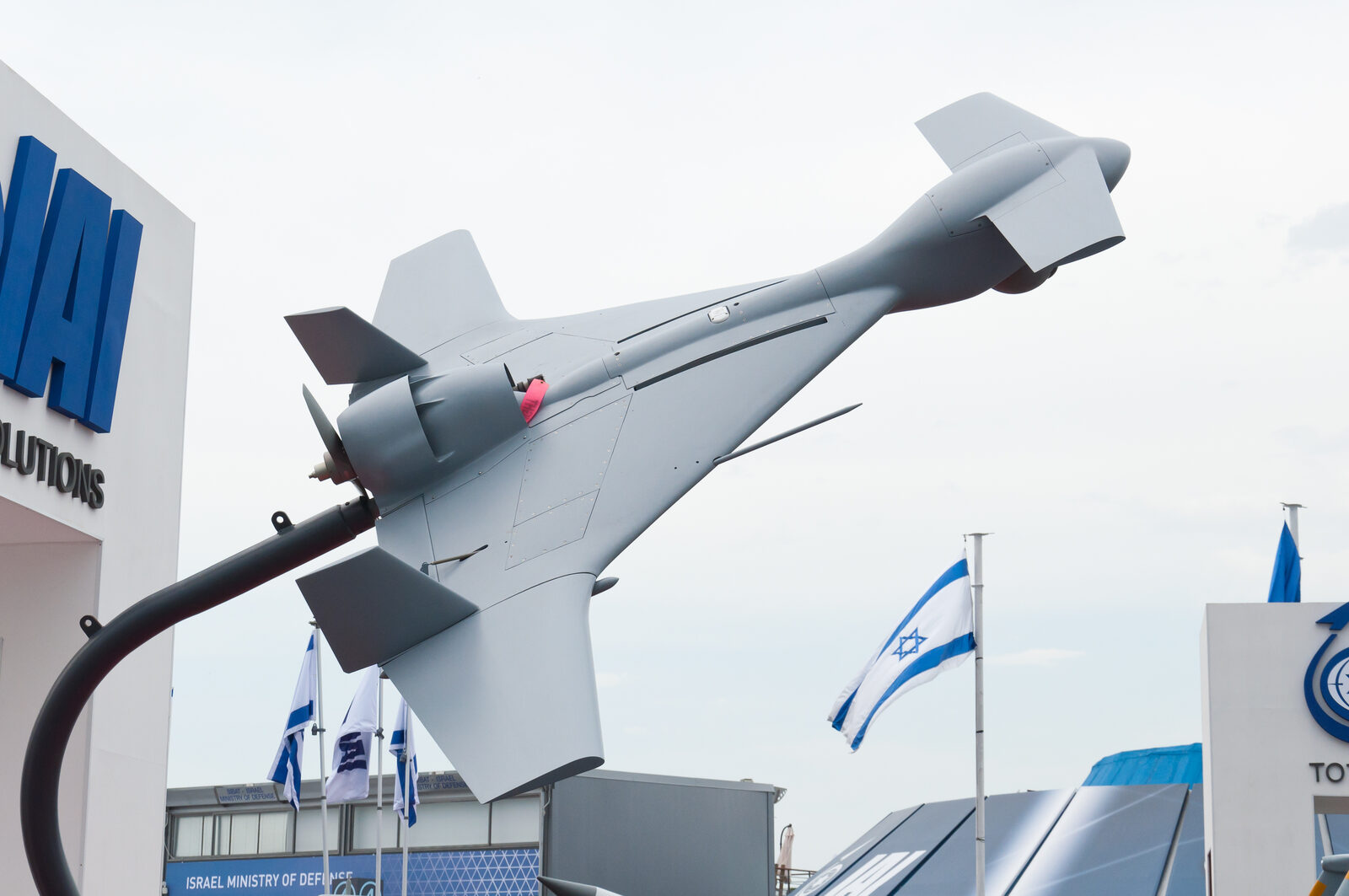
Israel Aerospace Industries didn't just build a better weapon when it developed the Harpy in the 1980s — it created an entirely new weapons class. The Harpy is an expendable drone-missile hybrid that autonomously circles a battlespace hunting radar emissions, then dives to destroy them. More than 35 years later, that concept underpins the defining category of modern aerial warfare, with IAI's Harop evolution combat-proven across two wars, serving eight confirmed operators, and North Korea copying the design without a license.
The Original: Fire-and-Forget Radar Hunting
IAI describes the Harpy as "the world's first and most operational Anti-Radiation Loitering Munition system," engineered specifically for SEAD and DEAD missions — Suppression and Destruction of Enemy Air Defenses. The calculus driving the design: integrated air defense networks hinge on radars, and killing those radars conventionally means sending crewed aircraft into the exact threat envelope those radars defend. An autonomous weapon with enough endurance to outlast the radar operator's patience changes that calculus entirely.
Canister-launched from a ground vehicle or naval platform, the Harpy carries no pilot and recovers nothing — it is the warhead. No prior target location intelligence is required; the weapon finds its own targets by scanning the electromagnetic spectrum. Its anti-radiation seeker identifies radar emitters by frequency, cross-referencing a database of known air defense systems before committing to an engagement. If the radar shuts down, the Harpy loiters and waits; when emissions resume, it attacks. The weapon approaches from any direction using shallow or steep dive profiles, making shutdown a temporary reprieve rather than a reliable escape.
The airframe is compact, powered by a pusher-propeller engine. Top speed reaches 225 knots; operational ceiling is 15,000 feet. Endurance runs to nine hours, day or night, in all weather and GPS-denied environments.
Harop: Adding the Human Back In
Developed in the early 2000s, the Harop retained the loitering-munition airframe concept but fundamentally changed its targeting architecture. Where the Harpy hunts autonomously on RF emissions, the Harop replaced that seeker with an electro-optical/infrared sensor and added a two-way datalink, inserting an operator into the engagement at every stage.
The operator receives live EO/IR video from the weapon as it orbits the target area, can redirect it mid-flight, select a specific target, initiate the strike, or abort — all the way up to the moment of impact. As The Aviationist describes the capability:
"The operator can direct the selected Harop to the target area and use the video feed to select a target and initiate the attack."That abort-until-impact window matters: it supports rules-of-engagement verification, civilian proximity assessment, and real-time re-targeting that fully autonomous weapons cannot provide.
The hardware matches those operational demands: 2.5 m airframe, 3 m wingspan, approximately 125 kg, electric pusher-propeller propulsion cruising at around 185 km/h with a 9 km operational ceiling. Range reaches 1,000 km; endurance is six to nine hours. The two-way datalink operates out to approximately 200 km and is immune to GNSS jamming. The warhead is a 23 kg shaped charge; CEP is reported at under one meter. Estimated unit cost runs $100,000–$200,000 per round.
Harop also extended the addressable target set beyond Harpy's SEAD-only mission. Its EO/IR sensor can engage non-emitting targets — command posts, armor, supply depots, unmanned surface vessels — that an anti-radiation seeker would ignore entirely. C4ISRNet's description during the weapon's first confirmed combat deployment captures it cleanly: Harop is "a loitering munition that is essentially UAV designed to directly strike a target like a missile."
Export Roster and Combat Validation
Turkey was Harop's first export customer in 2005. India followed in 2009 with an approximately $100 million order for the Indian Air Force. Eight operators are now confirmed: Azerbaijan, China, India, Israel, Kazakhstan, South Korea, Turkey, and Uzbekistan. Germany acquired the system through a Rheinmetall partnership. North Korea displayed an unlicensed copy at a military parade; a proposed Ukrainian sale was dropped under Russian political pressure.
First confirmed combat use came in April 2016 during the Nagorno-Karabakh Four Day War, when Azerbaijan deployed Harop against Armenian forces. Video evidence captured the weapon in its terminal dive; Armenian officials reported a strike killing seven soldiers on a bus.
The strategic test came in the 2020 Nagorno-Karabakh war. Azerbaijan's Harop fleet systematically dismantled Armenian air defense infrastructure — S-300 long-range systems, Tor medium-range batteries, Osa point-defense units — in a GPS-jammed winter combat environment. The datalink held; the man-in-the-loop kill chain performed under contested conditions. IAI describes the system as "combat proven," a designation earned across two separate armed conflicts.
Why It Matters
Harpy and Harop established the structural template every subsequent loitering munition follows: ISR and precision strike capacity fused into a single expendable airframe. The category's defining attribute is not warhead mass but patience — the weapon orbits until conditions are favorable and strikes on its own terms rather than on the launch clock. As IAI's Boaz Levy described the Mini Harpy to Jane's: "the system we developed loiters in the air waiting for the target to appear and then attacks and destroys the hostile threat within seconds." That architecture, first fielded by the Harpy in the 1980s, now sits at the center of every serious loitering munition program worldwide.
The 2020 Karabakh conflict demonstrated at operational scale what defense analysts had theorized: a comparatively modest loitering munition fleet can functionally neutralize a conventionally-equipped integrated air defense network. That result reshaped procurement strategies across NATO and non-NATO states and accelerated investment in counter-loitering munition systems globally.
IAI's 2019 Mini Harpy — 45 kg, 100 km range, 8 kg shaped-charge warhead, 120-minute endurance — fuses Harpy's autonomous anti-radiation seeker with Harop's EO/IR man-in-the-loop capability in a single airframe designed to engage "fast-moving targets that 'blink' for a few seconds." It is the fourth generation of a concept now four decades old, and it signals that the category IAI invented continues to evolve faster than the countermeasures being fielded against it.
Sources
- C4ISRNet — Kamikaze drone filmed in Nagorno-Karabakh conflict (2016)
- Jane's — IAI announces new Mini Harpy loitering munition (2019)
- The Aviationist — IAI loitering munitions overview (2022)
- MissileStrikes — Harop specifications and analysis
- Battle Policy — Harop loitering munition
- Military Factory — IAI Harpy / Harop details
