
Every serious drone mission planner knows the number: thirty minutes. That's roughly what a capable multirotor gets on lithium-polymer cells before it's nursing reserves back to the pad. For infrastructure inspection, long-range surveillance, and military ISR, a platform that needs to land and recharge every half-hour is a logistics tax that eats the operational case alive.
Two distinct propulsion strategies are attacking that constraint. Hydrogen fuel cells replace the battery pack with an electrochemical generator fed by compressed or liquid hydrogen. Gas-electric hybrids keep a small combustion engine running at its efficiency sweet spot to drive a generator, using a battery buffer for peaks. Neither is exotic research anymore — both have certified products on the market, military program funding, and customers who've decided endurance is worth the complexity premium.
The Chemistry of the Advantage
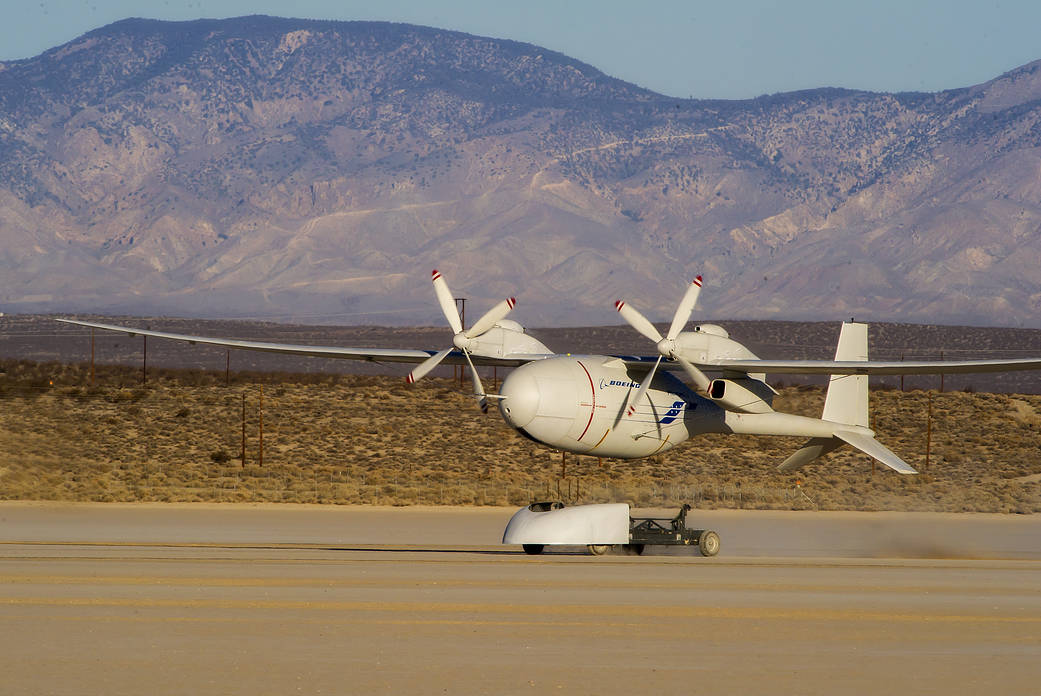
The core argument for hydrogen is energy density, and the numbers are stark. Hydrogen fuel cells achieve over 480 Wh/kg — roughly 2.6 times the energy density of the best available batteries, based on 2007 Pterosoar flight data from the Horizon Fuel Cell / NASA Dryden collaboration. Doosan Mobility Innovation puts the practical delta at 4–5 times battery energy density for its commercial product line.
The dominant architecture for drone applications is the proton-exchange membrane (PEM) fuel cell. Hydrogen flows to the anode, oxygen from ambient air reaches the cathode, and the reaction produces electricity and water vapor — no combustion, no carbon output. Because fuel cell output is relatively steady, the architecture pairs it with a lithium-polymer buffer battery: the fuel cell handles cruise power, the battery covers takeoff, landing, and burst demand. Doosan's DS30 demonstrates what this delivers in production: a 2.6 kW fuel cell, a 350-bar carbon-composite tank carrying 300 grams of hydrogen in 10.8 liters, 2 hours of flight, 80 km/h top speed, 5 kg payload. Tank replacement takes within 5 minutes versus up to an hour for battery recharging. Doosan's data show the DS30 covers an area eight times larger per sortie than a battery counterpart.
Twenty Years of Records
The endurance record list for hydrogen UAVs traces a technology maturing from naval labs into product catalogs. In November 2005, the U.S. Naval Research Laboratory's Spider-Lion — a 5.6-pound aircraft on Protonex compressed-hydrogen cells — flew 3 hours 19 minutes. By October 2007, KAIST's sodium borohydride liquid fuel cell kept a 2 kg aircraft aloft for over 10 hours, producing roughly 10 times more electricity than existing batteries. AeroVironment's Puma surpassed 9 hours in March 2008 under AFRL funding, demonstrating "three to four times the endurance capability of its standard batteries." The NRL Ion Tiger reportedly flew 48 continuous hours on liquid hydrogen in 2013.
The current frontier belongs to large fixed-wing platforms. In April 2025, an AVIC Chengdu / Tsinghua University fixed-wing UAV completed a 30-hour hydrogen flight in China. The Tianmushan-1 reportedly logged a Guinness World Record non-stop flight of 188.605 km in December 2025. That trajectory — from a 5-pound NRL test article to record-breaking endurance in twenty years — tracks a standard technology diffusion curve now entering its commercial phase.
H3 Dynamics' HYWINGS fixed-wing UAV (announced November 2016) illustrated the commercial translation: 10-hour flight time, 500 km range, 7 kg total takeoff weight, hand-launched without runway or catapult. Cellen H2's H2-6 achieves up to 150 minutes versus 20–40 minutes for lithium-ion equivalents, carries up to 10 lbs payload, and targets oil and gas, energy, telecoms, and construction. CEO Roberto Yelin describes the offering beyond hardware:
"We offer frictionless refueling solutions and hydrogen ecosystem services."
The Gas-Electric Alternative
Gas-electric hybrids take a different path: a small ICE runs at constant optimized RPM to drive a generator supplying electric motors and charging an onboard battery. Operators can run battery-only for quiet flight, combustion-plus-generator for endurance, or both in parallel for demanding phases. The ICE runs at peak efficiency regardless of flight demand fluctuations.
LiquidPiston's XTS-210 rotary engine (used in the HEXE configuration) — 25 hp — is up to 90% smaller than an equivalent piston diesel, runs on standard jet fuel, and has been retrofitted into a 600-lb Army drone with approximately 60% LiquidPiston content, supporting roughly 2-hour missions and receiving up to $15M in Army SBIR CATALYST funding. Phase 2 flight demonstrations completed by summer 2025. Senior VP of Corporate Development Per Suneby was direct at XPONENTIAL 2025:
"We're not going to be in the UAV business. We're going to be in the UAV propulsion business."
For military applications, hydrogen stacks a stealth argument on top of the endurance case. ZeroAvia's defense analysis documents fuel cell exhausts as 3 times cooler than jet engines, with IR radiation reduced by up to 80 times and noise down by up to 85% — figures that represent a qualitative survivability shift against man-portable air defense. The U.S. Defense Innovation Unit's approval of Heven Aerotech's Z1 as the first hydrogen drone on the Blue UAS Select list signals that supply-chain security requirements are navigable for hydrogen platforms. Large Class III ISR drones could push endurance from 40 hours to beyond 60 hours on liquid hydrogen storage.
Storage: Where Physics Pushes Back
The case against hydrogen at scale comes down to storage. Compressed hydrogen at 350 bar in carbon-composite cylinders is the commercial standard; cylinder swaps take within 5 minutes but require pressurized ground supply equipment. At 700 bar, volumetric density doubles — but compression imposes significant energy overhead. Liquid hydrogen stores more per volume but requires cryogenic infrastructure and suffers boil-off; liquefaction consumes approximately 40% of the hydrogen's energy content. Metal-hydride canisters eliminate high-pressure handling risk but require up to 300°C to release hydrogen, adding weight and energy overhead that erodes the density advantage.
The most promising near-term development is solid-state storage via metal-organic frameworks. H2MOF, headquartered in Irvine and co-founded by Nobel laureate Omar Yaghi, develops nano-engineered reticular materials that store hydrogen at low pressure and ambient temperature, reporting greater than 5.5 wt.% gravimetric efficiency and greater than 40 g/L volumetric efficiency — approximately 30% better gravimetric efficiency than 700-bar tanks and double the volumetric capacity. If those figures hold at production scale, they would materially reduce the infrastructure burden for field operations.
The economic trajectory supports the technology. The global hydrogen fuel-cell drone market sat at $41 million in 2024; analysts forecast $2.1 billion by 2031. Hydrogen and hybrid propulsion have cleared the demonstration phase — the constraint now is whether the logistics chain for storage and refueling can mature as fast as the platforms themselves.
Sources
- Barnard Microsystems — UAV Fuel Cell Milestones (NRL, AFRL program records)
- Vicor Power — Fuel Cell Powered Drones
- ZeroAvia — Hydrogen in Defense: Stealth and Range Enhancement for UAVs
- Doosan Mobility Innovation — Hydrogen Drone Technology
- Hydrogenera — Hydrogen-Powered Drones: A New Era of Long-Endurance Flight
- DroneLife — LiquidPiston's Hybrid Power System at XPONENTIAL 2025
- Commercial UAV News — Cellen H2 Hydrogen-Powered Drones
- DroneLife — How Solid-State Hydrogen Is Powering the Next Generation of UAVs
- Grepow — What Are Hydrogen-Powered Drones and eVTOLs?
- Unmanned Systems Technology — H3 Dynamics Launches Fuel Cell UAV with 10-Hour Flight Time
- U.S. Department of Energy — Hydrogen and Fuel Cell Technology Basics