
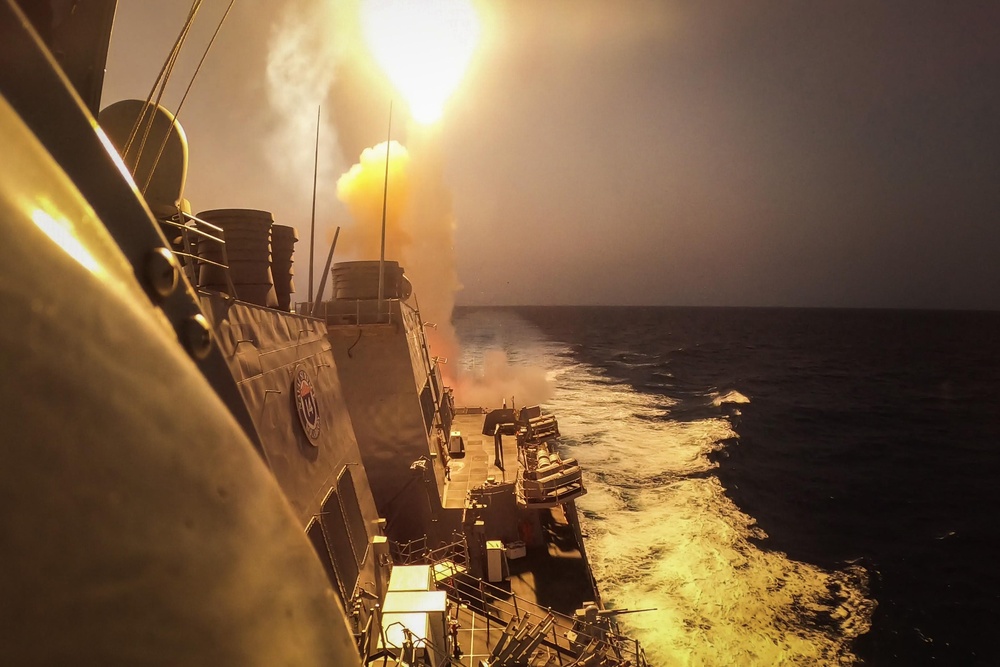
Before the first Houthi attack drone crossed into international shipping lanes, the Red Sea carried roughly 10 to 15 percent of global seaborne trade. Approximately 2,068 vessels passed through the Suez Canal each month in November 2023. By October 2024 that number had fallen to roughly 877 — a 58 percent collapse. Container shipping costs rose 233 percent compared to June 2023. Vessels rerouting around the Cape of Good Hope added more than ten days at sea and up to one million dollars per voyage in additional fuel. The proximate cause was a sustained Houthi maritime interdiction campaign that, by August 2024, had logged over 190 attacks documented by the Pentagon, approximately 38 percent of which resulted in hits despite coalition interception efforts.
The campaign began on October 19, 2023, when the USS Carney intercepted three cruise missiles and drones the Houthis had fired from Yemen toward Israel — the first naval engagement of what the Center for Maritime Strategy has since characterized as "the longest naval engagement since World War II" for the US Navy. Less than a month later, on November 19, Houthi forces seized the Galaxy Leader, a British-owned, Japanese-operated cargo ship, taking 25 crew hostage. That boarding established the operating premise: the Red Sea was no longer neutral maritime space for ships connected, however tenuously, to Israel or to Western commerce.
Ship by Ship: The Documented Strike Record
What followed was methodical escalation. On December 11, 2023, an anti-ship cruise missile struck the M/T Strinda, a Norwegian tanker, in the Bab al-Mandab Strait — the chokepoint at the southern mouth of the Red Sea. Commercial traffic began diverting almost immediately; container, bulk carrier, and tanker traffic in the Red Sea had dropped more than 80 percent by January 2024, with dry bulk traffic still down roughly 80 percent as late as June 2024.
The campaign's first confirmed sinking came February 18, 2024, when a missile struck the M/V Rubymar, a British-owned bulk carrier. The ship developed an 18-mile oil slick before sinking on March 2, still carrying 21,000 tons of fertilizer. Three weeks later, on March 6, an anti-ship ballistic missile struck the M/V True Confidence, a Liberian-owned vessel — killing three crew members and injuring four, the first fatalities on a commercial ship in the campaign. On March 9, coalition forces spent four hours intercepting at least 28 suicide drones in the largest single swarm documented to that point. January 15 had already seen an anti-ship ballistic missile strike the M/V Gibraltar Eagle; January 26 brought a second ballistic missile hit on the M/V Marlin Luanda, with the USS Carney subsequently extinguishing the resulting fire.
June brought the second confirmed sinking. On June 12, Houthis deployed an explosive unmanned surface vehicle (USV) against the M/V Tutor; the vessel sank days after the June 12 strike. In July, a modified Sammad-3 drone flew approximately 1,000 miles from Yemen to Tel Aviv — routed through Eritrean and Sudanese airspace — and detonated near the US Embassy branch office on July 19, killing one civilian and wounding four. The drone penetrated Israeli air defenses, confirming a standoff strike radius the Houthis had not previously demonstrated at operational scale.
The Arsenal and Its Iranian Architecture
The Houthis did not improvise this campaign. The primary strike system — the Sammad-3 — is an Iranian-designed, extended-range one-way attack UAV. The anti-ship missile inventory includes the Mohit and Asef anti-ship ballistic missile variants, the Al-Mandab-2 anti-ship cruise missile, and Burkan-3 and Zulfiqar rockets (Iranian Qiam and Rezvan variants under Houthi redesignation). Explosive USVs were also deployed at scale throughout the campaign.
Behind the hardware was a functioning Iranian logistics pipeline. On January 11, 2024, US Navy SEALs boarded a dhow carrying propulsion systems, guidance components, and warheads for medium-range ballistic missiles bound for Houthi forces. Seventeen days later, the US Coast Guard seized another vessel carrying ballistic missile components, explosives, and unmanned vehicle parts. The Combating Terrorism Center at West Point documented that Iranian supply lines bypassed UN Verification and Inspection Mechanism (UNVIM) screenings starting in spring 2024, with 500 or more truckloads reportedly avoiding inspection by May 2024 and approximately 12 vessels docking at Houthi-controlled ports between May and August.
Iranian personnel were embedded with Houthi forces to support missile guidance and C4ISR systems. The Iranian vessel Behshad provided maritime surveillance support in the region. Electronic warfare equipment and AIS vessel-tracking systems were also transferred — enabling the targeting operations that characterized the campaign, though imperfectly: the CTC West Point analysis found that 37 percent of vessels attacked between November 2023 and August 2024 failed to match the Houthis' own declared targeting criteria, reflecting the limits of the intelligence picture despite Iranian support.
The tactical architecture itself evolved in three documented phases. The first, December 2023 through May 2024, relied on single-system stand-off strikes. The second phase, May through June 2024, introduced multi-system sequential combinations pairing UAVs with anti-ship ballistic missiles to complicate interception sequencing. By June through August 2024 the campaign had shifted to "wolf pack" coordinated flotillas integrating USVs, close-in weapons, and stand-off missiles simultaneously — a step change that demanded coalition forces counter multiple overlapping threat vectors rather than serial engagements.
Coalition Response and the 62 Percent Problem
The US-led response operated on two tracks. On December 18, 2023, Secretary of Defense Lloyd Austin announced Operation Prosperity Guardian, a multinational maritime task force eventually comprising 24 or more nations — the UK, France, Italy, the Netherlands, Bahrain, Canada, Norway, Spain, and others. Its mandate was defensive: intercept incoming threats and protect commercial shipping in transit.
"This is not just a U.S. issue. This is an international problem, and it deserves an international response." — Secretary of Defense Lloyd Austin, announcing Operation Prosperity Guardian, December 2023
The offensive track launched January 11–12, 2024, when Operation Poseidon Archer deployed over 150 US and British precision munitions against 60 Houthi targets: radar installations, drone and missile storage facilities, and launch platforms. Strike escalation continued through the year. In October 2024, B-2 stealth bombers — their first combat use since 2017 — dropped GBU-57 Massive Ordnance Penetrator bunker-buster bombs against Houthi underground weapons storage.
Despite that escalating investment, the coalition's intercept rate against incoming Houthi attacks stood at approximately 62 percent through August 2024 — meaning 38 percent of attacks resulted in strikes on vessels.
Multiple US MQ-9 Reaper drones were destroyed during the campaign. US Navy munitions expenditure reached nearly $1 billion by April 2024, roughly eight months into the campaign.
Why It Matters
The cost arithmetic at the center of the Red Sea campaign is the reason defense analysts and acquisition planners treat it as a template rather than an anomaly. Coalition interceptors ranged from the Rolling Airframe Missile at approximately $905,000 per shot to the SM-6 at $4.3 million — against Houthi one-way attack drones that, analysts estimate, cost a small fraction of the interceptors used against them. The Standard Missile-2 runs approximately $2.1 million; the Evolved Sea Sparrow approximately $1.7 million. Saudi Arabia had already run this equation before the Red Sea campaign opened, spending hundreds of millions in Patriot and AMRAAM missiles against low-cost Houthi drone threats inside its own borders. The Red Sea campaign repeated that arithmetic at global scale, against commerce rather than a single nation's territory, and against a coalition of 24 nations rather than one.
The Houthis conditioned any ceasefire on the lifting of Israel's Gaza blockade — a political demand that no coalition navy could fulfill regardless of tactical performance. The CTC West Point assessment concluded that the Houthis emerged from the first year of the campaign with more "newfound global recognition" than any other member of the Iran-aligned Axis of Resistance. The Congressional Research Service has continued tracking the campaign through mid-2025, documenting an operation that has compressed one of the world's most critical trade arteries using mass-produced one-way drones, exported ballistic missiles, and explosive boats — and absorbed B-2 strikes on hardened underground facilities without losing the ability to launch 28-drone swarms. The question that the Red Sea campaign forced onto defense planners is not whether cheap one-way UAVs can disrupt expensive naval task forces. It is whether existing interceptor inventories and per-shot cost structures are operationally viable against an adversary willing to sustain a dramatically asymmetric cost-exchange ratio for years.
Sources
- Wilson Center — Timeline of Houthi Attacks
- Combating Terrorism Center at West Point — A Draw Is a Win: The Houthis After One Year of War
- Congressional Research Service (congress.gov) — Houthi Attacks on Shipping, IF12581 (July 22, 2025)
- Iran Primer / USIP — Houthi Explainer: Conflict and the Red Sea
- Center for Maritime Strategy — The Houthis, Operation Prosperity Guardian, and Asymmetric Threats to Global Commerce
- Responsible Statecraft — Operation Prosperity Guardian
- Washington Institute for Near East Policy — Houthi Shipping Attacks: Patterns and Expectations, 2025
- GlobalSecurity.org — Operation Poseidon Archer
- Air & Space Forces Magazine — Operation Prosperity Guardian and Houthi Attacks
