
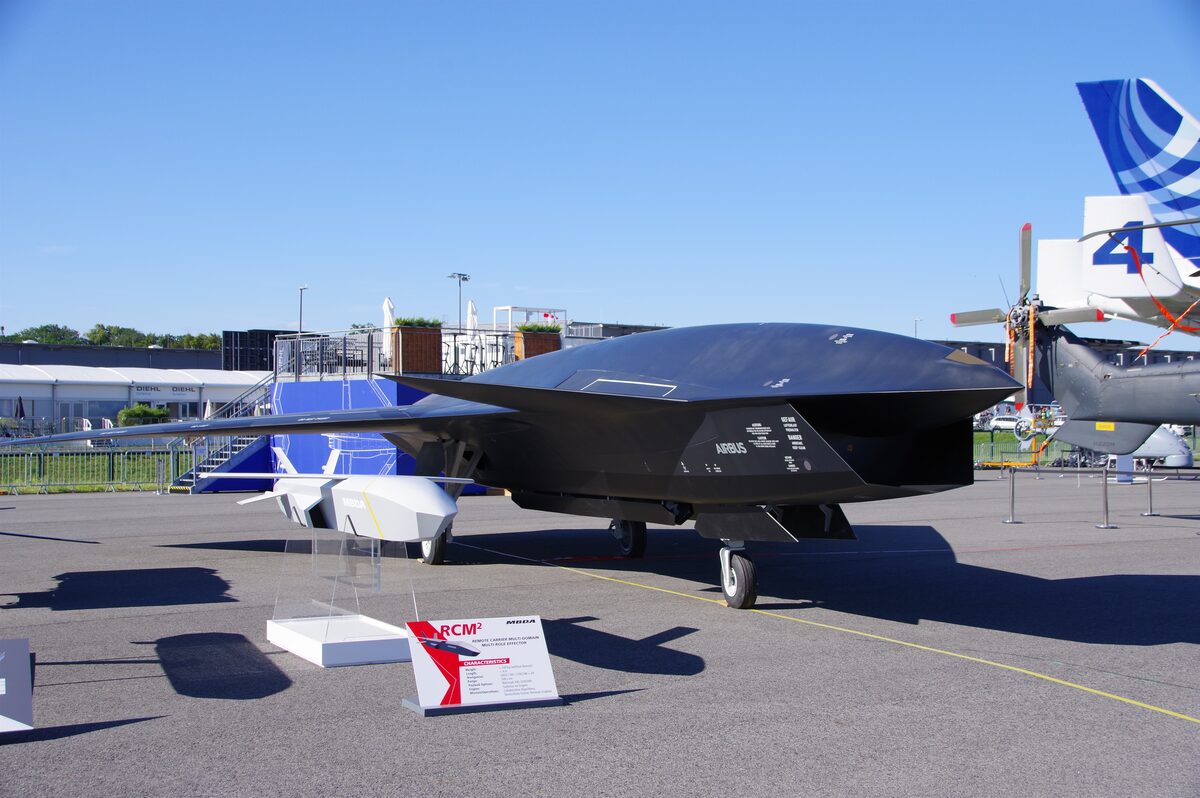
Most combat drones carrying electronic warfare payloads were designed to carry something else first. A kinetic airframe gets a jammer bolted on, a pod hung from a hardpoint, an existing bay repurposed. Helsing's CA-1EA, unveiled at ILA Berlin on June 11, 2026, represents a different premise: build the aircraft around the electromagnetic mission from the start, with the software stack conceived for EW rather than adapted to it. Whether that distinction survives contact with procurement is a separate question, but it is the animating concept behind the platform.
Airframe and the AI Stack
The CA-1EA is manufactured by Grob Aircraft, a southern Germany-based firm that Helsing acquired to secure organic airframe production. According to reporting from the show, the aircraft spans roughly 10 meters of wingspan, stretches approximately 11 meters in length, and carries a maximum take-off weight of around 4 tonnes. The configuration is high-subsonic, with an internal weapons bay and provision for modular payloads — a form factor consistent with a low-observable wing loading for persistent loiter in a contested electromagnetic environment.
The autonomy stack sits on three layers. At the top is Centaur, Helsing's proprietary AI platform, which handles mission-level decision-making. Below that, and specific to the electronic-warfare role, is Cirra — described by Helsing as a deep-learning EW system capable of processing the electromagnetic battlespace in real time. The primary jammer payload is the Hensoldt Kaeletron, integrated under Cirra's sensor-fusion umbrella. The software backbone tying it together is MDOcore, Helsing's multi-domain operations framework.
The Cirra capability claim is the most technically assertive part of the announcement. According to Helsing's announcement at ILA, the system can "rapidly identify previously unknown electromagnetic emitters and assess the intent of adversary air-defence systems in real time." That is a significant claim — the ability to fingerprint novel emitters on-the-fly rather than match against a pre-loaded library is the kind of electronic intelligence adaptation that currently requires dedicated collection platforms and extensive post-mission analysis. Helsing is positioning Cirra as compressing that loop to a tactical timescale, though no independent verification of that capability exists at this stage of development.
Teaming: The CA-1KA and the Eurofighter
The CA-1EA does not operate as a standalone. Helsing's published concept of operations pairs it with the CA-1KA, a kinetic variant riding the same airframe. The CA-1KA reportedly carries a 500-kilogram payload alongside a SAR/GMTI synthetic aperture radar and an EO/IR sensor suite — a reconnaissance-strike package built on the same platform as the jammer. The intent, according to reporting from the show, is that the two aircraft work in coordinated mixed flights: the CA-1EA suppresses and blinds adversary air defenses while the CA-1KA and, crucially, manned Eurofighters prosecute targets behind the electromagnetic corridor the CA-1EA opens.
This is the collaborative combat aircraft model applied to the suppression-of-enemy-air-defenses problem specifically. SEAD and DEAD missions have historically demanded either dedicated platforms like the EA-18G Growler or heavy expendable missiles; a persistent, reusable CCA that can maintain an electromagnetic envelope over the course of a strike package offers a different risk calculus. The teaming with the Eurofighter is a deliberate political and industrial signal as much as an operational one — the CA-1EA is positioned as an asset for European air arms that fly Typhoon, not a competitor to them.
Timeline Reality and the ILA Crowd
The program timeline deserves scrutiny. According to reporting from the show, the CA-1KA kinetic variant is targeting maiden flight in early 2027. The CA-1EA is on a later schedule: pre-series production in 2028, initial operational capability in 2031. That is a five-year runway from today to IOC for an aircraft that has not yet flown in any configuration. Five years is not an unreasonable development timeline for a novel combat aircraft, but 2031 IOC from a pre-maiden-flight baseline is aggressive. The Grob acquisition gives Helsing industrial control over the airframe, which removes one dependency, and the Cirra/Centaur stack is presumably further along in software maturity than the airframe is. But slippage in programs at this stage is the norm, not the exception.
The CA-1EA also lands in a crowded field. ILA Berlin 2026 featured multiple European collaborative-combat-aircraft announcements in the same week, with Airbus's U760 Ravenstorm reveal — covered by The Aviationist — among the most prominent. By The Aviationist's count, the U760 became the fifth CCA contender in the European market. The concentration of European CCA announcements reflects both the urgency European defense ministries feel after years of underfunding and the compressed timelines several programs are now claiming in parallel. Not all of these programs will make it to production; the procurement math does not support five independent European CCA lines, and industrial consolidation pressure will accelerate.
What distinguishes the CA-1EA in that field is the specificity of its electronic-attack identity. Most CCA programs being announced in Europe are kinetic-primary with EW as a secondary mode. Helsing is making the inverse argument: that the electromagnetic fight is sufficiently complex and rapidly evolving that it warrants a purpose-built AI-native platform, not a multi-role drone with a jammer option. Whether European air forces agree with that argument — and whether they fund it — will determine whether the CA-1EA is a landmark concept or another ILA static display that never reaches the flight line.