
The United States has cleared Greece to buy a batch of AeroVironment's Switchblade 300 loitering munitions, opening the door to a Foreign Military Sale valued at roughly $80.1 million. The U.S. State Department authorized the potential transaction, and the Defense Security Cooperation Agency (DSCA) transmitted the required congressional notification — the standard first step before any deal is finalized under a Letter of Offer and Acceptance.
The package covers 350 Switchblade 300 Block 20 loitering munitions together with 35 Fire Control Systems, according to the DSCA notification and reporting from defense outlet Army Recognition. The end user is the Hellenic Armed Forces' Special Warfare Command, which intends to field the systems to secure two of Greece's most sensitive frontiers: the Evros River border with Turkey and the Eastern Aegean islands.
What Is Actually Being Sold
The Switchblade 300 is a man-portable, tube-launched loitering munition — a category of weapon that blurs the line between a reconnaissance drone and a guided missile. Built by AeroVironment, it is small enough to be carried and set up by a single operator, and once launched it can loiter over an area to provide low-altitude, rapid-response intelligence, surveillance, and reconnaissance (ISR) before diving onto a target to engage it directly.
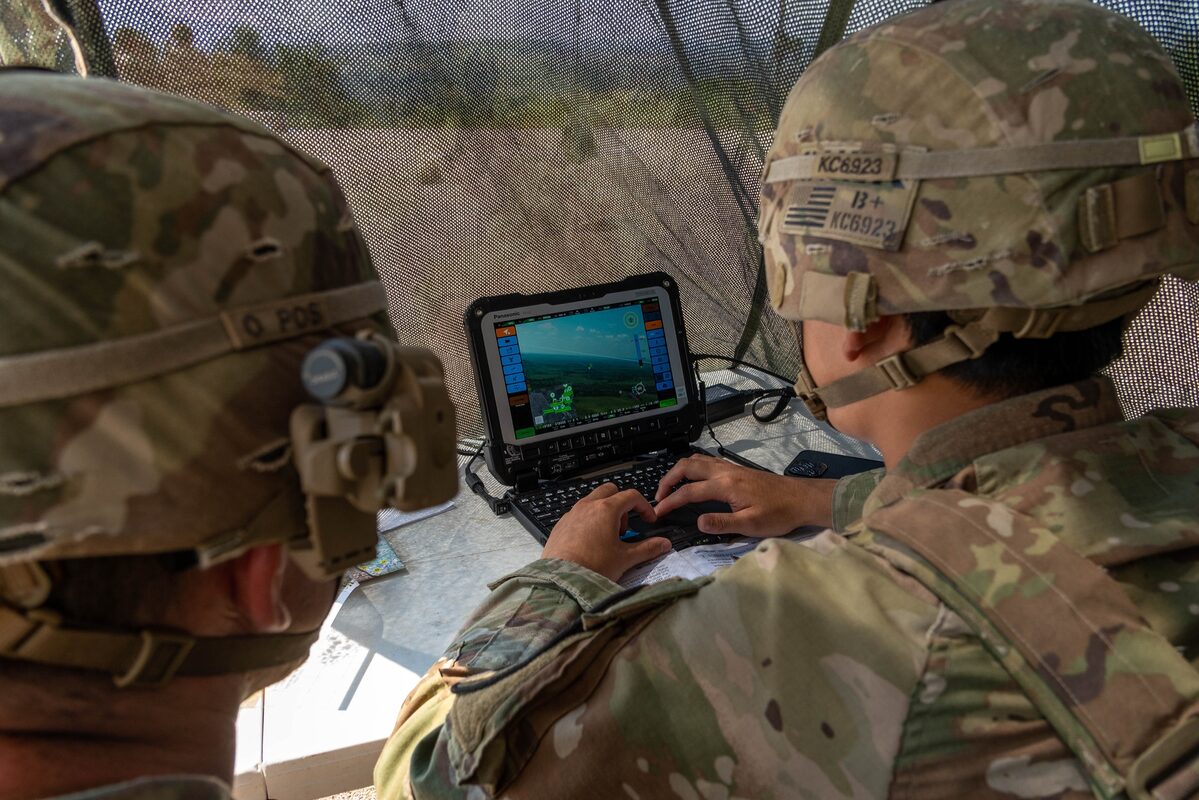
The proposed Greek buy is built around the Block 20 variant paired with 35 Fire Control Systems, the ground element operators use to plan, launch, and guide the munitions. According to the reporting, the systems are intended to operate within roughly a 30-kilometer control radius — the working envelope inside which a team can push a Switchblade out, watch a target through its sensor, and strike if authorized.
At 350 rounds across 35 fire-control units, the package works out to an average of ten munitions per system — a magazine depth consistent with a force that expects to expend the weapons in real operations rather than hold them purely as a demonstration capability.
Why Greece Wants Them, and Where
The stated destination for the capability is telling. The Hellenic Special Warfare Command is slated to deploy the Switchblades along the Evros River frontier and across the Eastern Aegean islands — the terrain and maritime approaches where Greek forces most frequently confront border-security and rapid-response scenarios.
Both geographies favor exactly the kind of tool the Switchblade 300 represents. Along the Evros, a river-and-scrub frontier, a loitering munition gives a small unit organic overwatch and a precision strike option without waiting on higher-echelon fires. Across the Eastern Aegean, where Greek islands sit close to the Turkish coast, the same weapon offers a way to observe and, if needed, engage low-altitude or close-in threats from dispersed island positions.
How the Sale Process Works
It is worth being precise about what has and has not happened. A DSCA Major Arms Sales notification is not a signed contract. It is the mechanism by which the executive branch formally tells Congress that the State Department has approved a possible sale, disclosing the dollar value, the quantities, and the principal contractor. Congress then has a window to review the transmittal before the deal can proceed.
From there, the transaction moves through the Foreign Military Sales system on a standard Letter of Offer and Acceptance (LOA) — the government-to-government document that, once signed by both sides, turns a notified case into a binding order. Quantities and dollar figures disclosed at the notification stage can shift by the time an LOA is finalized. Reporting on this case points to an expected first-delivery timeline in late 2026 — accelerated from an earlier 2028 schedule — though delivery schedules of that kind are contingent on the deal closing.
Why It Matters
Loitering munitions have moved from a niche special-operations tool to a mainstream line item in Western arms transfers, and this sale is another data point in that shift. For Greece, a notified $80.1 million buy of 350 Switchblade 300s hands a special-operations command a precision strike-and-ISR capability that it can push down to small teams operating on contested frontiers — a materially different posture than relying on crewed aircraft or larger, less responsive fires.
For the broader arms-export picture, the case is a clean illustration of how the U.S. FMS pipeline works in practice: State approves, DSCA notifies Congress with hard numbers and a named contractor, and the deal then lives or dies on the LOA. It also underscores AeroVironment's continued reach into NATO and allied inventories for the Switchblade family. Whether the 350 rounds and 35 fire-control systems arrive on the late-2026 timeline being reported will depend on the deal clearing congressional review and both governments signing — but the authorization itself signals where allied demand for small, expendable, precision-strike drones is heading.