
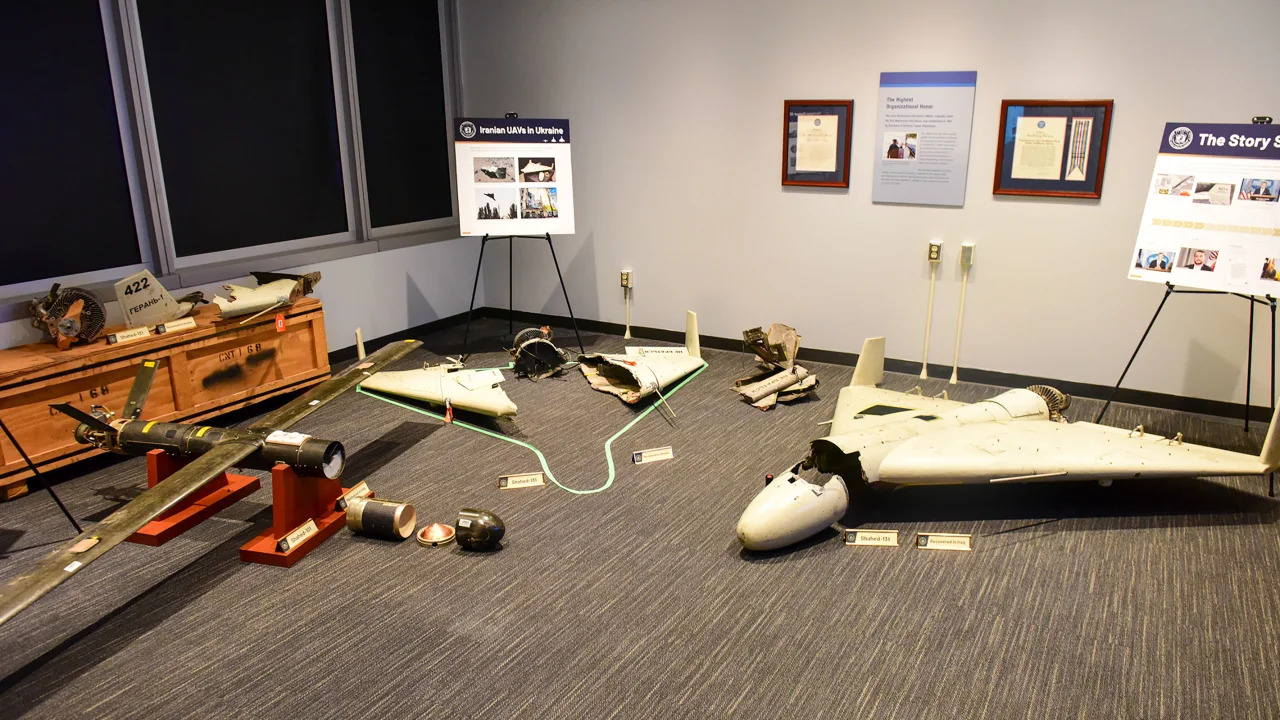
On Aug. 12, Ukrainian forces shot down a jet-powered Geran-4 attack drone over Kyiv Oblast. According to Ukrainian military intelligence (HUR), it was built at the Alabuga Special Economic Zone, Russia's largest production site for Shahed-family drones. When investigators took it apart, they found nearly 100 non-Russian components, and most of them were attributed to American technology companies. The newest parts are the bigger problem for Western export controls. Some of the chips were made in the first months of 2026.
The findings come from a Kyiv Independent investigation published Nov. 24. It was produced with OCCRP, Belgium's De Tijd, Lithuania's 15min and Germany's Paper Trail Media, and it draws on a Ukrainian intelligence report. The day before it ran, President Volodymyr Zelensky said Ukraine's defense against Russia's jet drones depends partly on stricter export controls in other countries.
What was inside the drone
Twelve of the foreign components in the Geran-4 carried readable date codes. These are the short markings manufacturers print to show when a part was made. Seven of the twelve were made in 2026, three in 2025 and two in 2024. None came from pre-war stockpiles.
The report names several of the 2026 parts:
- Timing chips marked as CTS Corporation parts, with date codes pointing to January, February and March 2026.
- A Vishay diode with date code 2607, meaning the seventh week of 2026, or mid-February.
- An STMicroelectronics microcontroller with date code 2606, meaning early February 2026. Based on its markings, it was assembled and tested in Malaysia.
The dates set a tight timeline. The microcontroller came off a production line in early February and was inside a drone shot down over Ukraine on Aug. 12, roughly six months later. In that window it had to leave the manufacturer's distribution channels, reach Russia, be installed in a drone, and be launched. Reverse-engineering old stockpiles does not explain that. These parts reached Russia through supply chains that were working in 2026.
The companies' replies followed a familiar pattern. STMicroelectronics said it no longer has operations in Russia and maintains a global trade compliance program, without addressing the specific component. Vishay said it blocked all shipments to Russia in February 2022 and likewise offered no explanation for the parts. CTS did not respond to repeated requests for comment. Ukraine's sanctions envoy, Vladyslav Vlasiuk, told the Kyiv Independent that Kyiv is not accusing manufacturers of supplying Russia directly. He said the products pass through a chain of three or four intermediaries, such as front companies in third countries.
The SIM card trail
The investigation also followed a second, lower-tech supply line. A Ukrainian intelligence report contained images of eight Lithuanian SIM cards from the prepaid brand Pildyk, run by Tele2 Lietuva, recovered from Russian drones launched in 2025. All eight were purchased and activated in 2024.
The timing matters. Lithuania began requiring identification to buy new prepaid SIM cards on Jan. 1, 2025, so cards activated before then could be bought without verifying identity. Tele2 told reporters it suspects specialized groups buy, activate and resell the cards, and that fraudsters and smugglers can misuse them.
A European Commission spokesperson said there is no EU-wide obligation to register prepaid SIM cards, which is a national competence, and that the main challenge is often not formal export but diversion, illegal procurement and resale. In other words, goods are often obtained legitimately and then rerouted to Russia.
Measuring the problem
Ukrainian agencies report two very different counts of foreign parts in Russian weapons. HUR's public War and Sanctions portal lists 6,377 components across 214 weapon units as of its Nov. 13 update. Besides components, the portal has sections on involved enterprises and the logistics of the trade.
Ukraine's Prosecutor General's Office gives a much larger number. It told the Kyiv Independent that investigators have identified more than 16,000 foreign-made components in Russian drones, missiles and other weapons, bearing the markings of manufacturers from more than 30 countries. The Kyiv Independent notes that this is well over double what HUR has made public so far. The Prosecutor General's Office has sent 28 mutual legal assistance requests to authorities in other countries. Both numbers point the same way: Russian weapons still rely heavily on foreign electronics.
Zelensky: "real export controls"
On Monday, Nov. 23, Zelensky spoke after a meeting of the Supreme Commander-in-Chief's Headquarters that focused on defense against Russian jet-powered drones in 2026 and 2027. In his evening address, quoted by Interfax-Ukraine, he said Ukraine needs "both sanctions and real export controls – definitely stricter than those currently in place in some countries."
He listed export controls alongside military measures: more F-16s, Gripen fighters scheduled to arrive starting in January, more effective interceptors against jet Shaheds, and contracts for as many interceptors as possible. He said specific tasks had been set at the level of the president, the Foreign Ministry and the Defense Ministry to provide Ukraine with additional aircraft.
Zelensky did not name the countries he meant. Still, the line puts trade policy in the same air-defense plan as fighter jets and interceptors.
Why It Matters
According to the Kyiv Independent, the Geran-4 flies faster and higher and is more maneuverable than earlier Geran models, which leaves defenders less time to react. Cutting off the supply of parts would reduce how many are built in the first place.
This investigation shows where that supply effort is breaking down. The EU and the U.S. imposed export restrictions on microchips to Russia after the 2022 invasion, yet the parts in this drone were made years later. According to Vlasiuk, they reached Russia through intermediaries and front companies in third countries. The microcontroller assembled in Malaysia and the SIM cards activated before Lithuania's ID rule each show a point in that chain where an item can drop out of view.
Timing chips, diodes and general-purpose microcontrollers are typically made in large volumes for civilian products, which makes them hard to track one by one. That is consistent with the Commission spokesperson calling diversion the main challenge, and with Zelensky asking for stricter controls rather than sanctions alone. Vlasiuk's proposals, as reported by the Kyiv Independent, are criminal prosecution of intermediaries rather than only sanctions listings, manufacturer responsibility for the end users of their products, and G7 action against the financial flows behind the trade.
Until those gaps close, investigators are likely to keep finding recently made Western parts in Russian drones, as Vlasiuk said they did in a downed Geran-5 in September, when they found a transistor from a major European manufacturer made in February.
Sources
- Exclusive: Freshly made European, American components found in Russian drones attacking Ukraine (Kyiv Independent, Nov. 24, 2026)
- Foreign components in weapons (War and Sanctions portal, Ukraine Defence Intelligence)
- Ukraine needs more Gripen fighter jets, which expected to arrive starting in Jan (Interfax-Ukraine, Nov. 23, 2026)
