
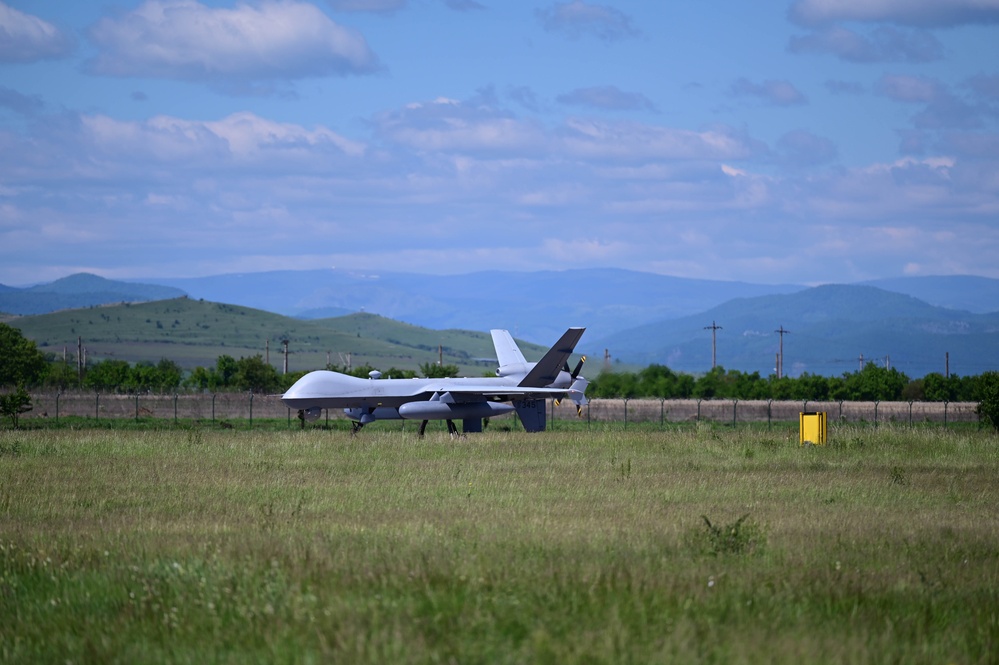
GA-ASI is not a publicly traded defense prime. It is not a startup disrupting the legacy players. It is something more unusual: a privately held, family-controlled company that, over 34 years, built the aircraft that defined the armed drone era — and is now placing a major bet that it can define the autonomous-fighter era as well.
General Atomics Aeronautical Systems Inc. was formally established on April 28, 1992, as a subsidiary of General Atomics, the broader defense and high-technology conglomerate that Neal Blue and his brother Linden Blue acquired from Chevron in 1986 for an estimated $60 million. That acquisition — of a company best known for nuclear energy research — is the seed of everything that followed. No venture capital. No IPO. No outside investors. The Blue family has retained control ever since: Neal serves as Chairman and CEO of General Atomics; Linden serves as Vice Chairman of General Atomics and CEO of GA-ASI. As of 2020, the split was approximately 80-20, Neal to Linden.
Neal Blue, born in 1935, attended Yale University, holds a pilot's license, and served in the U.S. Air Force. These are not incidental details. The Blues came to defense aviation as operators and enthusiasts first, executives second — and that orientation shaped what kind of company GA-ASI became.
The structure matters more than it first appears. Without Wall Street pressure to hit quarterly earnings targets, GA-ASI could fund the development of the MQ-9A Reaper entirely with company money before the U.S. Air Force had committed to buying it. The same internal investment model underwrote the Avenger, the MQ-9B, and — most recently — the development of the YFQ-42A Collaborative Combat Aircraft. When the company decided to bet on a next-generation platform, it could write the check itself.
From a Garage in Los Angeles to the Skies Over Bosnia
GA-ASI did not invent the concept of a long-endurance unmanned aircraft. It inherited one. Abraham Karem — born in Baghdad, raised in Israel, immigrated to the United States in 1977 — built the Albatross prototype in a Los Angeles garage. By 1981, it could fly for 56 hours, a performance that drew DARPA funding. His next aircraft, the Amber, cost only $350,000 to build, and by 1987 both the Army and Navy had expressed interest in purchasing roughly 200 units. Karem sold the technology to Hughes Aircraft, which then sold it to General Atomics. GA's first contract, signed in 1992, was for six GNAT-750 unmanned aircraft systems delivered to the Turkish government.
Two years later, CIA Director Jim Woolsey arranged to purchase two GNAT-750s for reconnaissance missions over Bosnia. The aircraft flew. They worked. And when the U.S. Joint Program Office solicited designs for a more capable successor — later transferred to the Air Force — GA won the contract in 1994. That aircraft became the Predator A, designated MQ-1.
The MQ-1 first flew in July 1994 and entered operational service in 1995. More than 320 were ultimately delivered before the production line closed in 2011. The fleet accumulated more than 2 million flight hours, approximately 90 percent of that on combat missions, across close to 141,000 total sorties. Hellfire missiles were not integrated until 2001 — the aircraft flew unarmed for six years — but once weaponized, the Predator became central to the post-9/11 counterterrorism campaign in ways that have generated years of legal and ethical debate over signature strikes and targeted killing.
The successor, the MQ-9A Reaper (Predator B), first flew in 2001 and represented a generational leap over the Predator A. The Army's parallel requirement produced the MQ-1C Gray Eagle, a GA-ASI derivative with a 56-foot wingspan, 24-hour endurance, and up to four Hellfire missiles. A Gray Eagle company operates nine aircraft across five Ground Control Stations and requires 128 personnel to sustain it — a staffing footprint that the Army's current leadership has cited as one argument against continued procurement. By 2022, GA-ASI's entire delivered fleet had logged over 7 million flight hours.
The Industrial Machine: Poway, Palmdale, and a Growing Customer List
GA-ASI's manufacturing base is anchored at a 40-plus-building campus in Poway, California, where aircraft are designed, assembled, and integrated. A Secure Advanced Manufacturing (SAM) facility, opened in 2023, handles classified next-generation programs. Flight testing runs out of the Gray Butte Flight Operations Facility near Palmdale, in the Mojave Desert. Additional sites span Arizona, Utah, and North Dakota, with personnel embedded at international customer locations. The company employs over 9,000 people across those facilities.
The numbers behind 34 years of production are not modest. GA-ASI has delivered more than 1,000 aircraft, and on any given minute, close to 70 GA-ASI aircraft are airborne somewhere in the world.
That operational footprint has made GA-ASI the dominant supplier in the NATO Medium-Altitude Long-Endurance market. The MQ-9B — available as the land-based SkyGuardian and the maritime-configured SeaGuardian — has accumulated a customer list that now includes Belgium, Canada, Denmark, France, Germany, India, Japan, Poland, Taiwan, the United Kingdom, and the United States. Germany recently signed a contract through the NATO Support and Procurement Agency for eight MQ-9B SeaGuardians and four Certifiable Ground Control Stations, with first deliveries expected in 2028.
The foreign military sales pipeline is substantial. In January 2022, the State Department approved a $300 million FMS case to France for MQ-9 contractor logistics support, with GA-ASI named as prime contractor.
"The proliferation of MQ-9B in Europe delivers commonality between NATO countries," GA-ASI CEO Linden Blue noted in announcing the German contract, "and for Germany, it will provide opportunities for interoperability with their fleet of P-8As."
The Gray Eagle's future is less settled. Army Chief of Staff Gen. Randy George and Army Secretary Dan Driscoll announced the end of new procurement under the Army Transformation Initiative, characterizing the system as obsolete in the same breath as they cancelled the AH-64D. GA-ASI pushed back directly: "When we talk to actual Gray Eagle operators with experience using the aircraft in combat, and infantry soldiers who have brought them to bear on the adversary, the universal feedback is that the Army needs more, not less." The production line's fate remains contested.
The FQ-42A: Fighter Designation, Uncrewed Airframe
In April 2024, the U.S. Air Force selected GA-ASI to develop a production-representative Collaborative Combat Aircraft. The aircraft was designated YFQ-42A in March 2025 — "Y" for production-representative prototype, "F" for fighter, "Q" for uncrewed. Ground testing began in May 2025; first flight followed in August 2025. The interval from contract selection to first flight was just over 15 months. The autonomy software was trained on over five years of flight test data from the MQ-20 Avenger, GA-ASI's own jet-powered stealth UAS program.
On June 17, 2026, the Air Force awarded GA-ASI a production contract for the FQ-42A — one of the first aircraft to carry the new "FQ" uncrewed-fighter designation. The Air Force has stated an objective of fielding more than 150 combat-capable CCAs by the end of the decade, with nearly $1 billion in FY2027 procurement budget requested.
"Moving to production on FQ-42A is the result of an extraordinary partnership and many years of investments between General Atomics and the U.S. Air Force," said GA-ASI President David R. Alexander. The company describes nearly 20 years of uncrewed jet experience — the Avenger, the XQ-67A — as the technological foundation beneath it.
Why It Matters
GA-ASI occupies a position that almost no other defense contractor can claim: a privately held company, answerable to two brothers rather than a quarterly earnings call, that has twice now shaped what an unmanned military aircraft looks like and what it is expected to do. The first time, with the Predator, it built not just a product but a doctrine — persistent ISR, remote strike, the grammar of counterterrorism operations for 20 years. The FQ-42A is the second attempt, targeting autonomous air combat at a moment when every major air force is asking whether uncrewed wingmen can survive in contested airspace against peer adversaries.
That question has no proven answer yet. But the company asking it arrives with 7 million flight hours logged by 2022, a mature manufacturing base in Poway, a customer list spanning 11 countries, and a history of funding its own next generation before the Air Force knew it needed one. Whether the autonomous-fighter era belongs to GA-ASI the way the armed-drone era did is genuinely uncertain. That the company is positioned to compete for it is not.
Sources
- GA-ASI — 30 Years of UAS Innovation
- General Atomics — Neal Blue biography
- Air & Space Forces Magazine — As the Predator Retires, Its Inventor Remembers Its Birth
- U.S. Army (army.mil) — MQ-1C Gray Eagle Unmanned Aircraft System
- GA-ASI — YFQ-42A CCA Flight Testing
- GA-ASI — USAF Awards FQ-42A Production Contract
- The War Zone — USAF Orders FQ-42 and FQ-44 into Production
- The War Zone — Army Leadership Decrees End to Gray Eagle Procurement
- GA-ASI — Predator A Turns 25
- GA-ASI — Germany Buys Eight MQ-9B SeaGuardian Through NSPA
- GlobalSecurity.org (DSCA source) — France MQ-9 FMS Notification, January 2022
- GA-ASI — New Secure Advanced Manufacturing Facility
