
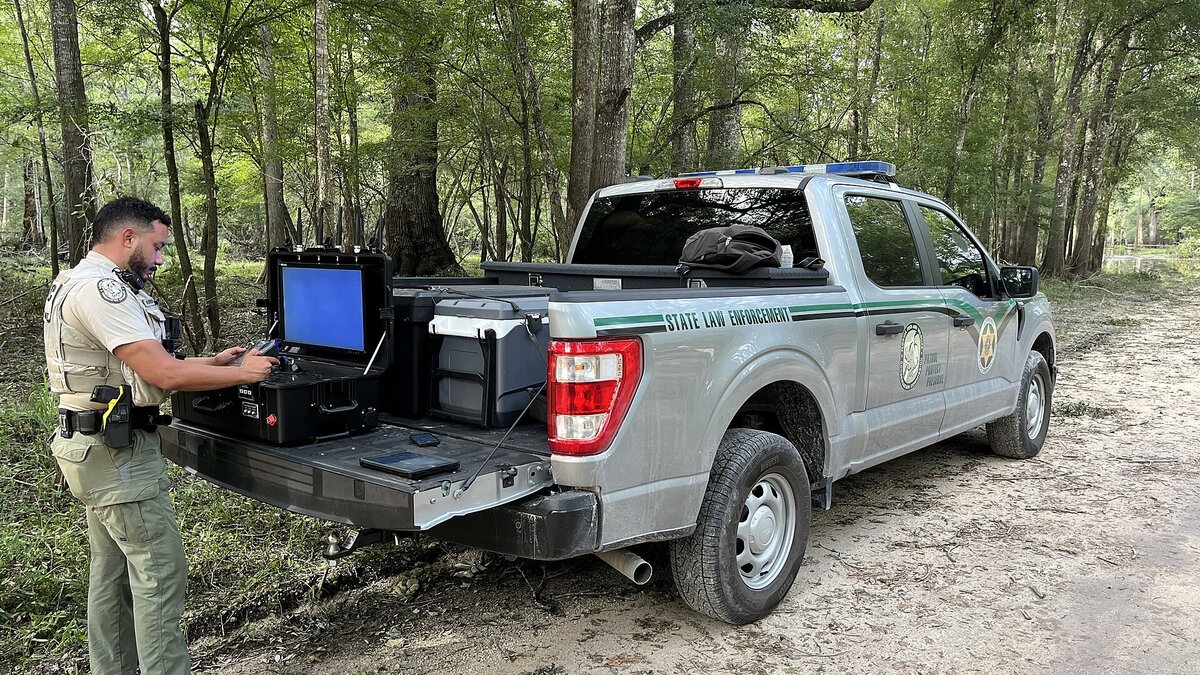
Florida's newest public-safety drone fund ran out about as fast as it opened. The Florida Department of Law Enforcement (FDLE) began taking applications for its Drone as First Responder Grant Program at noon on Oct. 1. According to DroneXL, which quoted an FDLE update dated Oct. 16, the department reported that "All available funding has been claimed." That fund held $2.5 million for fiscal year 2026-27. FDLE says it will reopen the program if any money frees up.
The name suggests the docked, autonomous launch-on-911-call systems that have come to define "drone as first responder" programs elsewhere. The statute behind the grant asks for less than that. It pays for new drones that meet Florida's government-drone security rules, and it says nothing about docks, autonomy or dispatch integration. It also pays only half the cost.
What the law actually says
The program sits in subsection (7)(g) of section 934.50, Florida Statutes, the same section that governs drone searches and the security standards for drones operated by government agencies. The text reads: "Subject to appropriation, the Drone as First Responder Grant Program is created within the Department of Law Enforcement."
The terms are short.
- Who can apply: law enforcement agencies, fire service providers, ambulance crews and other first responders. A local government may also apply on behalf of one or more of its agencies.
- What it buys: new drones that comply with section 934.50, which DroneXL describes as Florida's security rule for government drones, the rule that grounded Chinese-made aircraft at agencies across the state.
- How money is allocated: first-come, first-served, by the date FDLE receives the application.
- Match: at least 50 percent in local funds. FDLE may waive the match for agencies solely serving within a fiscally constrained county as described in s. 218.67(1).
- Caps: $250,000 per agency and a maximum of $50,000 per drone.
- Sunset: the paragraph expires July 1, 2027.
Because applications were ranked by arrival time and not reviewed competitively, speed counted for more than need. As DroneXL noted, if agencies applied at the $250,000 cap, ten of them would have used up the whole fund. The FDLE page does not say how many agencies got in.
A tenth of the money that came before
Scale matters here. When Florida's restrictions grounded agency fleets built on now-prohibited aircraft, the state put up $25 million to replace them, according to DroneXL. One state senator valued the grounded fleets at $200 million. That earlier Drone Replacement Program paid up to $25,000 for each banned drone an agency turned in, and its statutory paragraph expired July 1, 2026.
The new grant has one-tenth of that appropriation, and it covers half the price of each aircraft instead of offering a flat per-unit replacement payment. In its commentary, DroneXL argues that agencies with a grants office and matching money applied fast, while a small department without either would pay full price.
What $25,000 bought in Bradenton
The Bradenton City Council's Nov. 18 vote shows how this works for a mid-sized department. Council approved a $25,000 FDLE award as part of a group of items passed together, as reported by DroneXL and WWSB's Suncoast View. The award is numbered 4L001, and the money goes toward two more Skydio X10 drones for the Bradenton Police Department.
The figures, per DroneXL's reading of the agreement and the city's agenda memo:
- The grant agreement budgets "(2) Skydio X10 Drone Packages at $25,000 each," with the state paying half of that $50,000 budget, or $25,000, and the city matching the other $25,000.
- The actual purchase cost is $58,744.40, or about $29,372 per package.
- The city covers the remaining $33,744.40 from police forfeiture funds. That is more than the $25,000 match, because the packages cost $8,744.40 more than the budgeted line.
- The department must order by March 31, 2027. FDLE is holding the money until the city sends a vendor quote, because the application went in without one.
- The department estimates running costs of about $2,500 per year.
WWSB reported the grant's activity period as Oct. 1 through June 30. Bradenton already flies four drones bought with an earlier FDLE grant, so the new pair brings the fleet to six Skydio X10s. The department flies them in pairs: when one aircraft's battery runs low, the pilot switches to the second. The department told WWSB the grant will pay for a third pair.
WWSB said the department's drone work includes security for the Bradenton Area River Regatta, a barricade incident earlier this year and a case in which an elderly man wandered away from home. DroneXL notes that the budget in Bradenton's agreement covers two drone packages with cameras, batteries and chargers, and names no dock. It also reports that the department's 2025 annual report describes a Drone as First Responder pilot with aircraft launching from automated docks, so the department has tried the docked model as well.
Q&A: The questions agencies are asking
Is the money gone for good? Not necessarily. DroneXL reports that FDLE says it will reopen the program if any money frees up. Neither source says how much, if any, might be returned.
Does the grant pay for docks or "drone in a box" systems? The statute funds the acquisition of "new drones" that comply with section 934.50. It does not mention docking stations, remote-operations software or real-time-crime-center integration. Bradenton's award budgets aircraft packages, and DroneXL reports it names no dock.
Can a small county skip the match? It may be able to. FDLE may waive the match for agencies solely serving within a fiscally constrained county under s. 218.67(1); DroneXL counts 29 such counties. For every other agency, the 50 percent match means local money has to accompany the state's dollars.
Will there be another round? The statute makes the program "subject to appropriation," and the paragraph itself expires July 1, 2027. The current text provides for no round beyond that date.
Why It Matters
The Drone as First Responder grant follows Florida's replacement fund: a smaller, matched pot that favors agencies able to buy compliant hardware quickly. The 15-day sellout suggests demand for compliant aircraft outran the money available, and a first-come, first-served process rewards agencies that can apply fast and cover the match. DroneXL argues the state should fund the program at the size of the demand it just measured.
The fine print matters to vendors and departments. The program carries the "drone as first responder" name, but the statute funds any drone that meets the security rule, at up to $50,000 per aircraft, with at least half the cost borne locally unless the match is waived. Bradenton's award went to aircraft packages rather than a dock-based response network. Because the paragraph sunsets in July 2027, whether Florida keeps this as an ongoing program depends on future legislative action.
