
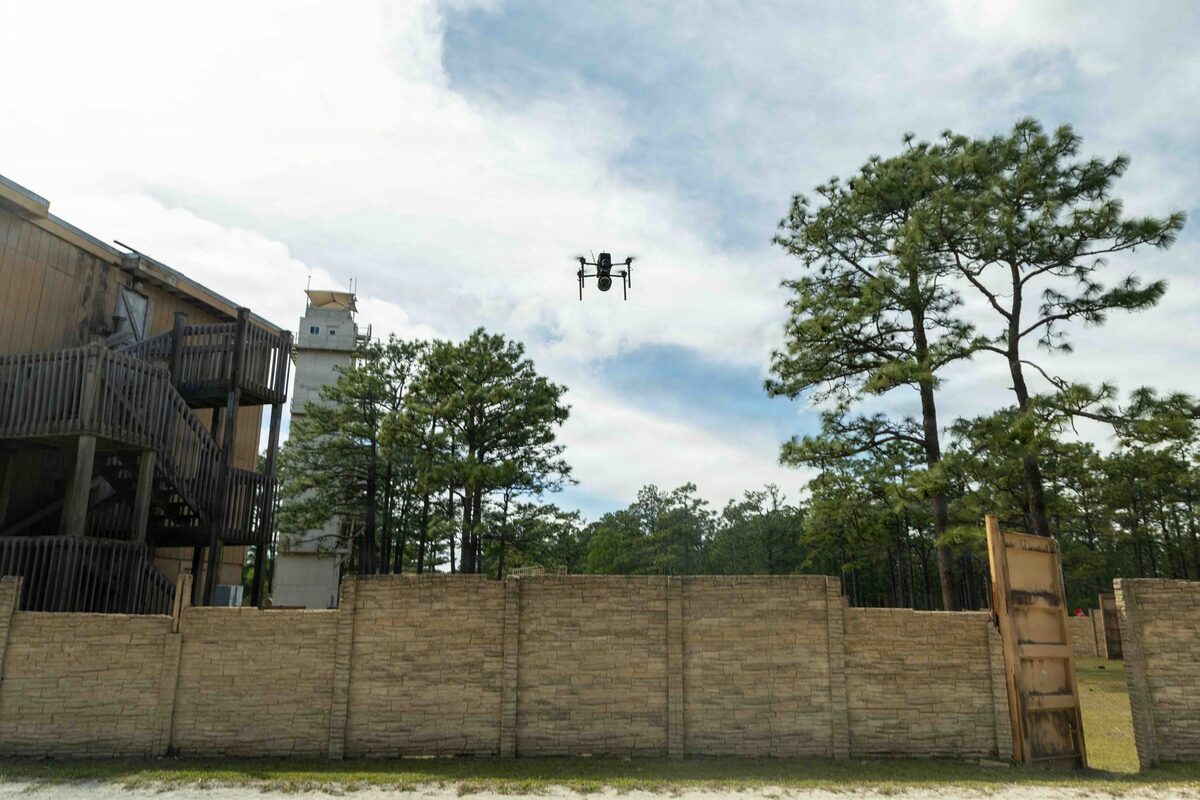
The Finnish Defence Forces have signed a multi-year, €14 million (roughly $16.2 million) agreement with Tampere-based Insta Group Oy to supply domestically designed and built first-person-view (FPV) drones to every garrison in the country, according to a report published by Janes on September 1, 2026, and corroborated by three Finnish outlets. The deal covers 7-inch and 10-inch FPV unmanned aircraft systems, and the first units have already been delivered.
The contract is not a one-off hardware buy. Per Janes, it bundles the airframes themselves with control systems, communications equipment, situational-awareness tools, payloads, training and maintenance and sustainment support — a full-service package intended to support flight training across all brigade-level units.
What Finland Is Buying
The centerpiece of the deal is a 10-inch FPV micro-drone, remote-piloted through FPV goggles, according to Finnish national broadcaster Yle. Insta Group manufactures the airframes in Finland, and the Defence Forces intends to use them for three core mission sets: reconnaissance, pioneer (combat engineering) work, and maintenance tasks. Janes' reporting adds that the procurement also includes a 7-inch variant, suggesting the Finnish military is fielding a small family of FPV platforms sized for different roles rather than a single airframe.
Helsingin Sanomat, Finland's largest newspaper, and the outlet Stara both independently confirmed the €14 million contract value, giving the figure consistent corroboration across Finland's domestic press alongside the Janes report aimed at an international defense-industry audience.
Yle reported that the €14 million figure represents the total contract value inclusive of options, an arrangement common in Nordic defense procurement that allows the customer to scale purchases up over the life of the agreement without renegotiating a new contract each time.
Training Rolls Out Nationwide
Unlike a pilot program confined to a single specialist unit, the Insta agreement is structured to push FPV competency across the entire force. Yle reported that training on the new systems is being rolled out at all Defence Forces garrisons nationwide. Janes similarly notes the deal supports flight training across all brigade-level units, indicating the Finnish military is treating FPV piloting as a baseline soldier skill rather than a niche specialty.
That shift has been underway for roughly a year. According to Yle, Finland's Ground Forces began FPV operator training for conscripts at the Army Academy (Maasotakoulu) in autumn 2025, and that training expanded to additional units starting in January 2026. The new Insta contract effectively formalizes and scales that pilot effort into a standing, force-wide capability.
In a statement cited by Yle and Helsingin Sanomat, the Defence Forces framed the acquisition in explicitly doctrinal terms, describing the procurement as part of the long-term development of its unmanned systems capability and saying that "the importance of unmanned systems in modern warfare has grown in recent years." Helsingin Sanomat's reporting likewise notes the Defence Forces' own characterization that the procurement expands FPV drone training to all military units.
A Parallel Ukrainian Robotics Tie-Up
The FPV contract did not emerge in isolation. In the same week, Insta Group and Ukraine's Tencore signed a Joint Statement of Intent — dated August 23, 2026 — covering production in Finland of Ukrainian-designed unmanned ground vehicles (UGVs), the establishment of a network of industrial partners, and the creation of a joint venture, according to Janes. Tencore said in a social media post the following day that the initial goal is to produce 320 TERMIT 2.0 UGVs for the Armed Forces of Ukraine. The agreement is under the Build with Ukraine initiative and follows a memorandum of understanding the two companies signed on February 24, 2026, laying groundwork for Finnish domestic production of the platform.
Build with Ukraine is a framework under which Ukrainian defense manufacturers license or co-produce battlefield-proven systems with partner-nation industry, letting allied militaries adopt hardware that has already been tested in combat conditions while giving Ukrainian firms manufacturing scale and revenue outside the active war zone. The Insta-Tencore UGV deal, running alongside the FPV drone contract, points to Finland absorbing Ukrainian unmanned-systems expertise on two fronts at once: aerial FPV reconnaissance and engineering-support drones for its own forces, and ground robotics manufacturing for Ukraine's forces.
Why It Matters
Finland shares an 830-mile land border with Russia and has, since joining NATO in 2023, moved to align its force structure with the alliance's northeastern flank. A decision to make FPV piloting a standard skill at every garrison — rather than concentrating the capability in a single specialized unit — signals that Helsinki views small, cheap, expendable drones as a baseline infantry and combat-engineering tool, not an exotic add-on. That mirrors the pattern that has defined the Russia-Ukraine war since 2022, where FPV drones costing a few hundred to a few thousand dollars each have been used at massive scale for reconnaissance, artillery spotting, and direct strikes against armor and personnel.
The domestic manufacturing angle matters as much as the doctrine shift. By sourcing the airframes from a Finnish company rather than importing them, Finland builds sustainment and surge-production capacity inside its own borders — a hedge against the kind of supply disruptions that have complicated Western support for Ukraine when foreign-sourced components or munitions were delayed. Pairing that with the Insta-Tencore UGV deal under Build with Ukraine suggests a broader pattern among NATO's newer and frontline-adjacent members: importing combat-tested Ukrainian unmanned-systems know-how and localizing production, rather than developing equivalent capability from scratch or relying solely on legacy Western defense primes. For an alliance still working out how to institutionalize the drone-warfare lessons of the Ukraine war, Finland's approach — mass fielding, force-wide training, and domestic production tied to Ukrainian expertise — is a concrete data point other militaries watching the same battlefield are likely to study.
Sources
- Insta Group signs FPV UAS deal with Finnish Defence Forces — Janes
- Puolustusvoimat hankkii lisää kauko-ohjattavia drooneja – käyttöön kaikissa varuskunnissa — Yle
- Puolustusvoimat hankkii lennokkeja 14 miljoonalla eurolla — Helsingin Sanomat
- Puolustusvoimilta 14 miljoonan investointi FPV-drooneihin — Stara