
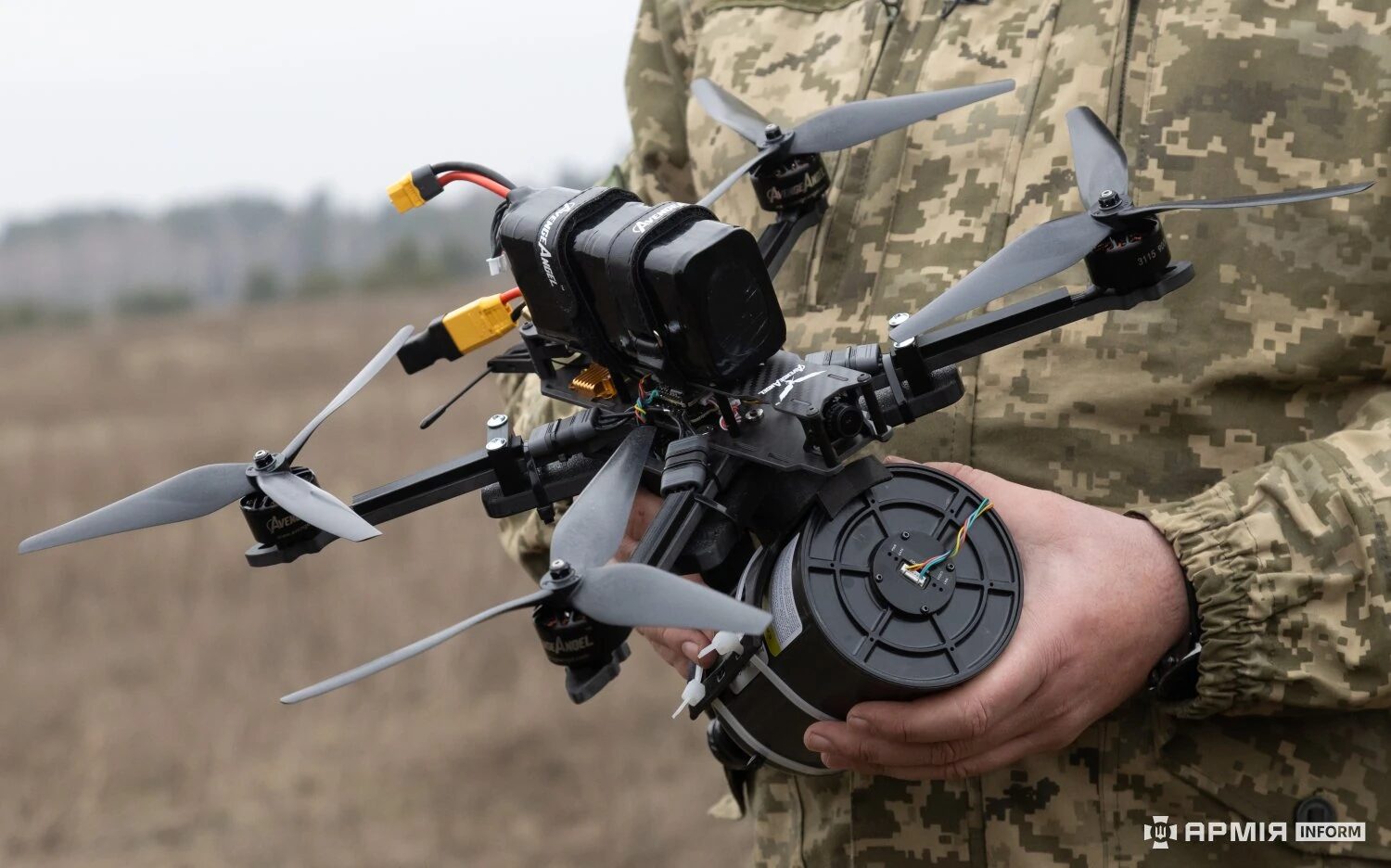
In April 2025, a drone operated by Ukraine's Birds of Magyar unit flew through the open door of a warehouse and destroyed a BMP infantry fighting vehicle worth potentially millions of dollars. The strike wasn't remarkable for the target. It was remarkable because no electronic warfare system in range could have stopped it. The drone's control link wasn't a radio signal — it was a continuous thread of glass fiber paying out behind the aircraft as it flew, carrying commands and video as pulses of light. Every frequency-agile jammer, every spoofing transmitter, every direction-finding array on that battlefield was irrelevant.
That strike is a precise illustration of what the past two years of fighting in Ukraine have demonstrated at scale: fiber-optic guidance technology has opened a physics-level hole in the electronic warfare doctrines that modern militaries have spent decades and billions of dollars building.
Why Light Beats Radio in a Contested Spectrum
The vulnerability of radio-controlled drones is structural. A radio link is a broadcast — electromagnetic energy radiating outward through open air, detectable by any receiver within range and interruptible by a stronger signal on the same frequency. Electronic warfare systems exploit exactly this: they detect the drone's uplink or downlink emissions, then overpower, spoof, or sever them. The entire multi-billion-dollar C-UAS electronics industry is built on this attack surface.
Fiber-optic control removes that attack surface entirely. A glass or plastic strand 100 to 250 micrometers in diameter — thinner than a human hair — guides light signals through total internal reflection. The signal is confined inside the medium. It doesn't radiate. It can't be detected from outside the cable, can't be jammed, and can't be spoofed. As Military Machine's analysis puts it: "A jamming system that cost millions of dollars to develop and deploy provides zero protection against a drone connected to its operator by a physical wire." Spotter Global's analysis frames the physics cleanly: "The only way to cut off communication would be to cut the cable."
Beyond immunity to jamming, fiber carries substantially more data than a typical radio video link — enabling higher-resolution video, lower latency, and more reliable control in electromagnetically contested environments. The bandwidth advantage alone would make fiber attractive for precision strike applications even without the anti-jam benefit.
What the Hardware Actually Looks Like
The spool mechanism is simpler than it sounds. Modern tactical fiber-optic drone cables use G657A2 or G657B3 single-mode fibers with outer diameters of 0.25 to 0.5 mm. A 10-kilometer length weighs 30 to 50 grams. Spools sized for 3 km of cable can weigh as little as 300 grams total. The cable winds onto a lightweight hub that mounts to the drone body; as the aircraft flies, the cable pays out freely from the spool under flight-induced tension. Tensile strength runs to 100,000 lb/in² or higher — the cable is more likely to break from an obstacle snag than to arrest the drone mid-flight.
The commercial market for these components has matured rapidly. United UAV offers nine spool models ranging from 5 km (UOF5) to 50 km (UOF50), priced at $159 to $837, in both HD 1080p lossless and analog variants. GL Fiber Cable, a manufacturer, runs production capacity of 1,200 km of fiber per day across 3 to 30 km spool options, with ISO/CE/RoHS certification. Ondas Holdings, through its subsidiary Apeiro, has introduced NDAA-compliant, Made-in-USA spools manufactured at its American Robotics facility — a direct response to NDAA supply-chain requirements for US defense procurement.
The cost addition to a standard FPV drone is modest: approximately $50 to $100 on a $400 to $500 base platform, bringing a complete fiber-optic FPV system to roughly $450 to $600. The unit economics are what make the technology strategically significant — the guidance link that defeats million-dollar jammers costs less than a decent rifle scope.
Historical Lineage: Precision Missiles to Cheap FPV
Nothing about fiber-optic guidance is new physics. The technology traces back to anti-tank missile programs of the 1970s and 1980s. Israel's SPIKE-NLOS missile has used a fiber-optic datalink at ranges up to 25 km for years, giving operators man-in-the-loop targeting control throughout flight. The SPIKE LR2 uses spools of approximately 5.5 km. These are purpose-built precision weapons with unit costs in the tens of thousands of dollars.
Ukraine's contribution was the application of precision-missile data-link technology to a drone costing under $1,000. That compression — the same physics at a hundred-fold cost reduction — is the actual innovation. When the underlying capability stops being exclusive to high-cost platforms and becomes available to any workshop producing FPV drones at scale, the strategic calculus changes.
The Battlefield Adoption Curve
The operational pressure that drove adoption is quantifiable. By mid-2024, hit rates for radio-controlled FPV drones in heavily jammed areas had reportedly fallen from 40 to 60 percent in 2023 down to 20 to 30 percent — a collapse that created an operational crisis for units depending on drone strikes as a primary fire support tool. Fiber-optic systems were the direct response.
By late 2024, at least 10 to 15 Ukrainian domestic companies and workshops were manufacturing fiber-optic drone systems. Russia deployed its own fiber-optic FPV variants on roughly the same timeline, including a purpose-built system identified as the "Prince Vandal Novgorodsky." Army Recognition analysis cites Russian fiber-optic drone ranges of up to 20 km depending on cable length and deployment configuration.
The operational incidents are illustrative of both capability and countermeasure. In February 2025, Ukraine's Kara Dag Brigade tracked a Russian fiber-optic drone team near Vodyane by spotting the reflective cable glinting in sunlight — then followed it kilometers back to the operators' position and bombed it. That tactic has since been neutralized by scale: fields around Pokrovsk and Chasiv Yar in Donetsk Oblast are now littered with so many abandoned fiber cables that tracing a live one back to an active operator has become, as Euromaidan Press characterized conditions on the ground, subject to "difficulties in trying to trace specific fiber optic cables from the hundreds in the fields back to an operator." Operators have also learned to deliberately abandon cable positions as decoys.
Technician Umer, serving with Ukrainian forces and speaking to Euronews, noted that fiber-optic drones are safe from electronic warfare unless physically destroyed by cutting the cable or shooting the drone down.
The Honest Accounting: What Fiber-Optic Drones Cannot Do
The tradeoffs are real and structurally embedded in the technology. Every fiber-optic drone is a one-way weapon. The cable cannot be respooled; the drone cannot return to base. Range is hard-capped at spool length with no extension possible via relay. Each system requires a dedicated operator with line-of-sight situational awareness of the cable routing — autonomous swarm operations are impractical because each aircraft needs its own human and its own physical tether. The extra spool weight, 30 to 50 grams per 10 km of cable, reduces payload capacity. Multiple fiber-optic drones operating simultaneously risk cable entanglement. And in wooded or urban terrain, snagging risk is significant: the cable that makes the system unjammable is also a physical object that trees, debris, and building edges can catch.
These are not engineering problems awaiting a clever solution — they are consequences of the fundamental physics that also make the system immune to jamming. The same property that confines the signal to the cable makes the cable a physical constraint on the aircraft.
Countermeasure options for defenders are limited but not zero. Jamming is useless; defenders must go kinetic — anti-aircraft guns, interceptor drones, directed-energy weapons. Traditional surveillance radar remains effective because it detects the drone's physical body regardless of its communication method. Ukraine has also struck Russian optical fiber manufacturing facilities inside Russia with long-range drones, targeting the supply chain rather than individual systems. What defenders cannot easily do is distinguish a fiber-optic drone from a radio-linked one in real time, which complicates the decision of when and whether to activate electronic warfare assets at all.
The likely trajectory for fiber-optic drone systems is a durable niche rather than general displacement of radio FPV. The physics that make them immune to jamming will not change. The cost floor is low enough that manufacturing scale is achievable. But the one-drone-one-operator-one-cable constraint makes them fundamentally solo precision strike weapons, not building blocks for the autonomous swarm architectures that represent the medium-term future of drone warfare. They will persist as a specialized tool for high-value targets in EW-saturated corridors precisely because no amount of spectrum management closes the gap — but they will not replace the radio FPV platforms that can be coordinated at scale.
Sources
- Euromaidan Press — Fiber optics everywhere: Ukraine's battlefield adoption
- Military Machine — Fiber-optic drones: unjammable weapons analysis
- Euronews — Ukrainian drone safe from electronic warfare thanks to fibre-optic cables
- United UAV — Optical fiber spool product catalog
- Army Recognition — Analysis of Russian fiber-optic FPV drone development and use in Ukraine
- Spotter Global — New stealth fiber-optic guided drones (FOG-D): how to detect them
- GL Fiber Cable — High-performance optical fibers for drones: reliable data transmission in EMI-heavy environments
- Dronelife — Ondas launches NDAA-compliant fiber-optic spools for drones
- Congressional Research Service — U.S. Army Small Uncrewed Aircraft Systems Programs (IF12668)